Thursday, June 13, 2013

ICE Still Detaining and Deporting US Citizens, And Still Lying About It


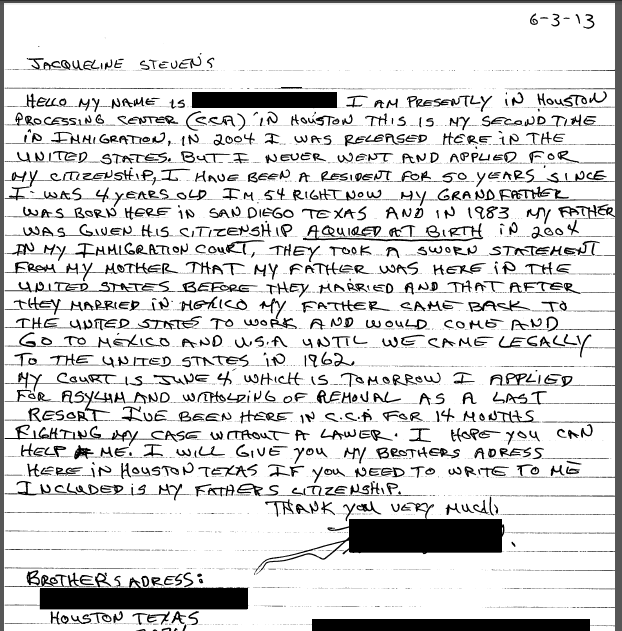
On June 7, 2013 an immigration judge terminated deportation proceedings for a 54 year old United States citizen who had been locked up without a lawyer for 14 months, one of three individuals to contact me in the last two weeks from Houston, SPC.  


ICE and the Corrections Corporation of America that held Mark Lyttle in 2008 are still holding US citizens.


The full letter from FS I received yesterday is here, redacted because he has not given me permission to publish his name.  It is just a page.  Anyone who thinks Mark Lyttle's case is a one-off should read this letter and then read why this is still happening.  As long as poor U.S. citizens of Mexican descent, or the perception they are of Mexican descent, are locked up, ICE is going to be falsely imprisoning and banishing U.S. citizens.

 On April 29, 2013 The New Yorker published an article by William Finnegan "The Deportation Machine" about Mark Lyttle's deportation to Mexico.  (More later on Finnegan's plagiarism of my work, and the New Yorker's bizarre apology and inadequate efforts at redress.)  John Morton, Director of Immigration and Customs Enforcement, replied indignantly to the article, claiming new "stringent safeguards to protect against the possibility of a citizen’s detainment or removal..."

As soon as I read Morton's inventions, I knew that I would again need to start documenting U.S. citizens being detained and deported.  ICE is lying today just as they did when I first started doing this research in 2008.  ICE propagandists have gone from denying that it ever happened -- that was the company line in 2008 and 2009 -- to now saying that they stopped doing this.

Alas, it was as easy to do this last month as it was in 2008 to 2011.

Daniel (not his real name)
 A few weeks ago I came across an April,  2012 Board of Immigration Appeals (BIA) decision affirming the appeal of a respondent who was indignant that EOIR adjudicator Jimmie Benton refused to recognize his claim for U.S. citizenship because he did not know the law on this. 


I called the locator system, learned Daniel was still detained and wrote him a letter.  The letter was properly addressed but not accepted by the CCA mail room because my research assistant had not used an "alien number" on the envelope -- on what legal grounds can CCA refuse a properly addressed piece of mail just because it lacks some weird code they use and that most people cannot obtain unless they are able to contact the person they are writing?

In the event, Daniel had just had the remanded hearing, again before Benton, who didn't understand the law in 2012 and still didn't understand it in 2013.  Daniel told me over the phone just before he was deported that Benton said that he would only terminate proceedings if Daniel could produce a Certificate of Citizenship, something that costs $600.  Daniel is indigent.  He told me that it took several months for his request for a fee waiver to be approved and he was still waiting on the final Certificate.  He had all the necessary underlying documents but Benton refused to consider them.   (FS also did not have a Certificate of Citizenship but in his case the IJ relied on the underlying documents and on that basis terminated the proceedings.)

(To be clear, a Certificate of Citizenship is NOT a requirement for U.S. citizenship.  Anyone who is a U.S. citizen by birth has that status because of meeting the underlying criteria, e.g., birth in the United States or birth outside the U.S. to a parent or parents who are U.S. citizens.)

A few days after public affairs in Houston was alerted to my request to speak with Daniel, he was shipped out to Juarez, Mexico.  There he will be facing the same problem that Andres Robles encountered after ICE deported him to Mexico in 2008.  Three years later he was sent a letter, care of his lawyer, saying that his application for the Certificate of Citizenship had been approved but that it would be impossible for Andres to pick it up because, the USCIS Field Office Director acknowledged, the government had deported him.    (In the last few weeks, thanks to the persistence of his sister, Maria, Andres obtained the representation of Andrew Free of the Ozment Law Firm and will be filing a civil rights lawsuit against the thugs who falsely imprisoned and then banished Andres.)

Robert (not his real name)
Robert's situation is somewhat more complicated, not because of anything he did but because he lives in a primitive era of ethnic cleansing, such that his mother and grandfather were treated by their government as foreigners and not the U.S. citizens they really were.

Robert's great grandmother was born in Texas in 1902, and her father and mother also were born in Texas.  She lived in Mercedes, Texas but gave birth to her son, Robert's grandfather, Gino, in Mexico.  Gino was by law a U.S. citizen at birth but instead of being recognized as such, when he entered the United States he was given a green card and then later, long after his daughter,  Robert's mother Rachel was born, became a naturalized U.S. citizen.

Rachel then also grew up with a green card.  I've spoken several times with her and Robert. They had hired an attorney but he didn't understand the possibility of the acquired citizenship.  Robert has a forthcoming hearing.  Meanwhile we are trying to assemble the documents underlying these claims so his attorney can present the probative evidence that should trigger his release.  This is actually the responsibility of the U.S. government--Morton's 2009 memorandum requires ICE to conduct investigations into claims of U.S. citizenship.  His family's green cards and naturalization means all the underlying birth certificates and marriage certificates are already in the Citizenship and Immigration Service database, but Robert's been locked up for over a year.  He said his deportation officer did nothing to help him.

Robert and Daniel have signed privacy waivers and we will be obtaining their files shortly. I also will be writing to FS and will be asking him to sign a waiver as well.  Hopefully we can find an attorney who will help him hold the government accountable for his false imprisonment as well.  (FS had already been through this once in 2004 when an IJ then as well terminated the deportation order.)

As I've been writing, the only way to follow the U.S. Constitution and prevent U.S. citizens from being in the unlawful custody of ICE is to provide all detained respondents assigned attorneys.  As these cases show, generations of racial profiling have deprived people the status and thus knowledge of their U.S. citizenship. The U.S. government has been stripping people of their U.S. citizenship and has an obligation to stop doing this; that's only possible if everyone in these ICE jails has an assigned attorney.

Finally, it is urgent that we not lose sight of the big picture: the borders of the nation-state are arbitrary and it is as ridiculous to restrict our movement on their basis today as it was to confine people to parishes in England and transport them to America when they were caught in London without a pass.

The reason I focus on the detention and deportation of U.S. citizens is the same reason that slavery abolitionists supported criminal prosecutions for the especially brutal treatment of slaves.   The prosecutions forced the public to think about what slavery looked like in practice.  The unprovoked shootings of slaves and detentions and deportations of U.S. citizens are expressions of these respective institutions when they are doing what they are supposed to do, and not rare aberrations.   Slavery and deportations are barbaric; it is as impossible to deport people without unlawfully harming respondents, including U.S. citizens, as it was to have slavery without unjust, horrifying violence.

Monday, June 10, 2013

Guatemalan Locked Up for One Year to Win Right to Attorney in Deportation Proceedings


The docket information for a Guatemalan respondent who had appealed his deportation order based on his need for an attorney was recently released by the Executive Office of Immigration Review following FOIA litigation. The respondent also was released from custody, after being locked up for about a year.

The docket information on the case locator system used by the Executive Office of Immigration Review shows more evidence of the incompatibility of the deportation machine with the rule of law.  In January, 2012 the respondent requested an attorney and to be released from custody.  Unfortunately the respondent had the bad luck of  appearing before Sylvia Arrellano, who ignored his entreaty for a hearing on his asylum claims and ordered him deported to Guatemala.

The respondent in Matter of CB appealed and won, but it took a year.


As the docket shows, after the case was remanded in August, 2012.  Then it took more than a month before a new master calender hearing.  A new full hearing is scheduled for January, 2014, 2 years after the respondent was first taken into ICE custody.

The record here is not clear on the terms of release, if any.  UPDATE: sorry, worked on this late last night and just noticed that docket indicates the respondent has been released!  Somehow it took a year for this to happen.  The case was assigned to immigration judge Dana Marks in San Francisco. It's still unclear how this happened because  no new bond hearing is noted. The information here is consistent with a) the DHS unilaterally changing the terms of custody; b) poor record keeping.

Meanwhile, two Guatemalans committed suicide this spring at the nearby Eloy Detention Center.

For background on the FOIA litigation behind obtaining this, please go here.  Thanks again to Andrew Free of the Ozment Law Firm and Sam Niiro, Northwestern Class of 2016 and Deportation Research Clinic FOIA specialist.


Thursday, June 6, 2013

Federal Judge Orders Top Immigration Court Officials Stand Trial for Civil Rights Violations, Orders Discovery


On June 4, 2013, Judge Orinda Evans, Northern District Court, Georgia, issued two orders in the cause of government transparency, in particular recognizing the rights of the public and the media to attend immigration hearings.  Judge Evans is granting my attorneys' motion to enter an amended complaint, one holding accountable in their individual capacities for monetary damages top officials at the Executive Office for Immigration Review.  And she opened discovery.

This order is relevant for anyone who has filed a misconduct complaint with the federal government and has preliminary evidence to suggest that supervisors assigned to investigate are trying to coverup and not reprimand misconduct by agency employees.

In the context of the EOIR, Judge Evans decisively swatted away the claims of judicial immunity:
For example, not only does Plaintiff allege her rights were violated by the decision, on the relevant days, to exclude her from the courtroom, but she also alleges due process violations and a civil conspiracy to cover up her removal and exclusion. Included in these counts are claims based on incomplete responses to her FOIA requests, and a claim that Keller and Smith, assistant chief immigration judges based at EOIR headquarters in Virginia, failed to properly investigate her administrative complaint. Surely. the government is not asking this Court to grant all executive officials who handle administrative complaints or FOIA requests absolute judicial immunity.
The government has fallen woefully short of its "burden of establishing the justification for such immunity." Roland, 19 F.3d at 555
  (This means that if a jury finds they violated my civil rights, these individuals pay the damages, not the taxpayers.)  Second, she granted our request to open discovery for four months.  On the first order Judge Evans granted the government's request to deny the Bivens claim against Cassidy based on his so-called "absolute judicial immunity." We will be appealing this after this part of the case has concluded on the grounds that immigration courts are not judicial.

(Most of the folks reading this blog will know this, but the background is that on April 19, 2010 I was unlawfully removed by force from the Atlanta immigration courts on order of a immigration judge, aka DOJ attorney.  William Cassidy, who has one of the highest rates of asylum denials in the country and draws complaints from numerous attorneys, deported U.S. citizen Mark Lyttle to Mexico and then was retaliating against me, in concert with his cronies in the Falls Church headquarters, for reporting on this.  His cronies then covered this up.)

Thanks so much to my attorneys Ray Lerer and Beth Taylor at Federal Hasson in Atlanta for their persistence and great work on these briefs.

Also, if anyone reading this has suggestions for discovery, either for specific documents or questions for depositions, please let me know, either by posting a comment here anonymously or by sending me an email, jacqueline-stevens AT northwestern.edu.

I have positive updates to report on the FOIA litigation as well, undertaken with Andrew Free of the Ozment Law Firm in Nashville, and will post on that next week, as well as on US citizens who have been recently detained and deported from Texas.


Monday, May 20, 2013

New FOIA Lawsuits


from TVtropes.org


"from Matter of C.B.

I decided it was time to push back against the slow poke or nonresponsive replies to my requests for information under the Freedom of Information Act.  Sam Niiro and I are now filing pro se lawsuits.  Sam is just finishing his first year as a Northwestern undergraduate.  And many thanks to attorney R. Andrew Free who is taking over after we file them!

Complaint Against the Executive Office of Immigration Review
The first complaint, filed in April, was to obtain the case docket for "Matter of C.B." an August 15, 2012 Board of Immigration decision that, pathetically, had to be written in order to tell a Department of Justice attorney that respondents really do have a right to an attorney.   I requested the hearing history because I wanted to know how long it took someone locked up to have this due process right affirmed.  The coercion of detention pressures so many people to abandon their legal claims to residence and I wanted to document what this wait looks like.  

I had received precisely this information in response to a previous FOIA request, with the respondents' names redacted. But this time around the geniuses at the DOJ said they did not maintain this information.  (The problem is not terminology because I used the exact same language on both requests, as my complaint points out.)

Finally, please note in this decision and all BIA decisions the gross flaunting of the rule of law the EOIR perpetuates when it hides the names of the immigration judges, another symptom of the kangaroo court mentality among the folks who run that agency.  In exchange for the great power judges have they must submit their decisions to public scrutiny.  But of course kangaroo courts can provide this discretion and cloak these DOJ attorneys in the hangman's garb of anonymity.

Complaint Against the Department of Homeland Security, Office of Inspector General
The second complaint, filed a couple weeks ago, is on behalf of a woman who in 2011 was falsely imprisoned, kidnapped, and robbed by DHS employees when she was returning from Nigeria.  The Office of the Inspector General conducted an investigation that resulted in her being returned to the United States at government expense but the OIG is not releasing the underlying investigation results that led to this decision.   I'll be posting more details on her situation shortly.

EOIR, MaryBeth Keller email
Next up is the email to and from EOIR attorney MaryBeth Keller about the coverup that she participated in pertaining to the investigation of my own misconduct complaint against William Cassidy, the Atlanta immigration court attorney who deported U.S. citizen Mark Lyttle and then illegally failed to allow us to observe hearings, ordered me removed from the building, and then lied about it.

Ironically, Keller, point person for misconduct investigations, herself failed to comply with the FOIA law for over a year.  The EOIR is not among the components that consider employee FOIA responses in their performance reviews, something that needs to change.  Keller is the EOIR official who sucks up the misconduct complaints against the immigration judges and then, in violation of the statutes, helps her  colleagues sweep them under the rug.  There are statutes that require her to forward these complaints to the DOJ Office of Professional Responsibility or Office of Inspector General but last time I checked she and the rest of her colleagues were regularly violating these statutes.


Monday, April 22, 2013

Recent Cases of U.S. Citizens Detained and Deported at Reynosa/Hidalgo: DHS Business as Usual


From Google Analytics screenshot, click for full image

City:   "Reynosa"         

Keyword:  "have a n600 interview but stuck in mexico deported"

Every once in a while I check the keyword searches that are bringing people to this site.  Just as The New Yorker magazine is publishing a story about Mark Lyttle's deportation in 2008-2009 I've been receiving over the past week several visits to my site from what appears to be someone stranded in Reynosa who is frantically trying to figure out how to attend an interview for his N-600 application for a Certificate of U.S. Citizenship.  (The screenshot above is for a visit to the site on Thursday, April 18.)

(UPDATE: 4/25 I finally had a chance to read the entire article carefully and agree with my colleague who said he found William Finnegan's plagiarism of my reporting here and my law review article "appalling."  I'll document this in detail shortly but it's quite clear that Finnegan simply plagiarized important chunks of the article and that he failed to properly attribute others.  I had an inkling this might happen to some extent but it wasn't until today that I realized how aggressive he had been in appropriating my work and representing it as his own.)

If you're a U.S. citizen but you're indigent and you've been deported, it's still extremely tough to fight the Department of Homeland Security's (DHS) ethnic cleansing mindset if not policies, as this individual knows from reading the posts here on Andres Robles, a U.S. citizen whose return was rebuffed in 2011 at the Brownsville, Texas crossing even after a Citizenship and Immigration Services field officer sent him a letter telling him his Certificate of U.S. Citizenship had been approved but he would be unable to convey it to Andres because Andres had been deported.

(Andres's sister Maria told me recently that he had problems obtaining his social security card and is still looking for an attorney to sue the US government for damages from his wrongful deportation and its aftermath; yes, you'd think it would easy but the attorneys who know the deportation laws are not litigators and the litigators lack the training to take on the complexities of deportation law; U.S. citizens who lack the resources to avoid being deported are typically not in a position to find attorneys to help them sue the federal government.)

U.S. Citizens: Still Having Problems Returning from Reynosa/Hidalgo
Reynosa is where you find yourself after you've been flown from, among other places, the Stewart Detention Center near Fort Benning in Lumpkin, Georgia.   That's how Mark Lyttle ended up there and the reason I visited in the summer of 2009.   There are several state and informal shelters and refugee camps close to and right on the Rio Grade; hundreds of people from all parts of Mexico and the rest of Latin and South America are fed or stay there each day, either because they've just been deported from the U.S. or because they are contemplating entering.


Centro de Apoyo Cristiano/ A Indigentes y Deportados, Reynosa, Mexico
June, 2009  (click to enlarge)


Today I decided to do a little searching online to see what resources a U.S. citizen who had been deported this month and was indigent would find, to see if one would have an easier chance of figuring out how to return from Reynosa than Mark did in 2009.  It sure doesn't look that way, which is probably why this person is ending up here: there still is no clear government policy much less web page information for U.S. citizens who have been deported.

I have no further information about the underlying facts of citizenship for the person doing this search (please e-mail if you read this, jacqueline-stevens AT northwestern.edu), but I do know that in March, 2013 a U.S. citizen born in Texas and wrongfully ordered deported was taken into custody by Border Patrol officers in Hidalgo, the U.S. entry point on the other side of the bridge from Reynosa, and brought to a detention center in Louisiana, even though she had a certified copy of her birth certificate issued shortly after her birth in Texas.

The only fix for this is assigned attorneys for anyone being deported, especially because some people take the word of the government and wrongly believe they are not U.S. citizens even though they really are, or they may not have the cognitive skills to meaningfully participate in the deportation proceedings.


(No, a national database won't work: it would have simply recorded her unlawful removal order and the guards would say her birth certificate was fake or that it was issued for someone else.  Mark and his social security number were in the federal database ICEagents saw and listed as a U.S. citizen but that didn't stop ICE from deporting him.)


Government Resources Today
Today someone in Reynosa trying to figure out what to do if they were a U.S. citizen and couldn't attend their N-600 interview because of being deported would see this, note the link for "Consular agency: Reynosa":


But then if you clicked on "Consular Agency Reynosa" you'd see this:


Turns out that the Reynosa Consular Office is closed, though it seems unlikely that it is for the reason stated elsewhere on the website, i.e., the resignation of the Reynosa Consular Agent:


The resignation was in September, 2012.  It's been seven months.  Our Foreign Service lacks one other person who speaks Spanish and can manage an office?

The more likely explanation is that the U.S. has been scared out.  There have been frequent attacks at the consular office in Matamoros and the Reynosa office was officially closed in 2010 because of drug war violence.


With no consular services in a dangerous border city, the only "welcome committee" for deported U.S. citizens are the same border patrol guards who greeted Mark Lyttle and threatened him with prison time for "False Personation of a U.S. Citizen."

The woman from Texas was taken to a detention center and not released until her family, who knew she was returning to her home country, obtained a lawyer.  But the vast majority of deported U.S. citizens are coming out of jails and prisons, and their families tend not to know they are being deported.

The DHS's complacency about the plights of these U.S. citizens is shocking at face value, and also because it is so at odds with how most U.S. Americans feel and also our laws.  That's probably why Brian Hale, Assistant Director of the Office of Public Affairs at DHS,  is so inventive when it comes to sidestepping requests for concrete information about ICE's treatment of U.S. citizens.  (Hale has zero integrity; not only does he use his office for propaganda, he's also ordered ICE officers to  violate the rules and First Amendment rights that authorize detained respondents to meet with the press and visitors.)

In short, Hale is telling the press that ICE is no longer deporting and detaining U.S. citizens at the levels I have documented (1% of people ICE detains for removal are U.S. citizens and about .5% of those deported are U.S. citizens, mostly through derived or acquired U.S. citizenship from parents born or naturalized in the U.S. and of Latino descent).  And yet Hale refuses to provide any agency data to back up this assertion.  This is exactly what happened, by the way, in the time frames Hale now seems not to be disputing: ICE propagandists Richard Rocha, Virginia Kice and others were telling the media in 2008 and 2009 that ICE "never" detained or deported U.S. citizens even though this was obviously happening and being reported, just as it is now and just as was happening in very similar reports on immigration agent misconduct in the early 1930s.

ICE has had over a year to release data that would contradict what I reported on the basis of reviewing findings from over 8,000 records maintained by the Florence Project in Arizona, interviews with immigration judges, interviews with ICE agents, and interviews with deported and detained U.S. citizens and their attorneys.  EOIR data also state that 1% of its cases in 2010 were adjourned because of claims of U.S. citizenship, a number that does not mean that all these cases resulted in determinations of U.S. citizenship but that may still understate the total because not all immigration judges tabulate detailed reasons for the adjournments and because a successful appeal to the Board of Immigration Review or the federal courts overturning an adverse decision by an immigration judge would not show up as a case adjourned because of U.S. citizenship.

In short, despite repeated requests from scholars, members of Congress and the national media and the fact that the reporting criteria for DHS and EOIR indicate they have the data, these agencies are not coming clean.  (And, the DOJ also has the underlying data on federal court decisions overturning instances when the DHS makes administrative mistakes in adjudicating determinations of U.S. citizenship and could release that as well.)

On April 20, 2013 I sent Hale an email referencing his comments to the New Yorker reporter William Finnegan and the fact-checker who spoke with me as well.  I requested data to support his claim that ICE's alleged changes in procedures (easier found on paper than in practice) have resulted in a decrease in the number of U.S. citizens detained or deported.

Hale did not reply to this request from The New Yorker nor from me.  If he does I will post it.  

Tuesday, March 26, 2013

Are the APSA President and Executive Director Hypocrits? An Open Letter Responding to their Open Letter to Senators


The American Political Science Association is still issuing alarmist statements about Congress voting to defund political science research along the lines of the rhetoric that inspired me to write "Political Scientists are Lousy Forecasters," an opinion piece published in the New York Times Sunday Review on June 24, 2012.

I have never endorsed the Congressional proposals to defund political science research, but in the June opinion piece, and in other correspondence and posts on this blog, I have argued that the apoplexy about this is irrational; that our country would be better served by funding priorities other than those currently used by NSF grant adjudicators; and that the APSA needs to have an open conversation about the criteria we believe are reasonable for assessing grant proposals, including entertaining the possibility that distributing research funding at random to proposals that are coherent and have sound budgets might be a strategy most likely to yield robust research agendas and knowledge that isn't just a hot finding for a few years and then displaced by the next election or war or spurious correlation announced as a breakthrough in discovering a new causal mechanism.

A colleague this morning brought to my attention that Sen. Tom Coburn quoted from the Times article in his floor speech in support of defunding the discipline.  He is not a very good reader.  I wrote:
To shield research from disciplinary biases of the moment, the government should finance scholars through a lottery: anyone with a political science Ph.D. and a defensible budget could apply for grants at different financing levels. And of course government needs to finance graduate student studies and thorough demographic, political and economic data collection. I look forward to seeing what happens to my discipline and politics more generally once we stop mistaking probability studies and statistical significance for knowledge.
Still, I understood when I wrote the opinion piece that it might be misused in exactly the way Coburn misused it and decided that these consequences and any debate about this would be preferable to business-as-usual.

For that discussion to occur, however, requires that the APSA stop worrying about protecting democracy in Congress and start practicing it in our own organization.  What follows is a letter I sent via email this morning to Jane Mansbridge, President, APSA and Michael Brintnall, Executive Director, APSA.

Dear Professor Mansbridge and Mr. Brintall,
I hope this finds you well.  I am writing because a colleague just brought to my attention that Senator Tom Coburn cited in his floor speech last week an opinion piece I wrote last summer in which I questioned whether quantitative political science research of the sort prioritized by the NSF contributes to knowledge about politics. 


As a result of that piece not appearing on the APSA NSF page alongside other opinion pieces about the NSF controversy, including another piece critical of NSF funding, I was in correspondence over the summer with Mr. Brintnall and Professor Powell about how how they had ascertained that the position statements coming out of the APSA actually were representing the interests of its membership.

The response was that they had no specific authorization from either the Council nor the membership for these statements and were issuing them on the basis of previous commitments that also had no specific authorization from the APSA membership or Council.  Professor Powell indicated that there would be a discussion of the APSA relation to the NSF, including input on funding criteria, at the Council meeting in New Orleans.

That meeting was cancelled and I am wondering if the Council has actually discussed the statements issued in our name.  I am especially concerned about the language in your March 15, 2013 letter echoing previous statements offering our colleagues' services to so-called national security and defense interests.  Senator Coburn seems to have taken you up on this.  I am wondering on what basis you decided to emphasize our colleagues' availability for this research, and not, say, research on how vague nativist national security anxieties such as those invoked by your letter undermine the rule of law, not to mention rational research priorities.

Senator Coburn affirmed one part of my argument but then contradicted himself by creating an exception to the ban on NSF funding for political science if it is used to advance the national security or economic interests of the United States.  If political scientists are bad at producing useful knowledge, the part of my argument Coburn affirms, then it seems illogical to rely on these dart-throwing monkey equivalents in areas about which Coburn prioritizes. However, alas, this is exactly the exception emphasized in your open letter.

Your open letter to senators also states that our "discipline [is] devoted to learning how to make democracies work better" and you mention your concern that the passage of this measure would be an "embarrassment for the world's exemplary democracy."  In light of the fact that you are advancing positions without following a single recognized procedure of representative democracy these lofty sentiments seem hypocritical and absurd.  The Senate openly debated and voted on a measure and amendment ascertaining the relationship between the NSF and our discipline.  I am aware of no deliberative or decision-making procedures that have been followed pursuant to establishing a position on NSF funding for our own organization.  Instead, the President and Executive Director in 2012 and 2013 appear to have been simply issuing these statements by fiat.

We do not need NSF funding to bring democracy to our own organization. Why not a moderated digital conversation under the aegis of the APSA about the priorities we would seek of the NSF funding of political science?  What about actually being the democratic change and using tools for digital democracy among our own membership?

In short, the APSA is a membership organization but follows no procedures for ascertaining its best interests much less for representing these to the public.  Without this, the claims you make on behalf of political scientists as saviors of democratic values lack any integrity.  Instead of presenting your membership as eager to lick up the scraps alongside the trough of the country's militarist, homeland security funding, why not treat us as serious intellectuals who may be driven by intellectual curiosity and ideals of creativity, justice, freedom, peace, and, yes, democracy?

I am copying this to the Council Secretary John Green and am requesting that he distribute this to the current Council members (not all of them have their email addresses available online).  I understand it is possible that there has been some conversation among them and look forward to having these views more openly distributed and a range of positions on important questions such as the government funding for our discipline more systematically deliberated.

Yours,

Jackie

-- Jacqueline Stevens
Professor
Political Science and Legal Studies Board
Northwestern University

Director
Deportation Research Clinic
Buffett Center for International and Comparative Studies
http://www.cics.northwestern.edu/programs/deportationresearch/

phone 847-467-2093
fax  847-491-8985

Mail
601 University Place
Department of Political Science
Northwestern University
Evanston, IL  60208

http://www.jacquelinestevens.org

http://stateswithoutnations.blogspot.com

Thursday, March 7, 2013

Government Keeps Thousands Locked Up for Months Without Final Decisions, Authorizes New Delays for Bond Hearings


On July 14, 2010, Brian O'Leary, Chief Immigration Judge for the Executive Office of Immigration Review (EOIR) issued an order authorizing arbitrary delays for bond hearings and case completions for people locked up pending determination of their citizenship or immigration status.

According to documents released to me under the Freedom of Information Act (FOIA), the Office of the Chief Immigration Judge established a 60 day case completion goal for 85% of detained respondents and increased from 3 to 21 days the time that people may be held pending bond hearings.  (The "redeterminations" refer to the immigration judges' initial bond hearings to evaluate the conditions of release set by the Department of Homeland Security, not reassessments of bonds set by the immigration courts.)


O'Leary signed onto a policy of the United States government holding people on the authority of DHS agents without any review for at least 21 days.  The data show that the agency has met this seemingly unconstitutional goal for 90% of those detained, and thus also shows that thousands of people are having to wait for more than 21 days for a bond hearing.  For instance, their data shows that for the first quarter of 2012, 1,324 people did not have bond hearings within 21 days of being taken into custody by DHS.

(The full release of this data includes analysis by immigration court and will be available here by zip file this weekend.)

Taking these data at face value, the government is funding the capacity to lock people up at a level greater than the capacity to provide the admittedly limited review for these custody decisions.

O'Leary's response to this is to sell out the rights of those on the EOIR docket.  Rather than release them because it is unconstitutional to hold people indefinitely without an independent review of their custody status, O'Leary is playing the role of the good bureaucrat and expanding the time frame for incarcerations so that it accommodates the rate of DHS lockups.

The case completion data also are troubling.  On the basis of their own data, 18% of people locked up have been waiting for their cases to have final decisions in a time frame we know is beyond 60  days.

Finally, it is not clear that the tracking information is accurately reflecting what is happening on the ground.  Each time a respondent moves from one immigration judge to another, the clock starts over for the EOIR tracking data.  For instance, when the EOIR violated Esteban Tiznado's due process rights by hand picking a former Office of Immigration Litigation employee to hear Tiznado's case in its Falls Church headquarters, instead of leaving it with the case load of Sylvia Arellano in Florence, Arizona, the clock would start over and the initial decision against Tiznado issued almost seven months after he was most recently detained would show up as being issued in the time frame from when his case was redocketed.

We know from the recent response to the budget sequestration that when the funds are short, the DHS will release people it would otherwise detain.  If the DHS will do this because it lacks funds for housing people, then  the DOJ should do this as well, when it lacks funds for protecting their due process rights.  If the EOIR cannot because of budget shortfalls staff the immigration courts at a level sufficient to protect respondents' constitutional rights, then O'Leary needs to instruct his IJs to order their release, not reset goals to accommodate indefinite detention.


Monday, February 4, 2013

This Is What Solitary Confinement Looks Like


A few weeks ago Esteban Tiznado sent me these drawings of what lockdown looks like from his perspective.  (If you click on them you'll see larger versions.)


The government's unconscionable treatment has been documented in previous blogs, including how Esteban ended up in the segregated units and 24/7 lockdown because he objected when a guard spit in his face.  I have since realized in the course of reading other complaints from U.S. residents locked up in deportation jails that this practice is not isolated to Pinal County Jail wing rented out to ICE and that guards across the country use their words to add injury to insult.

CURRENT STATUS
Esteban's case was pulled from the docket of Sylvia Arellano in Florence and assigned an October, 2012 televideo hearing before adjudicator Quynh Vu Bain in the EOIR Falls Church headquarters; no explanation was provided.  However, based on the experiences of Stephanie (Dae) Cho and her husband Edward Bloodworth in Atlanta, Georgia -- when Cho's case was pulled form Cassidy's docket after Bloodworth filed a lawsuit against Cassidy and EOIR adjudicator J. Dan Pelletier was assigned the case and quickly awarded her a green card -- it is clear that the EOIR hand picks adjudicators, something that would never happen in a real federal court system.  

Informally the EOIR admits that it tries to assign "complex" cases to "more experienced" IJs but Cassidy has lots of experience deporting people and when "more experience" means adjudication before a career prosecutor, this deprives respondents to their right to a neutral adjudicator and is a clear due process violation.

In Esteban's case, the EOIR picked someone whose entire career is devoted to defending the government.  Below is the text from the EOIR announcement of her appointment in 2008:
Judge Bain was appointed as an immigration judge in March 2008. She received a bachelor of arts degree in 1988 from Dickinson College and a juris doctorate in 1991 from the Dickinson School of Law of the Pennsylvania State University. From 2006 to 2008 and 1996 to 2001, Judge Bain served as senior litigation counsel and an appellate lawyer in the Department of Justice, Civil Division, Office of Immigration Litigation. From July 2003 to September 2006, she worked as a trial attorney in the Civil Division, Torts Branch, Environmental Torts Section. From 2001 to 2003, Judge Bain was detailed to the Office of the Deputy Attorney General where she served as counsel to the Deputy Attorney General. From 1991 to 1996, she was a trial attorney with the former Immigration and Naturalization Service (INS), entering on duty through the Attorney General’s Honors Program in 1991. From 2000 to 2006, Judge Bain also served as an adjunct professor at American University, Washington College of Law, where she taught two courses in asylum and immigration law. She is a member of the Pennsylvania and New York State bars.
Another irregularity is that right now the EOIR has Esteban scheduled for a hearing on Feburary 6, except that Bain made it clear to the attorneys that she would not be scheduling further hearings and would on the basis of their written and oral motions provide her decision in mid-February.

The fake hearing date is a symptom of a larger problem to be addressed in the next post in which I will be releasing a FOIA response with the data the EOIR is using to track how long it is taking detained respondents to have hearings.

For a very good article on Esteban's case, please read Tim Vanderpool's article in the Tucson Weekly.

Tuesday, January 22, 2013

Federal Judge Green-lights Lawsuit Against DOJ and DHS: William Cassidy's Actions to Receive Strict Scrutiny


At the instigation of immigration judge William Cassidy, a former deportation agency prosecutor, on April 19, 2010 various federal officials and Paragon Systems, Inc. guards interfered with my Constitutional rights to observe deportation hearings for the detained docket in Atlanta, Georgia.  Last week, Atlanta-based Eleventh Circuit District Court Judge Orinda Evans filed an order denying the federal government's motions to dismiss my pro se lawsuit based on those events and related ones.

For background on the underlying complaint, please go here.


The order allows me to show a jury the violations of my First and Fifth Amendment rights by guards employed by Paragon Systems, Inc. , and also to seek injunctive relief against William Cassidy, aka, the immigration-judge-who-deported-a-North-Carolina-born-U.S.citizen-who-speaks-no-Spanish-and-has-no-relatives-in-Mexico-to-Reynosa.  Judge Evans also denied his accomplices' motions to dismiss my lawsuit, and so they also remain as named federal defendants who may be ordered to follow the law that they are charged with enforcing.

These federal defendants are:  Eric Holder, Attorney General; Juan Osuna, Director, EOIR; Fran Mooney, Assistant Director for the Office of Management Programs, EOIR; MaryBeth Keller, Assistant Chief Immigration Judge, EOIR; Gary Smith, Assistant Chief Immigration Judge, EOIR; William Anthony Cassidy, Immigration Judge (EOIR); Cynthia Long, Atlanta Court Administrator, EOIR; Darren Eugene Summers, DHS.


Part of the order, alas, grants Department of Justice attorney/adjudicator William Cassidy absolute judicial immunity, from the damages portion of the lawsuit.  I will be appealing that portion of the order on the grounds that Congress deliberately denied immigration judges any authority to control the physical movement of anyone in their hearings or anywhere else, unlike federal judges who do have legal authority over the physical movement of spectators in their court rooms.  Congress provides federal judges the prerogative to issue orders to law enforcement personnel to make arrests and control the physical movement of people in their court rooms, and provides other contempt authority as well.  None of these are in the statute circumscribing the contempt authority for immigration judges, which at most would be to issue civil fines, but only if authorized by the Attorney General, and the A.G. has not provided even this limited authority.  Therefore, precedents that protect court room abuses by Article 3 federal judges do not apply to immigration judges.

(My complaint is that Cassidy unlawfully closed hearings and the damages are claimed because in addition to this, he ordered guards to remove me from the building.)

In addition to Cassidy lacking contempt authority, save the robes and other paraphernalia, immigration hearings are closer to kangaroo courts than actual judicial venues, including other administrative law proceedings.  Unless the courts want to rule that federal employees who wear black gowns can escape accountability for their civil rights violations, juries should have the opportunity to hold accountable immigration judges, along with the rest of the thugs in that gang.  

Thursday, January 17, 2013

Massachusetts Native, Deported for Ten Years, Sues for $12 Million


The tag for the Lawrence General Hospital infant crib Robert's mother saved from when he was born there; it has the same date and other information that appears on his official birth certificate.


Robert's Amended Complaint, filed October 4, 2012 by the law office of Gerald Phelps, Halifax, MA

Robert Dominguez was born in November, 1979 in the Lawrence General Hospital, a modest brick building in the heart of Lawrence Massachusetts, about a 30 minute drive north of Boston.  According to the first line of the 14th Amendment, that would make him a citizen of the United States: "All persons born or naturalized in the United States, and subject to the jurisdiction thereof, are citizens of the United States and of the state wherein they reside." 


But in 1998, deportation agents interviewed Robert, then 18 years old, at the Middleton jail.   They asked him for proof of his claim to U.S. citizenship, "I'm American, I don't need to claim U.S. citizenship.   If I'm born here, why do I need to claim it.  I'm a U.S. citizen, I'm born here, that's all that matters.  I let him know my part."

Robert went back to his cell and thought that was the end of the matter. But when he was released, instead of being picked up by the bus that was supposed to shuttle him to the Lawrence Court House, he was picked up by some guys in green uniforms.  "They kidnapped me from Middleton and brought me to New Hampshire, and kept kidnapping me to different systems." Over the course of a couple months, deportation agents ignored his statements about being born in the United States and shuffled him around a few deportation jails in New Hampshire and Massachusetts before taking him to a detention center in Batavia, New York where, he said, "A lot of people were on a hunger strike.  'If you bring me back to my country they're going to kill me.'  I'm thinking, What the hell is this place?" 

 For the first time he was given a copy of some bogus paperwork his parents put together in the 1980s and that Robert didn't know about.  Those documents stated, incorrectly, that Robert was born in the Dominican Republic. Robert also has two social security numbers, one from shortly after he was born, and another from  after he returned from the DR with his mother.

Robert didn't have an attorney, nor did he have in his possession his certified birth certificate with the same information on the Lawrence hospital bed tag above.  And like every single individual on the planet, he lacked first-hand knowledge of where he was born.  (An immigration judge once told me that the testimony from respondents about their place of birth is always heresy and should not be credited: the only relevant testimony on this question would be that of a respondent's mother, who is pretty much never present for these proceedings.) 

Knowing nothing about documents that Robert himself did not create, had never seen before, could not authenticate, and containing information he could not verify, he conceded alienage and asked the Department of Justice attorney John Reid, an immigration judge, not to deport him because even though he was learning he'd been born in the DR, he'd believed all his life he was a U.S. citizen.  The hearing recording reveals Robert telling Reid,
I never have had an immigration problem, getting jobs, being part of a school. It never affected me. They always asked me for my papers and where I was born and I would always tell them I was born here in the United States because that's what I thought all my life, until recently I just found out I was born over there, and I never had any problems with none of that. And if you could really reconsider me not getting deported, I would really appreciate it.
Robert explained, "I got all these very professional American government people right there telling me [I'm not a U.S. citizen] and I'm like, 'Wow...'"  Reid, who is still deporting folks from the same court in Batavia, never asked for more information about why Robert thought he was born in the United States.  Speaking over a televideo contraption set up in the Batavia, New York detention center--the only attorney in the room with him being the guy working for the government and trying to deport him, Robert begged Reid for mercy, when what he should have been demanding is the enforcement of his Fifth and Fourteenth Amendment due process rights, including a right to an attorney and not what Reid mentioned, a gimmicky list of folks who supposedly would provide pro bono legal services. 

The U.S. Constitution requires neither that Robert nor anyone else do something impossible, i.e., recall first-hand the details of her birth, nor that one have legal expertise on the nuances of deportation and citizenship laws.  And yet that is exactly what the government is demanding when it deports people, including U.S. citizens, without providing assigned attorneys.  

(In many regions, the deportation officers, the IJs, and especially the respondents, know that referencing these provider lists is a pro forma judicial joke at the expense of the respondents and the larger public appalled at what the government is doing in the name of "the people."  Some regions have lists that have top-notch nonprofit attorneys who do excellent work but in too many places these lists are distributed only so the agency appears to comply with a regulation requiring the EOIR to maintain such a list.  Even if there really is a working number and a real attorney answers, they are not able to provide individual assistance without compensation to every confused kid with a rap sheet who calls them, and indeed that was exactly what Robert said happened, and what he said was common knowledge among the other folks locked up with him.   Nonprofits firms and pro bono attorneys are doing great work, just as did individual attorneys before the landmark Gideon case; indeed it is precisely the benefits that some receive as a result of this work that makes clear the importance of a right to assigned counsel for everyone.  Robert is not alone; many of the U.S. citizens who are being deported have this happen for very similar reasons: parents creating confusing paper trails that assist perhaps education abroad or their own immigration status, documents that have implications for their children of which the children are entirely unaware.)

The next thing Robert knew is that Reid ordered him deported to the Dominican Republic, and not to return for at least ten years.  His file shows a round-trip trip ticket booked on American Airlines from Buffalo, New York to Santo Domingo, leaving on October 13, 1999 and returning on October 14, 1999.  Robert, of course, only used half of that ticket.  When he finally overcame his fear of being imprisoned for trying to return before ten years, he put together the documents his mother had saved from when he was born in Lawrence, presented them to the U.S. consulate in Santo Domingo, and in 2009 was issued a U.S. passport and used that to purchase with his own funds a ticket home.  That passport has since been revoked and is part of Robert's damages in the pending lawsuit. 

The next post will describe Robert's time in the DR, including some amazing stories about his work as a telemarketer for global finance firms, including accounts of fraud by AIG and other companies.  


Thursday, December 6, 2012

ICE Agents Deported Chicago Residents Without Criminal Histories Based on Unsubstantiated Claims of Gang Membership


Federal agents deployed through a special "Gang Surge Operation" have been arresting and deporting people based solely on unreviewed allegations of alienage and gang membership, including juveniles.  Moreover, according to the Chicago data, none of the program's key objectives are being met, an outcome ignored by the agent who reviewed this and indicated satisfaction that U.S. residents merely accused of gang membership and minor crimes were being deported with neither criminal nor immigration hearings.

In 2011 the Department of Homeland Security's (DHS)  Office of Inspector General (OIG) issued a report evaluating how effectively Immigration and Customs Enforcement's (ICE) Enforcement and Removal Operations (ERO) was identifying so-called criminal aliens and ensuring their deportation.  The report was focused on identifying false negatives, that is, whether immigrants with criminal records were not being flagged for deportation.  In reviewing agency actions, the OIG described a program that appeared to be deporting people who had no actual criminal record, if they were "alleged gang members."

Concerned about the due process violations this might occasion, I submitted a request under the Freedom of Information Act for the OIG to release to me the files of the Gang Surge Operation they reviewed.  They did not release these but they did release some spreadsheets and analysis.


The FOIA response I received reveals that ICE was plucking people off the streets of Chicago who had no criminal history, asserting they were breaking laws that should land them in state courts and jails, and then, instead of turning them over to state or local authorities, throwing them out of the country using Stipulated Removal Orders.  Also, most of the alleged violations were inconsistent with the high falutin' mission of attacking dangerous transnational cartels trafficking drugs and weapons, but were for relatively benign events, like "defacing private property," (graffiti) or possessing small amounts of marijuana.

Here is the first part of the record from the screen shot above, the first two columns blacked out are the person's first and last names.  The column with the word "none" is for the codes of previous arrests from the NCIC database.


That is, instead of the police arresting people and then, after they have been convicted and served their sentences, turning them over to ICE, ICE was arresting people, including juveniles, and then deporting them based purely on allegations of crimes and gang membership and without any administrative or judicial review.

Moreover, although a main concern of the OIG research was to learn whether people being released on their own recognizance were committing crimes and not showing up for their hearings, 25 of the 27 who were deported through STIPs had no prior orders of removal.  This was their first time in ICE custody.  The agent reviewing this data:  1) describes a policy to deport alleged gang members who have never been convicted of a crime; ("..discussed that unless there is a conviction, subjects are often released," in other words, discussed the presumption of innocence and how Gang Surge Operation could supersede this;  2) grossly mischaracterizes the program success by collapsing the number of individuals whose records required mandatory detention with those who signed Stipulated Removal orders, thus misleadingly suggesting ICE was deporting recidivist gang members, and overlooking the extent to which ICE was deporting non-criminals without hearings; 3) recommends OIG should no longer review whether those arrested through Gang Surge Operation have records consistent with mandatory detention.  

The analyst writes: "I found that 33 case files indicated that the individual was subject to mandatory detention and 14 files indicated that the custody decision was discretionary."  But then later the analyst states, correctly, "Of these files, 33 were instances where detention was mandatory due to criminal history or that the individual had signed a stipulated removal..." (emphasis added). The more accurate breakdown is that only 7 of the individuals required mandatory detention and 40 did not, among whom 25 nonetheless signed stipulated orders of removal and were deported and another signed a stipulated order of removal and then an immigration judge released him or her.
ICE’s Office of Investigations arrested 1,785 gang members and associates, criminals, and other aliens during its 2009 Gang Surge Operation. The operation was part of the larger, nationwide Operation Community Shield, which targeted transnational street gangs involved in human smuggling and trafficking, narcotics smuggling and distribution, weapons smuggling and arms trafficking, and other crimes. According to ICE’s Office of Investigations, violent transnational criminal street gangs represent a threat to public safety in neighborhoods across the United States. ICE’s Office of Investigations generally recommends that ERO detain gang members to protect the public.
We reviewed 52 gang member arrests during the Gang Surge Operation in 2009. Upon arrest, ICE turned the alien gang members over to ERO custody for removal. For each case, we determined whether ERO overturned ICE’s initial custody recommendations and released the aliens. Of the 52 arrests, 47 (90%) aliens were subject to mandatory detention or ICE detained them because they posed a danger to the public. ICE’s Office of Investigations recommended that ERO release three (6%) aliens because they were juveniles (two) or participating in an ongoing ICE investigation (one). The remaining two (4%) aliens were incarcerated in federalprisons or local jails. We did not identify cases where ERO overturned ICE’s initial custody recommendations. However, we determined that immigration judges later released six of the aliens from detention, and ERO released one into an ATD program.
If you know a little bit about how ICE agents really work, i.e., their own self-acknowledged "ruse operations" in which they impersonate everyone from insurance agents to Mormon missionaries, how they stake out church parking lots where Latinos go and write down license plate numbers, or hire local off-duty sheriffs to use their local law enforcement vehicles to pull people over for pretextual traffic stops and then hand them over to ICE, then this sounds lots of alarms.

The language of a "threat to the community" based on alleged gang membership alone and not criminal convictions is a huge red flag for potential ICE abuses.  (The doctrine of pre-emption is not just a problem in international law.)  I wondered, who exactly are these people ICE is arresting under its Gang Surge Operation and how can they be deported if they don't have any criminal records? And then I filed a FOIA request.

In late October I received a reply.  By coincidence the sample of the nationwide program OIG studied was based on the program in Chicago.  Here's what I learned:

FROM FOIA/PA No 2012-180:
-Among the 52 Chicago residents arrested through the Gang Surge Operation,  27 were deported on the basis of Stipulated Removal Orders (STIPs) -- meaning they signed a document in which they relinquished the right to an immigration hearing -- but only seven had been convicted of any crime, and none of the 27 were charged with the alleged violations supposedly triggering their ICE arrests.  

-Many of the individuals deported through the STIPs have traffic stops or other minor violations associated with their ICE arrests.  No legal status is provided, so it is unclear how many were legal residents, overstayed visas, or had entered without inspection.

In Gang Surge, ICE could, and apparently did, pick up people, including kids, told them to sign something, and shipped them out of the country, even if they had broken no laws.   (One entry says the individual has no criminal history and gives no reason at all for the arrest but lists the individual as a "Latin King.")  In two cases ICE released juveniles after their arrests--there is no information on how long they were held--but an additional two on the list of those who signed STIPS were arrested by ICE supposedly because of "possession of alcohol by a minor" and "possession of liquor by a minor."  One subsequently was "bonded out by an IJ" but the other was deported.

Again, the OIG evaluation focused on whether ICE was releasing criminals, and had no comment at all on these cases of juveniles signing stipulated removal orders.  Also, though one may be a minor and not a juvenile under state law for possession of alcohol, the definition of a juvenile in federal law, which governs deportation proceedings, is anyone under 21.
What is the definition of a federal juvenile delinquent? (top)
A juvenile is a person who has committed an act of delinquency, but has not attained his/her 21st birthday and is sentenced under the Juvenile Justice and Delinquency Prevention Act (JJDPA) (18 U.S.C. 5031 through 5042). In corrections, the term juvenile, juvenile offender, juvenile resident, student, and resident are used interchangeably and are considered synonymous. For more information, visit http://www.ojjdp.gov  (from the Federal Bureau of Prisons)
Most of this information I requested was not released to me and the material I received was highly redacted. I will be filing an appeal and will perhaps learn more about how this program was and is being run.


Saturday, December 1, 2012

Emergency Mandamus Petition Filed: Arizona District Court "granting ICE de facto jurisdiction to detain a person with a non-frivolous claim to U.S. citizenship"


Kara Hartzler, Esq. today filed an Emergency Mandamus motion with the Ninth Circuit on behalf of Esteban Tiznado, who has been locked up in solitary confinement by Immigration and Customs Enforcement despite a 2008 Arizona jury finding him "Not Guilty" of Illegal Reentry because of the copious evidence of his U.S. citizenship.

Ms. Hartzler's motion speaks for itself:
On May 30, 2012, Petitioner Esteban Tiznado-Reyna filed a petition for writ of habeas corpus and motion for preliminary injunction to the United States District Court of the District of Arizona. See Exhibit 1, Docket Report for 12-cv-01159-SRB-SPL. In this petition, Mr. Tiznado- Reyna contends that Immigration and Customs Enforcement (“ICE”) lacks jurisdiction to detain him on the basis of his non-frivolous claim to United States Citizenship. Six months later, the district court has failed to rule on the preliminary injunction or Mr. Tiznado-Reyna’s multiple motions to expedite, and the magistrate judge has failed to issue a Report and Recommendation on the habeas petition. The district court’s failure to act effectively abrogates this Court’s decision in Flores-Torres v. Mukasey, 548 F.3d 708 (9th Cir. 2008), which requires a threshold decision on ICE’s jurisdiction to detain a person with a non-frivolous claim to United States citizenship. On this basis, Mr. Tiznado-Reyna seeks an emergency petition for mandamus and injunctive relief.
The petition documents the numerous urgent habeas motions and filings on which District Court Judge Susan Bolton and Magistrate Judge Steven Logan have failed to rule, despite having the Government's response brief since July 10, 2012. The petition also highlights the many adjournments by the Florence immigration judge Sylvia Arellano, and explains how Mr. Tiznado-Reyna and his family are suffering as a result:
Mr. Tiznado-Reyna has now spent over seven months in immigrationcustody—much of it in solitary confinement. He suffers from depression and anxiety and has difficulty sleeping. Given the numerous continuances by the immigration judge, he has no idea when he will be released from detention. In addition, Mr. Tiznado-Reyna’s mother is partially blind and her health is in serious decline. Prior to his arrest, Mr. Tiznado-Reyna had served as her caretaker, but since his incarceration, she has been without  assistance. Mr. Tiznado-Reyna’s depression and anxiety is severely  heightened by his concern for his mother and his fear that she may pass away while he is in detention and that he will never see her again.
 This and numerous other cases in which the  federal courts are ignoring habeas motions reveal the government's refusal or inability to pay for the Constitutionally required protection of our due process rights.  Right now the backlog of cases is unconscionably pressing down on the bodies and spirits of people challenging the government's right to remove them from their homes and communities.

 If the government will not or cannot spend the money needed to protect our Constitutional rights while holding us in government custody, then it has abrogated its legal authority to lock us up and immediately must release Mr. Tiznado-Reyna and the tens of thousands of others being held amid interminable delays for immigration hearings.