CAUTION: This Post Contains Digital Audio Material That May Be Offensive To Some Civil Rights Attorneys
 |
Houston Correction Corporation of America
Immigration Courts, July 10, 2013 |
Retired Immigration Judge Jimmie Benton
Highlights EOIR Management and Training Weaknesses
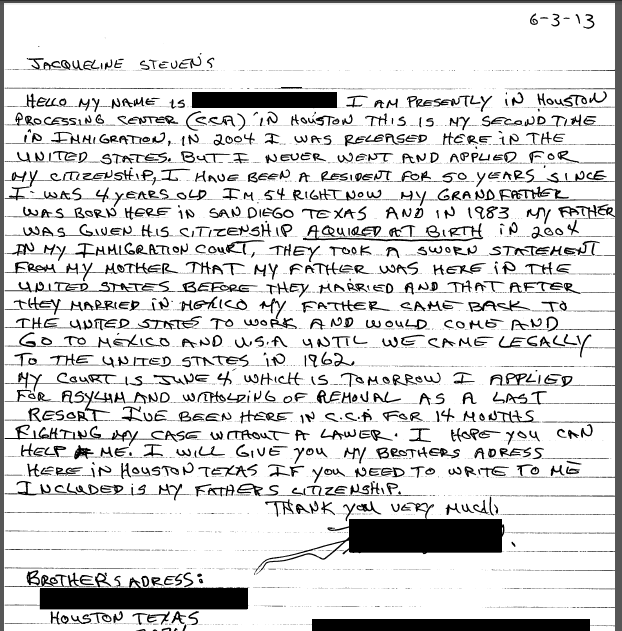
Frank Serna wrote me from Houston CCA in June,
where he'd been locked up for 14 months. An immigration judge in 2004 held a hearing and found credible his mother's testimony and other evidence of his U.S. citizenship and terminated proceedings, but in 2012 Immigration and Customs Enforcement ignored Frank's narrative and their own records and brought him in again. He was surprised, "ICE picked me up in 2009 and let me go." After a six month sentence in Laredo in 2012 for drug possession he thought he was free, "But then when I got out, ICE was there, and I was thinking, 'Why are they picking me up?'"
Obviously this just had to be a huge mistake. Serna, whose best language is English, said, "It seemed like a last minute decision." Once he was in an immigration court one he figure'd he'd explain everything and be released.
But that's not what happened. On May 8, 2012 Immigration Judge Jimmie Benton said he heard the 2004 recording in which Immigration Judge Cary Copeland in Dallas had terminated the proceedings. According to the records, the government had failed to prove Frank was an alien and waived appeal.
 |
| Mail box ICE Houston CCA Visitors, 10800 Export Plaza |
Benton ignored the prior termination order based on a full hearing and kept Serna locked up. Benton implies Serna's failure to obtain a Certificate of Citizenship is grounds for holding him at CCA But unlike most of the population, the government had already brought Frank to immigration court and failed to prove his alienage. Thus Frank is the last person who should need additional documents from the government to avoid deportation hearings again. The government already knew it lost its case. Unless it could show it was closed without prejudice or fit some other exception, their day in court had come and gone.
 |
| Entrance to Houston CCA Immigration Court, photo by Sam Niiro |
At the hearing on May 8, 2012 Frank, without funds for an attorney, tries his best to stave off this unlawful and unjust deferral of his freedom. He tries to squeeze in between Benton's interruptions the correct legal analysis to explain how the law and facts confirmed his U.S. citizenship, but Benton cuts him off, "That's for the government to determine, that's not for you to determine. If the government determines you are not a U.S. citizen you can try to convince me."
In other words, in some strange legal world of his own creation, Benton had decided that immigration courts are not part of the government, and also that he could have another agency make a determination that under res judicata was his to make.
Listen for yourself
Andrew Free, Serna's attorney, said of the May 8, 2012:
I have rarely had such a visceral reaction to a piece of audio. It's just infuriating. I found myself screaming at the disembodied voice of the judge in my laptop.
About a year later (May 31, 2013), Benton "separated from the EOIR" according to Lauren Alder Reid, a public affairs official at the Executive Office for Immigration Review. Benton says he retired. On June 7, 2013 Houston Immigration Judge Saul Greenstein terminated proceedings on the basis of reviewing the 2004 recording and immigration court order at the time. Under Benton, the hearings had dragged out for over a year and Benton ordered him deported. Greenstein, aware of all this, held the first hearing on June 3, 2013 and four days later Serna was released.
With unlimited resources at its disposal, and backdoor channels to sway Citizenship and Immigration Services agents from issuing people like Frank Serna Certificates of Citizenship -- more on that later -- ICE is appealing Greenstein's order.
 |
| Frank
picking up mail informing him government will be appealing the
immigration judge decision to terminate deportation proceedings |
Frank is having a rough time finding work in Texas. E-verify is not his friend. And he still needs to fight the government to remain in the United States.
Attorney Andrew Free (who represents me in FOIA litigation) is now representing Frank before the Board of Immigration Appeals and is looking to help Frank close this chapter of his life sooner rather than later.
And Benton? I saw him in his old grim, windowless court at the Houston CCA in July. He was there to barter with the ICE attorney for his client's bond, along with the dozen other private attorneys. I heard it was his first time back in his old court since he left. The incongruity of the situation was palpable but it was business as usual, though Benton seemed to get a better deal from the ICE attorney for his client than the other attorneys did, $4,500 compared to the median $7,500.
Benton's Recollection of the Frank Serna Case and Others
We spoke today by phone. I asked him about the Frank Serna case and others in which the word was that Benton refused to allow hearings unless respondents first filed N600 applications. He defended this practice, "I tell them, that way they have two bites at the apple," a phrase that I indeed heard verbatim from respondents and attorneys who had appeared before him. "That way if they are unable to convince the government, they have an opportunity to try to convince me." Again, pretty much what he told Serna during that hearing.
But all the cases I'd heard about, including Serna's, showed ICE attorneys in ex parte communication with the CIS and Benton rubber-stamping the denials. I asked Benton if he ever terminated proceedings on the basis of US citizenship after an N600 application had been denied. He couldn't recall any.
Benton said that the paperwork for the N600 applications helped prepare for the hearings, but the rationale only worked for the government attorney and himself. He could not produce any reasons for why it would be beneficial for a US citizen to have to wait in detention for an N600 decision instead of having the hearing before Benton. This isn't to say it's not a fair strategy for IJs who have confidence in their own abilities to independently evaluate an administrative record, just that Benton lacked the training and qualifications to do this, and admitted as much. (Greenstein, on the other hand, is a former attorney in the Office of Immigration Litigation.)
And indeed when Serna's denial came back (via the government attorney, who gave a copy of it to Serna the day of the hearing), Benton just read it verbatim as part of the record for preparing the deportation order, and failed to countenance Serna's arguments about the evidence his mother shared with the immigration court in 2004.
Benton told me that if someone objected and wanted to have the hearing they could, though that does not seem plausible, at least for Serna. In fact, even attorneys told me that Benton refused to have hearings unless they filed N-600 applications.
Benton also told me that he interviewed Serna's mother and made his determination only after he had reached her, or someone whose phone number Serna said was hers, and found the information she gave him not sufficient. I was pretty sure that in that time frame, Frank's mother was deceased and asked if perhaps he was confusing that event with the hearing he'd listened to from 2004. Benton then and in a subsequent email was adamant about having spoken with Serna's mother and that this was during a hearing.
After we hung up I listened to all the hearings.
At the September 12, 2012 hearing, Benton asks Serna about whether he reach his mother for documents or other assistance and Serna says, "Both my parents are deceased." I'd be happy to give Benton the benefit of the doubt on this. After all the guy's heard thousands of cases. I don't think he lied per se about what he did, but he did misrepresent his temperment.
After the N600 denial, which appears to have been accomplished in coordination with the ICE attorney, when Benton is ordering Serna's removal, Serna is agitated. Making the same exact points that Greenstein makes a few weeks later, Serna points out that on the basis of his mother's testimony in 2004, the Dallas IJ terminated proceedings because he believed Serna was a US citizen. Benton says, "We've got somethhing here that's more
significant than the recollection of your mother. we've got
documents." Not only do the recordings show that Benton knew he could never call Serna's mother, or someone claiming to be her, they also show that he repeatedly dismissed the possibility that Serna might gather additional evidence to show that his father had filled out an INS form without quite understanding the question and thus misstated the first time he was in the United States, indicating it was 1954.
During the hearing Serna says, "He was working in the Galveston docks in
1944" and asks to be released so he can obtain evidence of that. Benton asks him how and Serna says he'll just go down there. Benton laughs and says, "That's not going to happen" and orders Serna deported
Here's the verbatim text from the email I received today from Jimmie Benton following our conversation, when I sent him a link to the hearing where he tells Serna to file an N-600 application, quoted in full with his permission:
Sorry. I can not listen to the recording at my office because there are
no speakers attached to my computer. will listen to it this evening.

Regardless, I will swear to you that I called the person he identified as his mother to receive from her the information she provided to IJ Copeland. There was no written decision in the ROP explaining how he arrived at his decision.

Yes, my general policy was to require N600 to be filed before I would consider hearing evidence of US citizenship. By my way of thinking that gave respondents two opportunities to establish their claim, organize their evidence and at the same time provide me the DHS position on the citizenship claim.. In a number of cases DHS found they were citizens, issued certificates of citizenship and motioned to terminate proceedings.

I do recall instances were DHS refused to adjudicate the N600 because the fee was not paid and they would not issue a fee waiver. Those cases I decided without DHS' adjudication.

Based upon the two cases you brought to my attention I was obviously flawed in my analysis of the citizenship claim. It would also be fair to say that I was weak in the area of citizenship. This was definitely something that EOIR should have addressed in the form of training. The substantive IJ training involving active give and take, questions and learned input from colleagues has been sorely missing for several years now.

I retired on May 31, 2013. None of my decisions have ever been the subject of discipline, admonishment or attention by the Chief Judge. The one complaint against me in my nearly 18 years on the bench involved an off the record statement I made to Respondent's attorney wherein I told her that if the case was remanded I would understand if she ask that I recused myself (this was an LPR cancellation matter).

My decision to retire was manifold: retirement eligible since 2011, lack of professional respect for OCIJ management because my immediate supervisors could not find there way around an immigration court, lack of meaningful training, crushing case load, the current flux in the immigration laws (not comfortable with issuing removal orders for people who may in the near future be eligible for releif) and my desire to enter private practice where there is no pressure to be financially successful.