Showing posts with label Private Prisons. Show all posts

Friday, April 22, 2022

ICE Letter Destroys GEO's Ninth Circuit Appellate Claims


                          ICE to GEO, June 21, 2018


Last fall, a federal jury found GEO's practice of paying one dollar/day for work performed by those in their custody under immigration law violated the Washington State Minimum Wage Act.  The jury calculated GEO owed the workers $17.3 million in unpaid wages.  A few days later, Judge Robert Bryan announced GEO needed to disgorge an additional $5.9 million to the State of Washington for its unjust enrichment going back to 2005. 

Last month, GEO submitted its appeal to the Ninth Circuit.  It tracks legal arguments Judge Bryan found unpersuasive, including GEO's claim that it was operating at the behest of the federal government. GEO is asking the appellate court to consider:

1. Does the WMWA require GEO to pay the State’s minimum wage to federal detainees participating in the Voluntary Work Program (VWP)?
2. Assuming Washington law requires paying federal detainees the minimum wage, does it violate the doctrine of intergovernmental immunity because it impermissibly discriminates against the Federal Government or because it directly regulates federal activities?
3. Assuming Washington law requires paying federal detainees the minimum wage, is it preempted by federal immigration law?
4. Assuming Washington law requires paying federal detainees the minimum wage, does it violate GEO’s derivative sovereign immunity?
5. Is GEO liable to the State for unjust enrichment on the ground that detainee participants in the VWP received payment of $1 per day?

Judge Bryan found that the Immigration and Customs Enforcement contract reimbursing GEO one dollar/day for those paid in the work program meant ICE would be reimbursing GEO for this program at the rate of one dollar/day, not that this was legal rate for paying those in GEO's custody.  

GEO is hoping it can persuade the appellate court that it was just doing what ICE told it to do, and so GEO can derive immunity from state laws.  But several letters ICE sent to GEO in 2018 make it clear that ICE read the contract the same way Judge Bryan read it. 

A while back ICE released a letter of June 21, 2018 rebuffing GEO's request for equitable adjustment to its contracts in order to cover legal fees and possible payments of wages to its detained workforce.  The line at the end revealed this information but the analysis behind this was redacted

My attorney Nicolette Glazer and I pushed back and today we received the letters in their entirety.  ICE is providing GEO the same legal analysis they encountered in Judge Bryan's orders.  In three separate letters for GEO's facilities in Aurora, Colorado, Tacoma, Washington, and  Adelanto, California, respectively, ICE gives the same three reasons for rejecting GEO's request.

1.  GEO did not demonstrate any change to the contract since they signed it: "This is a firm-fixed price performance-based contract. As such, the risk of performance, including the burden of administering the contract, falls to the contractor. Where there is no change to the contract, whether expressly or constructively, an equitable adjustment is not appropriate."

2.  The performance specifications and standards are not "incomplete" and are not defective. The Contract, as awarded in 2011, included a requirement to house detainees and perform related detention service in accordance with the Performance Based National Detention Standards (PBNDS). (Contract, Section H-5, item 10.). Specifically, the contract is clear about the terms and conditions of the Voluntary Work Program. The PBNDS outlines the purpose, scope, and expected outcomes of the program (PBNDS 2008 at Part 5, § 33 and see PBNDS 2011(2016 Revisions) at Part 5.8, as incorporated in Mod P00026).  Furthermore the award document and contract line item structure set forth the rate of
reimbursement for the program. (OF 336, CLIN x004, dated September 15, 2011).  Accordingly, the service provider has been on notice about these terms since contract inception, when the performance based contract was negotiated.

3.  GEO's legal fees and expenses are not cognizable costs under the contract terms or under FAR 31.205-47. Under the terms of the contract, GEO is required to provide detention services and ensure compliance with all applicable federal, state, and local work safety laws and regulations. (Contract, Section 11-5 and H-17). GEO's defense of these private lawsuits is a defense of its contract performance.

Two portions of this are especially important.  First, ICE parses the contract the same way that the plaintiffs and judge read it: GEO agreed to run a work program (pt. 2) and agreed to "ensure compliance with all applicable federal, state, and local work safety laws and regulations" (pt. 3).  In the trial GEO claimed the contract exempted it from state laws, but it's clear here that ICE lawyers disagree.  

ICE is not making this call on its own.  Communications here and in another recent release indicate that ICE had been in touch with the Department of Labor.  Bottom line: even the Trump administration couldn't save GEO.  (GEO could of course continue to insist that ICE forced GEO to pay those in ICE custody one dollar/day; but if the agency you claim is making you do something illegal denies this, and the contract does not actually state this, that's going to be a tough sell to a judge.  Also, did GEO inform shareholders that the federal government rejected its legal defense of the work program? Pretty sure they did not disclose this.) 

As more pieces of the work program puzzle are laid out, including staffing plans recently received for a different facility, it is becoming clear that GEO was paying those in their custody one dollar/day for the work GEO told ICE was being done by full-time employee and then pocketing the difference.  

In addition to questionable staffing plans for facilities I recently recieved, the most conclusive evidence is the paltry sum of $10 million/six months assessed last summer by the House Appropriations Subcommittee on Homeland Security as sufficient to cover the increase between current dollar/day/worker for all facilities across the country and wages paid under the Service Contract Act (SCA).  The rates of the SCA are far higher than minimum wage; for certain skilled labor more than $100/hour.  If GEO is telling the government that it is already paying these rates for staffing, then it cannot justify further increases. 

GEO told the Tacoma jury that if ICE were obligated to pay the much lower minimum hourly wages the increase in overall expenditures would mean that if GEO kept constant its profit rate, its absolute profits would increase.  GEO's attorneys and witnesses dared the jury to find them guilty so that ICE would need to pay them more and bill the U.S. taxpayers, i.e., the jurors. 

Anyone in the court room paying a little bit of attention, and especially the diligent jurors, had noticed that GEO could easily pay increased labor costs from its $18 million annual profits from the Tacoma facility.  As GEO has had work performed at these higher rates either by those in communities adjacent to the facilities or those in GEO's custody, the firm will be receiving a small increase in funds from the federal government.  However, if the labor laws are enforced, the money will be going to those doing the work GEO contracted to perform and the profits will be substantially reduced. 

If the outcome leaves ICE jails in place and paying more to the local work force, detained or otherwise, then the litigation will not have advanced the policy goal of thwarting deportations.  But if banks and financiers no longer find this a lucrative sector, then there is no reason for them to lobby for minimum bed mandates and more ICE prisons, and the deportation laws that keep them filled and degrade all of us.  

Thank you to the Deportation Research Clinic research assistants for 2021-22 at Northwestern University whose hard work drafting FOIA lawsuits, coding, reviewing redactions, and uploading documents make it possible to unveil an important document ICE tried mightily to withhold: Farrell Fellow Lorenzo Garcia, Minji Kim, Grant Li, Kristi Park, and a special thank you to Farrell Fellow and Eva Jefferson Paterson Fellow Caleb Young, class of 2022.    

Tuesday, June 8, 2021

GEO Making 33% Profit at Tacoma Facility, Possible Violation of Federal Acquisition Regulation - UPDATE: 36.79%!


Day 6 of Jury Trial on GEO's Exploitation of Detainee Labor in Tacoma:

Details of Super Profits Released


The first big financial reveal was when GEO's Associate Warden for Finance and administration  testified under oath that the annual profits for GEO at the Tacoma Northwest Detention Facility range between $18 to 20 million

The monthly invoice he was testifying about was $4.5 million for housing those waiting for their immigration case outcomes, and additional funds for transportion, for a total of about $5.1 million per month, or  annual profits of 29% to 33%

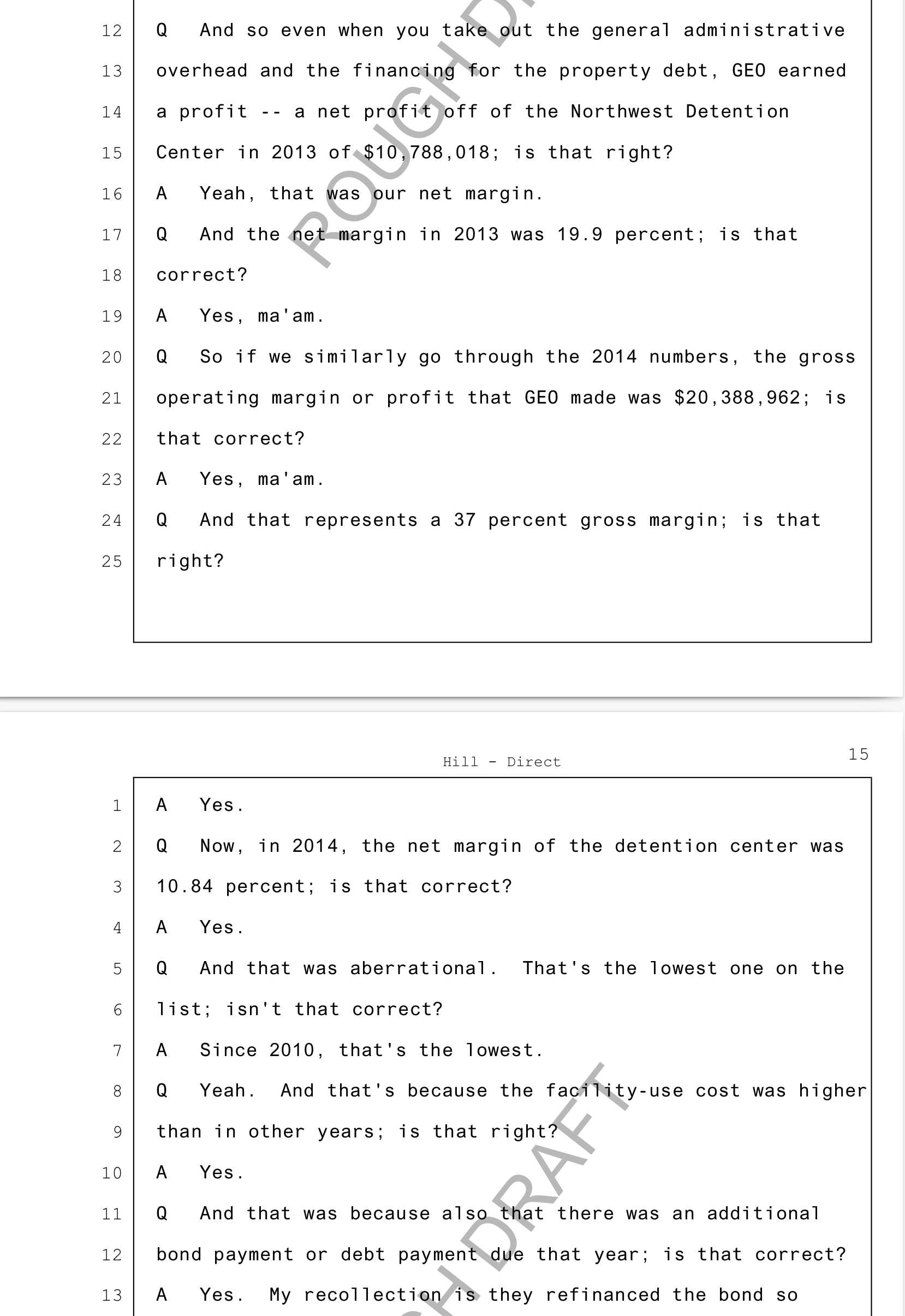
In the afternoon, Chuck Hill, the guy who handles GEO's budgets for the entire Western district explained a Powerpoint he'd produced in 2014.  It  showed GEO's revenues of $53,329,447 and profits of $19,621,970.  

The table Hill created, and plaintiff attorney Andrea Brenneke shared with the jury, showed profits of 36.79% in 2013.  

Hill took issue with the characterization of this number as "profits" but referred to it instead as the "gross operating margin," and pointed out that it did not take into account GEO's expenditures on financing, i.e., the payment to its bond holders. 

Once we deduct this, then GEO's net profits in 2013 were reduced to 19.92%.

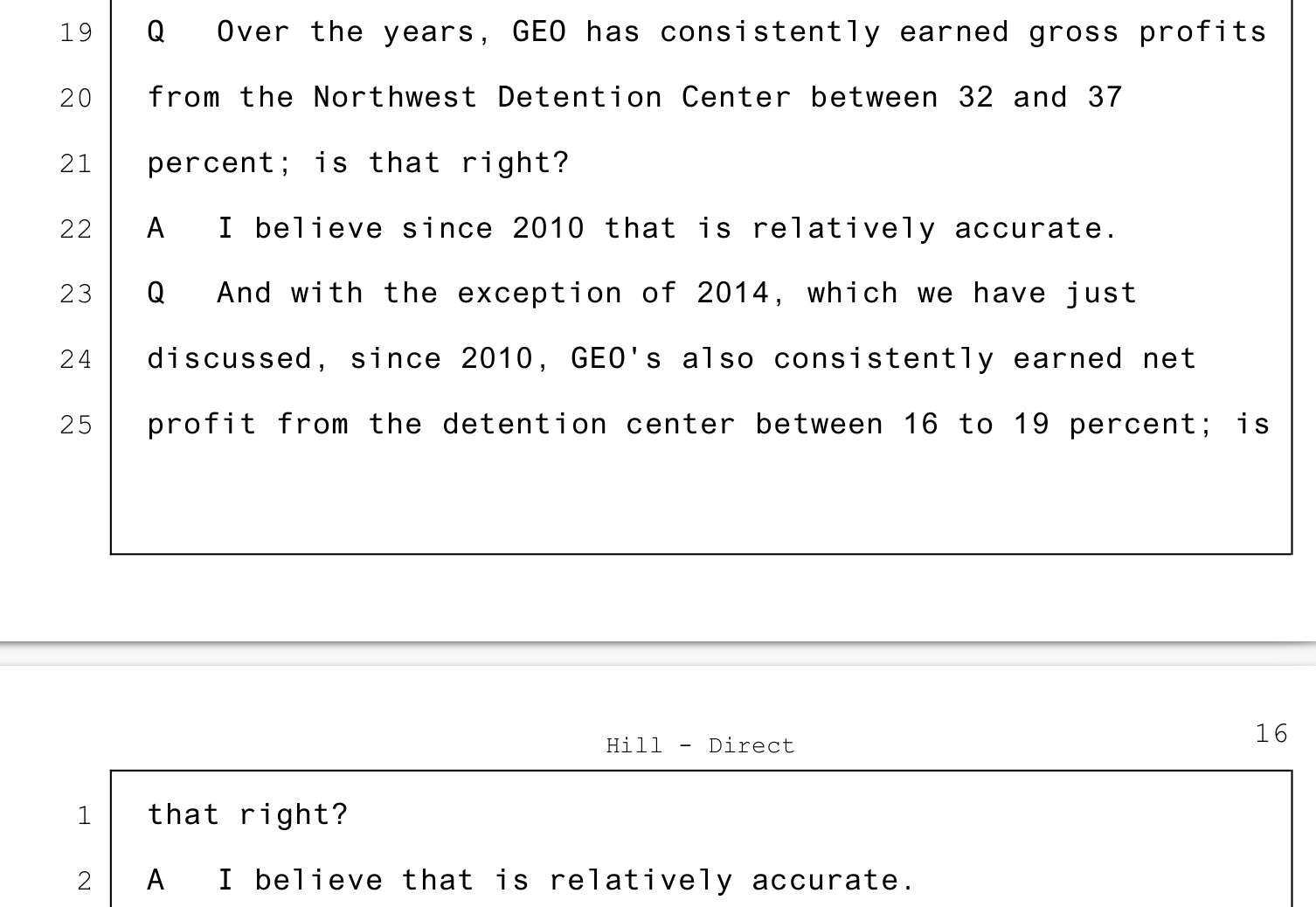
The attorney showed that in most recent years GEO, AFTER it paid its lenders, was still making 16% to 19% profits from its contracts for the Tacoma facility.


 Q and A:

(1)  Can GEO budget in its contract taxpayer money to be spent on interest payments and financing?  

A. No. FAR 31.205-20

"Interest on borrowings (however represented), bond discounts, costs of financing and refinancing capital (net worth plus long-term liabilities), legal and professional fees paid in connection with preparing prospectuses, and costs of preparing and issuing stock rights are unallowable."

(2) Okay, so is it legal GEO able to earn massive profits, and spend from these profits, what Mr. Hill called the "gross margin," on GEO's financing?

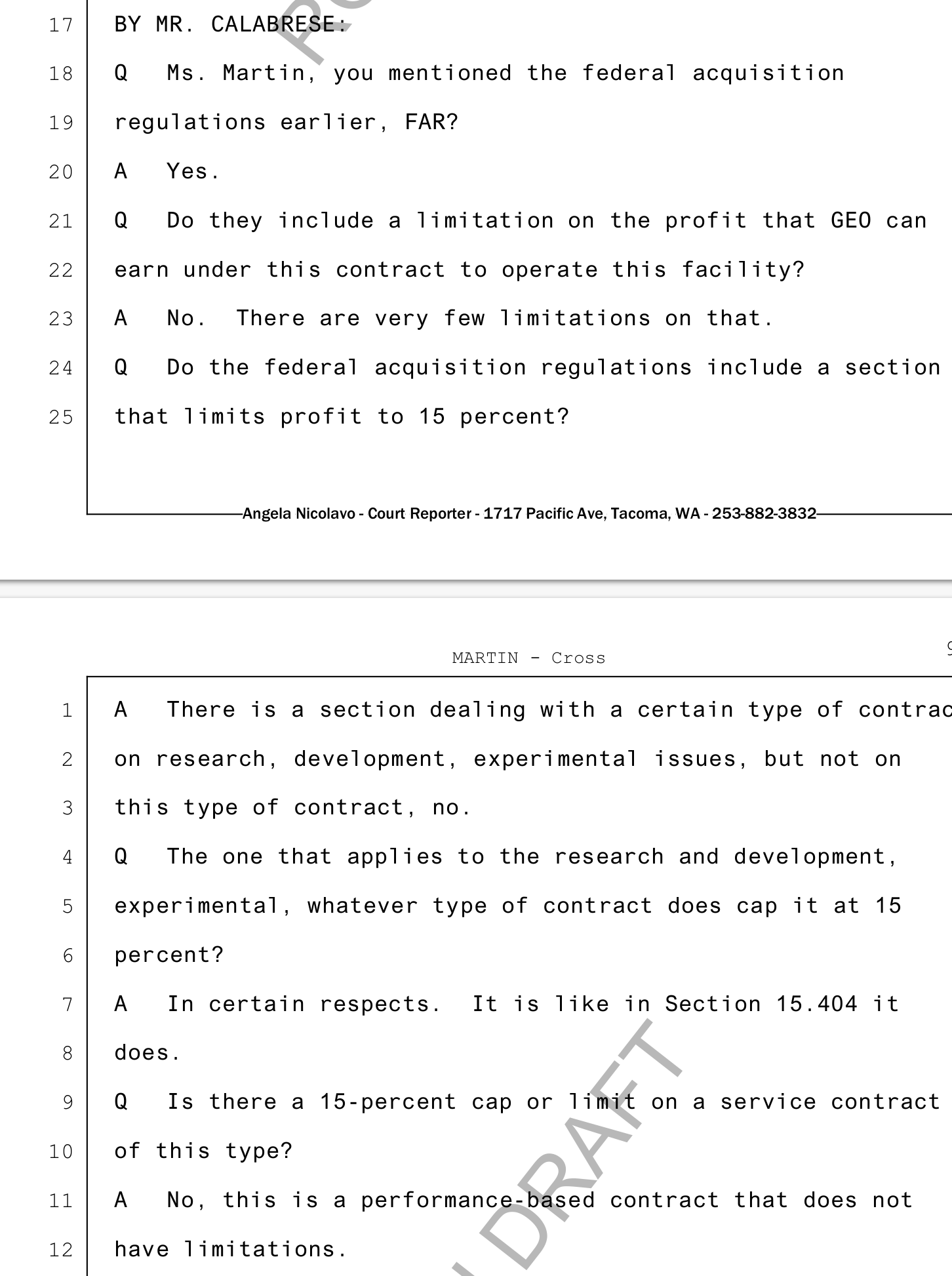
A.   No. FAR 15.404-4

"C) For other cost-plus-fixed-fee contracts, the fee shall not exceed 10 percent of the contract’s estimated cost, excluding fee."

GEO's legal strategy defending against the wage claims is to lie.   

UPDATE 7/8/2024: Subsequent testimony indicates that GEO was relying on a portion of the rule that does not limit profits.  The rule itself (15.404-4 "Profit") contradicts Congress's mandate for agencies to adopt protocols to “acquire property and services of the requisite quality and within the time needed at the lowest reasonable cost, utilizing competitive procurement methods to the maximum extent practicable.”  I am writing an article about history of this rule and its contribution to predatory governance and the federal deficit.


Lie #1  GEO is meeting all their contractual obligations without depending on the detainees to do any work.  GEO's marching in their officials and officers to say that GEO guards are cleaning and doing laundry and the detainees may once in a while pitch in because they feel like it and want to help out with cleaning where they live.  (And working in the kitchen gives them an opportunity to leave their pods.)

Their testimony is contradicted by the plaintiffs themselves, who are telling the jury that they are not working to avoid boredom but earn money.  A former GEO kitchen supervisor from 2009 - 2012 now performing similar duties at a nursing home confirmed their accounts.  So did the pay sheets plaintiffs introduced into evidence.  They showed dozens of workers in the dinner shift, not just a few.    

Lie #2   GEO's attorney in his opening statement said the rate was set in 1979.  Today GEO's Ryan Kimble said he saw the one dollar/day rate in a 1979 Congressional continuing resolution.   This makes it sound as though GEO is just following the payment schedule for the work program that Congress wants ICE to follow and that ICE in turn is obligating GEO to use.

At some point the plaintiff attorneys will point out that the first time the dollar/day rate was set was 19501979 was actually the last time Congress set a rate, and the bill Kimble claimed to have seen clearly states that Congress's appropriation at that rate ended on October 30, 1979

To be continued... 

C17-5769-RJB, Nwauzor et al. v. GEO Group, Inc. & C17-5806-RJB, State of WA v. GEO Group, Inc. The Complaint is here.

Sunday, June 21, 2020

ICE Officials Knew Dollar/Day Wages Lacked Congressional Authorization


click to enlarge

  E-mail ICE Fought to Keep Secret for Six Years May Clinch Minimum Wage Claims against Private Prisons


For the last ten years I've been conducting research on the history and legality of Immigration and Customs Enforcement (ICE) and its contractors paying $1/day to those in civil custody for work vital to the operation of the detention facilities. 

I've reported on the program's effects on U.S. citizens such as Mark Lyttle and others in ICE custody, the extent of the payments and their contributions to GEO and CCA (now CoreCivic) profits, the first lawsuit filed in Denver, the class certifications, and the positive treatment of these and subsequent cases by judges and appellate courts across the country.  (See other links at end.)

Today, almost six years after FOIA litigation to obtain e-mail behind the program, and following an order by Judge Harry Leinenweber telling ICE its "messaging communications" must be produced,  we now may have a proverbial smoking gun: 2014 e-mail from ICE's Director of the Office of Detention Policy and Planning (ODDP) challenging ICE's reliance on the 1979 appropriations bill for justification of the work program's $1/day wages, first disregarded and then, according to subsequent e-mail in this release, adopted as the agency's interpretation of appropriations policy for the ICE work program.

On May 1, 2014, ICE Director of ODDP Kevin Landy writes:
As indicated yesterday, I question the accuracy of this statement:
[']Facilities are reimbursed a minimum of $1 per day by ICE per Congressional appropriations standards.[']   Has someone concluded that the 1979 appropriations provision remains binding on ICE in perpetuity?  I don't think that's typically true for language inserted in appropriations bills. 
The subject heading is "NYT materials," presumably prompted by Ian Urbina, who was researching this article published on May 25.  Landy sent it to Barbara Gonzalez in the ICE public affairs office, as well as to other high-ranking officials, including Tae Johnson, then Assistant Director for Custody Management, Enforcement and Removal.  

On May 2, Ian Urbina received a statement claiming the Congressional appropriations standards justifying the work program identical to that proposed on May 1, suggesting ICE's colleagues rejected Landy's analysis.  The paragraph Landy challenged (and Urbina received) states:
Facilities that house the overwhelming majority of ICE detainees provide compensation for participation in voluntary work programs.  Facilities are reimbursed a minimum of $1 per day by ICE per Congressional appropriation standards. As of April 2014, the majority of those participating in some sort of voluntary work program -- well over 95% -- were provided monetary compensation.
Urbina's article was published on May 24.  

On May 27 at 3:34 p.m. Gonzalez proposed a response to questions from Telemundo, Univision, and Entravision triggered by Urbina's article.  The new statement, cleared by DHS, no longer included any reference to the Congressional appropriations authorization for the program.
 

At 10:39 p.m. that same day, in case one was not clear about the new version's rationale, Gonzalez sent an e-mail stating, "Sir, Per ERO, we struck this part of the background section: 'per Congressional approprations standards." (Emphasis added.)

Crucially, among the recipients was Thomas Homan, who became the acting director of ICE under Trump.  Homan's correspondence with GEO shows him rebuffing GEO's efforts for ICE to cover GEO's legal fees for the class action litigation over the firm's minimum wage and other labor violations, another indication Homan and his colleagues were fully aware that DHS and ICE did not find the 1978 appropriations bill for 1979 appropriations authorized the dollar/day payments for the ICE work program.
 
(ICE redacted the May 2 paragraph on the Congressional appropriations act in its release to me on Friday.  Fortunately, I have a previous FOIA production including the correspondence to Urbina from a prior FOIA request and this paragraph is not redacted; if I did not have this other release, the recent redaction would have made it impossible to document the change between the ICE statement of May 2 that included the 1979 appropriations rationale and the May 27 e-mail revoking this interpretation.)

In short, the release on Friday tells us that in addition to three federal judges, ICE itself since 2014 has rejected the claim by GEO and misleading statements by its own officials about the program's legal authorization in the appropriations act of 1978.  
 

Recently, the State Department's annual Trafficking In Persons report has made note of the litigation (p. 529).  Details on the legislative history of the program and its violations of the FLSA are available here; episodic scholarly publications, reports, and media coverage of the litigation are available via the Deportation Research Clinic, Buffett Institute for Global Affairs, Northwestern University.  

Thanks to Nicolette Glazer for her fabulous work in drafting motions to obtain the order for these materials to be re-reviewed and unredacted.  And thanks to Andrew Free for assistance in the initial FOIA litigation and brilliant work on the actual class lawsuits now underway.

Finally, none of this would have been possible without research assistance from Matthew Casler, Daisy Conant, Grant Li, Khadeejah Milhan, Caleb Young, and numerous other students who diligently tracked the redactions for us to challenge. Thanks also to the Buffett Institute, Posner Fellow Program, and Political Science department at Northwestern University for their support. 

Stay tuned for more analysis -- trying to upload entire file but server glitch.
6/22 update  -  93 page release now available here
Menocal brief from 6/30/2020 referencing new release here.

Friday, April 17, 2020

Updates on ICE Work Program Violations - FOIA Litigation b(5), b(6), b(7) Order and GEO-Karnes TRO Motion


In an order issued on April 8, 2020, Judge Harry Leinenweber (Northern District of Illinois, Eastern Division) ruled that the b(5) predecisional exemption is for policy decisions, not "how to spin its prior decisions":
...ICE’s internal communications about its responses to outside inquiries from the press, Congress, advocacy groups, and the public are not protected by the deliberative process privilege. From the Vaughn index descriptions and a review of the reprocessed supplemental production, ICE merely deliberates over which agency subpart should handle an inquiry and/or how to spin its prior decisions about the detainee volunteer work program and general operation of ICE detention centers. Those communications do not qualify as facilitating/informing a final agency decision or performing a deliberative function specifically assigned to ICE.... 
ICE must show that the messaging communications are so “intimately bound up with [the] agency’s central policy mission” to warrant protection. New York, 2018 WL 4853891, at *2. ICE does not make that showing here.... 
ICE’s Vaughn index descriptions and accompanying declarations do not demonstrate that these communications relate to anything other than rationalizing the agency’s final decisions. Thus, disclosure would not reveal the deliberative process behind not-yet-finalized policy decisions. Some of the redacted portions also appear to be pure facts and data that ICE solicited from its private jail operators. This kind of information is not protected by the deliberative process privilege. Nat’l Immigrant Justice Ctr. v. U.S. Dep’t of Justice, No. 12-CV-04691, 2018 WL 1508531, at *5 (N.D. Ill. Mar. 27, 2018) (citing Enviro Tech, 371 F.3d at 374) (noting the deliberative process privilege “typically does
not justify the withholding of purely factual material”).
(Case 1:14-cv-03305 Document 144, Filed: 04/08/20 Pages 17, 18, 19.)
The judge also rejected ICE's b(6) and b(7) arguments and ordered the agency to unredact the names of ICE officials who participated in these deliberations:
 ICE itself distinguishes between “personnel record files” and the emails at issue here. (Def.’s Reply at 8.) Yet, ICE argues that the names it redacted are protected because they belong to lower level employees. ICE labels these employees as “support staff.” (Id.) Generally, support staff provide administrative assistance to agency managers and would not have job titles like “Deputy Chief,” “Chief of Staff,” “Deputy Field Office Director,”or “Senior Advisor.” (Reprocessed Prod. at Supp. 105, 109, 138, & 299, Fuentes Decl., Ex. D, Dkt. No. 132-1.) Such titles indicate some level of managerial authority. Even if such employees were support staff, ICE overstates the authority supporting these redactions and fails to cite any case binding on this Court or directly relevant to these circumstances. See, e.g., Skinner v. U.S. Dep’t of Justice, 744 F. Supp. 2d 185 (D.D.C. 2010) (upholding redaction of law enforcement and support staff names, among others, from documents related to specific investigations under Exemption 7(C)); Associated Press v. U.S. Dep’t of Justice, 549 F.3d 62 (2d Cir. 2008) (withholding name redactions from a commutation petition under Exemptions 6 & 7(C)). Thus, Exemption 6 does not permit ICE to withhold the redacted federal employee names. As for Exemption 7(C), the Court asks whether these emails were “compiled for law enforcement purposes.” 5 U.S.C. § 552(b)(7)(C). While ICE is obviously a federal law enforcement agency, not every document ICE produces or amasses has been “compiled for law enforcement purposes.” Id. “Courts have generally interpreted Exemption 7 as applying to records that pertain to specific investigations conducted by agencies, whether internal or external, and whether created or collected by the agency—in other words, investigatory files.” Families for Freedomv. U.S. Customs & Border Prot., 797 F. Supp. 2d 375, 397 (S.D.N.Y. 2011) (collecting cases interpreting Exemption 7). The documents at issue are not investigatory files.
(Case 1:14-cv-03305 Document 144, Filed: 04/08/20 Page 25-27.)
Many thanks to Nicolette Glazer for her terrific briefing on this and other cases carrying on the litigation Andrew Free initiated on my behalf in 2014, when he filed a complaint to enforce my rights to documents about the contracts between Immigration and Customs Enforcement and the prison firms GEO and then-Correction Corporation of America, now CoreCivic.

GEO Karnes TRO
The FOIA litigation against ICE produced documents from which I quoted and linked in a law review article on the labor and employment law violations by these firms and was used in class action litigation against GEO and CoreCivic.  Federal judges and appellate courts have ruled against GEO and CoreCivic and the cases are going forward.

On April 6, 2020, attorneys filed a motion for a Temporary Restraining Order on behalf of "those subject to the Housing Unit Sanitation Policy (HUSP)."  The motion points out that
The living conditions encourage the rapid transmission of the virus and exposure to COVID-19 throughout the GEO facilities. And yet, GEO’s HUSPs still force Class Members to clean the epicenter of COVID-19’s spread at its facilities—the common spaces. GEO provides no protection to these workers, so they are unnecessarily exposed to COVID-19 because of GEO’s HUSP program. The circumstances call for immediate action to protect the Class Members where their ward, GEO, has completely failed.  5:17-cv-02514-JGB-SHK Document 252-1 Filed 04/06/20, pages 7-8.
Other cases in this litigation continue to move forward, including that of the nation-wide class of those alleging state and federal labor and trafficking law violations in the case against the GEO facility in Adelanto, California.

Wednesday, July 17, 2019

GEO Wants Taxpayers to Foot Bill for Private Prison Exploitation


GEO Execs Demand More Money
click image to enlarge
GEO and ICE communications about litigation linked below

In the last five years, seven class action lawsuits have been filed seeking damages and injunctive relief from private prisons that stand accused of forcing people to work in violation of several federal and state laws.  In letters obtain from FOIA litigation, we now know GEO is demanding taxpayers cover their fees and even damages.  The government, even Trump's government, so far is refusing.

The first lawsuit was filed in Denver in 2014 against GEO Corp.  Judge John Kane saw through GEO's whining captioned as a Motion to Dismiss and an especially overwrought Motion for Reconsideration and allowed two of the three charges to proceed.  Other judges did likewise and even allowed the minimum wage claims to go forward, the one charge Kane had sidelined.

In 2017, GEO told the Tenth Circuit appellate panel that if the class action lawsuit in Denver were allowed to proceed it would pose a "a potentially catastrophic risk to GEO's ability to honor its contracts with the federal government."  

GEO also told the Tenth Circuit panel that "the skeleton of this suit could potentially be refiled against privately operated facilities across the United States, causing GEO and other contractors to defend them even though GEO firmly believes that policies give the Plaintiffs no legal claim."  

In early 2018, the Tenth Circuit panel unanimously green-lighted the litigation. Apparently they were concerned more about the rule of law than GEO's profits.  

On January 11, 2019, the plaintiff attorneys sent out the following notice to up to 60,000 people held in the Aurora facility: "If you were detained at GEO’s Detention Facility in Aurora, Colorado between October 22, 2004 and October 22, 2014, please read this notice. A class action lawsuit
may affect your rights..." 

After six more lawsuits were filed against private prison firms for using those in their custody to do the work on federal contracts and had survived the motions to dismiss, I was curious about how the government was responding and filed a new request for documents.  

Here are a few highlights from the 4,015 pages obtained to date, pursuant to ongoing FOIA litigation.   

In a February 14, 2018 letter from GEO's Senior Vice President of Business Development to Acting Director Thomas Homan we learn:

1)  GEO has been begging ICE to intervene and support their exploitation of immigrants and U.S. citizens in their custody. "There is an urgent need for the federal government to particpate in the current and anticipated future litigation, as well as to justify and defend the programs and policies that ICE requires of its detention contractors."

2)  GEO thinks the U.S. taxpayers should reimburse GEO for their legal fees and damages.  Of the Colorado case, GEO writes: 
The legal discovery costs could total several millions of dollars and potential damages could be in the tens of millions.  Understandably, GEO would need to be reimbursed for all of the costs through an equitable adjustment request to ICE. To date, GEO has expended $1,615,000 in legal costs for which we seek an equitable adjustment.
GEO's letter also noted an additional $442,000 in fees for its defense against two lawsuits in Washington and new litigation and laws threatening their operations in California, including one requiring GEO to release information:  "The City of Adelanto has recently received multiple broad reqeusts for information about the Adelanto facility under this provision from the news againcy BuzzFeed and one individual." 

Apparently GEO does not want the public to become aware of its operations.  (Just guessing they won't be thrilled about our reading their correspondence about them not wanting us to read their correspondence.)
 
3)  Just a few months later, in May, 2018 GEO ups the estimate of legal fees alone to $15 to $20 million, and claims damages could be in the tens of millions. (This seems low to me.  GEO provides no basis for this estimate.)

4)  GEO hopes that by dramatizing a mutual enemy, Washington State's Attorney General, perhaps ICE, a.k.a. "U.S. taxpayers," will pay off GEO: "the State of Washington's suit is pursued by Washington's Attorney General, who has publicly boasted of his victories over the current Administration, including several regarding immigration."

5)  GEO continues to live in its own legal bubble and presses claims that several judges rejected when it made these claims to ICE in February 2018:  "Decades of precedents under the Fair Labor Standards Act have upheld the $1 per day allowance for detainee work, holding that detainees are not 'employees' of detention facilities and that minimum wage standards are inapplicable to detainees...Yet, GEO finds itself defending the agency and its policies against allegations of state minimum wage violations."   This is absurd on its face.


If courts for decades were upholding GEO's legal analysis, the lawsuits would have been thrown out and GEO wouldn't be begging ICE for money.  GEO's own summary of the litigation makes it clear that some courts in recent years are holding that GEO's organization of work by those in ICE custody could be an employer-employee relation.

About one per cent of class action employment lawsuits survive motions to dismiss and go to trial.  For these class action lawsuits against GEO and CoreCivic to have gone this far, it's pretty obvious the firms made some big mistakes and might now have to pay for them.  (The mainstream media has stayed away from in-depth coverage, a reflection and perpetuation of the legal illiteracy that advantages the fraudsters who wrangle massive government contracts amid egregious violations of federal laws and regulations.)  
 
There are several problems for GEO and CCA. One challenge is that the law GEO's Senior V.P. references in the letter, 8 USC 1555(d), says that the payments should be "at such rate as may be specified from time to time in the appropriation Act involved."  The last time Congress set a rate in its appropriations act was 1978.  That appropriations act expired in 1979 and was for "no more" than one dollar/day.  It also was in effect during a time frame when few people were in detention for more than a few days. 

Anyway, on the one hand, GEO is claiming that it is paying people in accordance with this (irrelevant, because long-expired) appropriations act.  

On the other hand, GEO clearly is not doing even this.  Internal email shows ICE attorneys very attentive to how GEO is using the labor of ICE residents as a mainstay for its operations, including by paying in some cases up to six dollars/day to insure GEO has the labor supply to meet its ICE committments.  

In an email of July 20, 2017, one official writes, "It is interesting that GEO is paying different rates at the facilities."  A colleague replies 20 minutes later, "I know! I'm really curious why they would pay more at Jena.  It is odd. (But good, I guess?  Then again, I hear commissary items are outrageosly expensive.  So, they probably just recoup it all that way.)"

In the end, ICE and the Solicitor General put the law and the taxpayers before GEO and CoreCivic.  On June 21, 2018 ICE denied all of GEO's requests for contract adjustments to cover their legal fees in this litigation. (It's on the last page.) ICE also declined to file as an intervenor and refused to defend the private prisons.  

An amicus brief filed on April 1, 2019 by the Solicitor General, "in support of neither party,"  affirmed the Trafficking Victims Protection Act analysis of the plaintiffs and the district court judge, i.e., holding that a for-profit prison is not categorically excluded from TVPA protections:
As the district court [in the seventh case, filed in Georgia] correctly recognized, there is no basis for reading this broad provision to categorically exclude from its coverage facilities operated by private entities that contract or subcontract to provide immigration detention services to the federal government, particularly in light of Congress’s repeated efforts to ensure that federal contractors do not provide goods and services to the government through reliance on forced labor.
It's the Trump administration and filed on April Fool's Day so I just checked again.  Trump's S.G. really says this.

The Georgia case against CoreCivic, the facility that held Mark Lyttle and is the subject of the above S.G. brief, makes no minimum wage claims.  The Eleventh Circuit appellate court has not yet issued its decision on whether the case  can proceed.  If it adheres to the analysis of the district court and the Solicitor General, the case should be ordered to proceed.  If it does, the outcome will hang on whether the CoreCivic can prove it was running the facility consistent with the Performance Based National Detention Standards.  (We know from independent audits and the Office of Inspector General reports that CoreCivic has flunked already.)  

 
Some folks reading this may be wondering about the policy implications. 
It is becoming painfully clear that there is a fundamental contradiction between the rule of law and the operations necessary to regulate the movement of people across national boundaries.  

In light of this, a lot of Trumpists think it's fine to suspend with the rule of law, the thought being: do we really want to make it either more difficult or more expensive to exclude or remove those without legal authorization from the United States? If the cost of controlling the ancestry of U.S. residents means blowing off our labor laws, then so be it, runs this line of reasoning, with no small support from some bad U.S. Supreme Court decisions from the nineteenth century.

This response reflects the success of our kleptocratic leaders in controlling public discourse.  They encourage the assumption that the object of the game is arbitrary population controls and not our intellectual, political, and economic vitality.

The important questions are the ones the Republicans and the Democrats alike don't want us asking: if we want to deter from residing here people who drain the U.S. coffers and avoid paying taxes on their booty, then why aren't we deporting the Trump family, or for that matter the Pritzkers and the Crowns of Illinois, who for decades laundered funds illicitly funneled from government coffers to themselves in the guise of public spending, going back to war profiteering in the 1940s, and who continue this through bogus "philanthropic" gifts and tax deductions today?  

"Without justice, what are kingdoms but great robberies?" -St. Augustine, City of God, c. 380.

What are the marginal public benefits of a dollar spent on GEO holding a guy who wants to pick tomatos, and his children, compared to a buck spent on investigating General Dynamics Information Technology for anti-trust violations connected to their gobbling up of firms that handle databases for Homeland Security, including apparently one that lost track of migrant children?   

Is the giant sucking sound jobs shipped to China, or funds whisked into the offshore accounts of those turned into billionaires from padded federal contracts, and who fight on various fronts to insure our taxes will never be available for responsibly, not corruptly, designed and built high speed trains, Creative Commons licensing training (and the elimination of the Bayh Act), or public health investments?  

Do we really want to investigate fewer than 1,200 cases of tax evasion annually, down from 1,948 in 2010  and leave tens of billions on the table while spending scarce resources capturing and locking up hundreds of thousands of people who might actually assist the U.S economy and pay more taxes than the jailers who are exploiting them? A Department of Treasury report notes "a significant decrease in the Collection function’s staffing in recent years.  The number of revenue officers declined over 40 percent, from 4,068 at the end of FY 2010 to 2,425 as of June 2016."
The myth is that the one percent somehow earned their wealth through the miracle of capitalism.  Sure, a few did.  But most wealth is from intergenerational transfers and much of this is from assests or commodities acquired from the state and federal government.  The largest spender in the world is the U.S. federal government, and it spent about $1 trillion, including taxes from noncitizens, on some of the world's most toxic commodities, from cluster bombs to biometric databases to prisons.  The folks hauling in these billions run firms that buy or merge with their competition, and spend millions on making nice with the people who control the purse strings to not ask questions or to install those who they can insure will not.

Shouldn't we be taking care of the real vulnerabilities to the rule of law, i.e., the corruption of those managing our treasury and our jails, i.e., our resources and liberty, before worrying about the lineage of new arrivals, a population less likely to be convicted of any crimes if they cross borders instead of being born here?

"We the People of the United States, in Order to form a more perfect Union, establish Justice, insure domestic Tranquility, provide for the common defence, promote the general Welfare, and secure the Blessings of Liberty to ourselves and our Posterity, do ordain and establish this Constitution for the United States of America." - Preamble, U.S. Constitution

Our wager as citizens is on a people defined solely by our desire to establish justice and further other principles, with no other criteria as to collective origins or fantasies thereof.  To the extent that ideas about ancestry and especially nationality favored by the identity politicians of the right and left crowd out these founding aspirations, they pose the real threats to the rule of law and hence the posterity of the founders.  Those arriving for the purpose of joining the  people of the U.S. Constitution are the posterity perfecting the rule of law and should be welcomed.  Any other decision-rules for admission or expulsion, especially hereditary, are distractions that are expensive and even lethal.

P.S. How this happened....
It's been just over ten years since June, 2009, when Mark Lyttle asked for help in obtaining what he said was $32 owed him by the Correction Corporation of America (CCA).  Mark had been working in the kitchen and had a midnight shift buffing floors at the Stewart Detention Facility in Lumpkin, Georgia.  CCA was paying him one dollar a day.

Mark, a U.S. citizen, in late 2008 was employed by a for-profit immigration jail.  The only difference between him and the janitor at the hospital down the road is that Mark was in the custody of his employer and was waiting for an immigration hearing. It's illegal for ICE to detain and deport U.S. citizens.  I was writing about that piece of his saga, and what it meant that William Cassidy, a federal attorney and hearing officer, a.k.a., immigration judge, could ship Mark to Mexico, lie about it, and still not be fired.    

I helped Mark find attorneys at the ACLU.  They filed a lawsuit for the detention and deportation.  No one followed up on the $32 CCA owed him.   

It bugged me.  I couldn't figure out why CCA thought they could pay him, or anyone who had not been convicted of a crime, one dollar per day, and not at least minimum wage.  (The 13th Amendment exampts from the prohibition against forced labor work performed as a condition of punishment.)

Thanks to the acumen of Andrew Free, who also handled the FOIA litigation crucial for obtaining documents for my research unwinding this, the class action lawsuits against the private prison firms for work programs along the lines of what Mark described to me rolled out nationwide. 


I am now also indebted to attorney Nicolette Glazer, who has stepped in to help out with the FOIA litigation, including the winding down of the prison contract litigation Andrew filed in 2014, which is still ongoing.  

Here's a link to a law review note updating the litigation last year.