Showing posts with label ICE. Show all posts

Friday, March 20, 2026

What Crazy Fact about the Rate of Trump's Unlawful Detentions did I just Learn from CourtListener, Thanks to Dan Kowalski and the Rest of the Fabulous Attorneys and Judges Defending the Rule of Law?

Habeas Challenges Increase by 4,119%    

To date under Trump II, about 23,000 habeas motions were filed on behalf of people in ICE Custody (1/21/2025 - 3/20/2026)


Click to Enlarge


Under Biden, for the Exact Same Period, 535 Habeas Motions were filed on behalf of people in ICE custody

   
Click to Enlarge

Prompted by Dan Kowalski's listserve blast with the subject heading: "81-year-old Judge Leonie Helen Milhomme Brinkema is NOT HAVING IT!" I read the court order, and some others on recent habeas relief.  As I was musing as to the number of habeas cases brought under Trump, compared to Biden, I realized the answer was readily available via the awesome CourtListener interface (every lawyer reading this needs to add "RECAP" to your browser).   


Thursday, March 12, 2026

ICE Releases Hundreds of its Detention Subfield Office Addresses and Phone Numbers, Following Court Order

 ICE, We Know Where to Find You! 
Release from Deportation Research Clinic, Buffett Institute for Global Affairs, Northwestern University


 Chicago Sample List from 1,250 Rows of ICE Subfield Offices Nationwide  
For entire spreadsheet, click here


Chicago Sample List of ICE Addresses and Phone Numbers 

click to enlarge, or download spreadsheet


Backstory
In 2009, I encountered an ICE report indicating that ICE had 186 "subfield offices," meaning locations with holding cells designed for 24 hours or less.  I filed a request of ICE requesting a list of their locations.  
 
When I received the list, I was stunned to learn that one of the locations was in the Chelsea Market, a couple blocks from my apartment.  The Chelsea Market is a tourist scene, not to mention home to the Food Network and other glam enterprises.  You can read about my conversation with the guy running the U.S. Marshal operation and coordinating on the third floor with ICE's Fugitive Operations in The Nation, "America's Secret ICE Castles."  The guy in charge  did not appreciate my pointing out that he was using Rachel Ray as a human shield and asked me not to reveal their operations, a request I turned down.  Here's a link to the list and story from 2009.  

About ten years later, I was looking at a release of similar list posted on the National Immigrant Justice Center.  Except it was too short and no addresses or phone numbers were included.

ICE's response to my request for the data for the missing fields was an unreadable PDF.  After years of litigation, and a court order from Illinois Northern District Court Judge Mary Rowland, ICE coughed up this list.  The contact information and specification of responsibilities should be helpful to those trying to assist folks ICE is arresting.
 
Many thanks to my FOIA attorney Nicolette Glazer.  The Deportation Research Clinic operates on a miniscule budget and the work of intrepid undergraduate research assistants, who draft our complaints and analyze productions.  Thanks to Gabriel Sanchez, Class of 2026, who worked on this litigation and many other cases.  
Please consider  supporting our work.      
 
Update, March 13, 2026 - The spreadsheet does not include the 88 Tenth Ave., NYC (Chelsea Market) location where ICE previously operated.  Turns out that the U.S. Marshals et al. relocated a few years ago to Brooklyn.  The new address and phone numbers are listed in the recently released spreadsheet as "NYC ECP" (Enforcement Criminal Prosecutions).   


Wednesday, May 1, 2024

Butler County Jail and ICE Violate Labor and Immigration Laws, Line Official Claims Coffee Packets for Work are "Monetary"


In 2019 I published records on the work program for those in custody under immigration laws at the Butler County, Ohio jail, as well as my interview with the warden.  The gist is that the program was paying people for work with coffee packets.  The sherriff expressed his view that it was fine for him to employ the same protocols for people in custody under criminal laws for people in ICE custody. 

In reporting on this, I contacted ICE's public relations office.  When they failed to answer my questions about the discrepancies between the programs and the law, I filed an additional FOIA request.

Five years after failing to provide responsive records and four years into litigation, ICE yesterday released some damning emails - 169 pp.).  

6:04 p.m.  


The highlights: ICE confirms the Butler County program was not in compliance; the inspection group erroneously claimed the jail did not have a work program and omitted any evaluation of the unlawful practices; and other jails also were and likely are still out of compliance.

6:12 p.m. (DSM = Detention Service Manager, supposed to monitor compliance)


I'll fill in the details later but wanted to make this available asap.  It is further evidence that the compliance reports are garbage and that ICE knows this.  The good news is that ICE did finally release information underscoring the agency's disrespect for the rule of law.  The bad news is that sitting on it so long -- part of a pattern and practice of violating the FOIA -- deprives the public of real-time accountability, though it may still be quite useful for suing Butler and other jails that violated their contracts and the law.

It also raises more questions about what is going with the DOJ's amicus brief supporting the work program protocols ICE officials internally affirmed to be unlawful.  


Friday, April 22, 2022

ICE Letter Destroys GEO's Ninth Circuit Appellate Claims


                          ICE to GEO, June 21, 2018


Last fall, a federal jury found GEO's practice of paying one dollar/day for work performed by those in their custody under immigration law violated the Washington State Minimum Wage Act.  The jury calculated GEO owed the workers $17.3 million in unpaid wages.  A few days later, Judge Robert Bryan announced GEO needed to disgorge an additional $5.9 million to the State of Washington for its unjust enrichment going back to 2005. 

Last month, GEO submitted its appeal to the Ninth Circuit.  It tracks legal arguments Judge Bryan found unpersuasive, including GEO's claim that it was operating at the behest of the federal government. GEO is asking the appellate court to consider:

1. Does the WMWA require GEO to pay the State’s minimum wage to federal detainees participating in the Voluntary Work Program (VWP)?
2. Assuming Washington law requires paying federal detainees the minimum wage, does it violate the doctrine of intergovernmental immunity because it impermissibly discriminates against the Federal Government or because it directly regulates federal activities?
3. Assuming Washington law requires paying federal detainees the minimum wage, is it preempted by federal immigration law?
4. Assuming Washington law requires paying federal detainees the minimum wage, does it violate GEO’s derivative sovereign immunity?
5. Is GEO liable to the State for unjust enrichment on the ground that detainee participants in the VWP received payment of $1 per day?

Judge Bryan found that the Immigration and Customs Enforcement contract reimbursing GEO one dollar/day for those paid in the work program meant ICE would be reimbursing GEO for this program at the rate of one dollar/day, not that this was legal rate for paying those in GEO's custody.  

GEO is hoping it can persuade the appellate court that it was just doing what ICE told it to do, and so GEO can derive immunity from state laws.  But several letters ICE sent to GEO in 2018 make it clear that ICE read the contract the same way Judge Bryan read it. 

A while back ICE released a letter of June 21, 2018 rebuffing GEO's request for equitable adjustment to its contracts in order to cover legal fees and possible payments of wages to its detained workforce.  The line at the end revealed this information but the analysis behind this was redacted

My attorney Nicolette Glazer and I pushed back and today we received the letters in their entirety.  ICE is providing GEO the same legal analysis they encountered in Judge Bryan's orders.  In three separate letters for GEO's facilities in Aurora, Colorado, Tacoma, Washington, and  Adelanto, California, respectively, ICE gives the same three reasons for rejecting GEO's request.

1.  GEO did not demonstrate any change to the contract since they signed it: "This is a firm-fixed price performance-based contract. As such, the risk of performance, including the burden of administering the contract, falls to the contractor. Where there is no change to the contract, whether expressly or constructively, an equitable adjustment is not appropriate."

2.  The performance specifications and standards are not "incomplete" and are not defective. The Contract, as awarded in 2011, included a requirement to house detainees and perform related detention service in accordance with the Performance Based National Detention Standards (PBNDS). (Contract, Section H-5, item 10.). Specifically, the contract is clear about the terms and conditions of the Voluntary Work Program. The PBNDS outlines the purpose, scope, and expected outcomes of the program (PBNDS 2008 at Part 5, § 33 and see PBNDS 2011(2016 Revisions) at Part 5.8, as incorporated in Mod P00026).  Furthermore the award document and contract line item structure set forth the rate of
reimbursement for the program. (OF 336, CLIN x004, dated September 15, 2011).  Accordingly, the service provider has been on notice about these terms since contract inception, when the performance based contract was negotiated.

3.  GEO's legal fees and expenses are not cognizable costs under the contract terms or under FAR 31.205-47. Under the terms of the contract, GEO is required to provide detention services and ensure compliance with all applicable federal, state, and local work safety laws and regulations. (Contract, Section 11-5 and H-17). GEO's defense of these private lawsuits is a defense of its contract performance.

Two portions of this are especially important.  First, ICE parses the contract the same way that the plaintiffs and judge read it: GEO agreed to run a work program (pt. 2) and agreed to "ensure compliance with all applicable federal, state, and local work safety laws and regulations" (pt. 3).  In the trial GEO claimed the contract exempted it from state laws, but it's clear here that ICE lawyers disagree.  

ICE is not making this call on its own.  Communications here and in another recent release indicate that ICE had been in touch with the Department of Labor.  Bottom line: even the Trump administration couldn't save GEO.  (GEO could of course continue to insist that ICE forced GEO to pay those in ICE custody one dollar/day; but if the agency you claim is making you do something illegal denies this, and the contract does not actually state this, that's going to be a tough sell to a judge.  Also, did GEO inform shareholders that the federal government rejected its legal defense of the work program? Pretty sure they did not disclose this.) 

As more pieces of the work program puzzle are laid out, including staffing plans recently received for a different facility, it is becoming clear that GEO was paying those in their custody one dollar/day for the work GEO told ICE was being done by full-time employee and then pocketing the difference.  

In addition to questionable staffing plans for facilities I recently recieved, the most conclusive evidence is the paltry sum of $10 million/six months assessed last summer by the House Appropriations Subcommittee on Homeland Security as sufficient to cover the increase between current dollar/day/worker for all facilities across the country and wages paid under the Service Contract Act (SCA).  The rates of the SCA are far higher than minimum wage; for certain skilled labor more than $100/hour.  If GEO is telling the government that it is already paying these rates for staffing, then it cannot justify further increases. 

GEO told the Tacoma jury that if ICE were obligated to pay the much lower minimum hourly wages the increase in overall expenditures would mean that if GEO kept constant its profit rate, its absolute profits would increase.  GEO's attorneys and witnesses dared the jury to find them guilty so that ICE would need to pay them more and bill the U.S. taxpayers, i.e., the jurors. 

Anyone in the court room paying a little bit of attention, and especially the diligent jurors, had noticed that GEO could easily pay increased labor costs from its $18 million annual profits from the Tacoma facility.  As GEO has had work performed at these higher rates either by those in communities adjacent to the facilities or those in GEO's custody, the firm will be receiving a small increase in funds from the federal government.  However, if the labor laws are enforced, the money will be going to those doing the work GEO contracted to perform and the profits will be substantially reduced. 

If the outcome leaves ICE jails in place and paying more to the local work force, detained or otherwise, then the litigation will not have advanced the policy goal of thwarting deportations.  But if banks and financiers no longer find this a lucrative sector, then there is no reason for them to lobby for minimum bed mandates and more ICE prisons, and the deportation laws that keep them filled and degrade all of us.  

Thank you to the Deportation Research Clinic research assistants for 2021-22 at Northwestern University whose hard work drafting FOIA lawsuits, coding, reviewing redactions, and uploading documents make it possible to unveil an important document ICE tried mightily to withhold: Farrell Fellow Lorenzo Garcia, Minji Kim, Grant Li, Kristi Park, and a special thank you to Farrell Fellow and Eva Jefferson Paterson Fellow Caleb Young, class of 2022.    

Friday, September 3, 2021

ICE, Increase the Real Intelligence Budget!


"Planned Activities: Respond to all media, NGO, educational, commercial and individual FOIA requests within the statutory time limits..." From fy 2016 ICE budget


"Don't ask and ye shall not receive."
- FOIA budgeting muse

I was talking with some colleagues today about the well-known problem of Immigrations and Customs Enforcement and other agencies telling requesters and courts that they cannot comply with mandatory Freedom of Information Act  deadlines because of equipment and staffing shortages.  And then the same agency tells Congress in their budget proposals, "Hey, nothing to look at here.  We've got our FOIA operations covered."  

Usually agencies ask Congress for more funds for their programs. What's up with this?  

Of course, ICE's daily mode of breaking the law benefits not one whit from misconduct being revealed.  If ICE had its druthers, I'm guessing it would request $100 billion to run drones to sweep up data on every person on the planet, and its FOIA budget would be "0." 

Congress passed the FOIA in order to deputize citizens to expose agency activities to sunlight necessary for oversight and policy changes.  There have been numerous episodes in which Congressional letters to agencies have gone unanswered but nonprofits and citizens have ferretted out the requested information through their FOIA litigation, especially during the Trump administration.  

The problem with the FOIA budgeting goes to the overarching need for the FOIA in the first place: agency officials make bad decisions, sometimes even ones that are illegal, and they want to keep these secret.

Why would Congress or anyone else think that the very agencies whose top officials are breaking the law would be requesting funding to support a program that effectively reveals their waste, fraud, and unlawful violence?  

A few FOIA lawsuits have been calling out ICE and US Citizenship and Immigration Services on this point. (TRAC's Sue Long at Syracuse University has been a tireless and productive trailblazer.  You can find their cases here and other cases on the incredible FOIA Project case locator.)

A few docs illustrating ICE's budget game can be found in the record of Civil Rights Education and Enforcement Center v. United States Department of Homeland Security et al. 1:18-cv-00302-JLK.  

Here are filings about the budget and ICE's misrepresentations:
Declaration of Catrina Pavlik-Keenan (2018) - She says she has been the director of the ICE FOIA office "since that office was created on December 18, 2006" (1).  (Fwiw, ICE was founded in 2003.) Anyway, she says ICE cannot process the documents as mandated by the law because it lacks the resources.  

Plaintiff Response (2018) - The plaintiffs pull a screenshot from the fy2018 budget and note, correctly, that "the current level of FOIA requests being received by ICE was both predictable and in fact anticipated. Yet the 2018 Budget request makes no mention of any funds needed or requested to address the anticipated increase in the number of FOIA requests" (4).

Plaintiff Motion for Sanctions (2019)  

The fy2018 budget on which CREEC relies does not specify funds expended.  

But other ICE budgets do give us a peek at what's going on.  (DHS budget page, through fy2022.)   

The fy2019 budget has information tied to new House accounting requirements that are requiring ICE to break out expenditures it otherwise does not report in its budget request to Congress.  It looks like of the $6.7 billion Congress appropriated for ICE in 2017, ICE spent just $6.45 million on FOIA operations.  (I agree.  That seems SO low; if anyone has another way of reading page 24 of the pdf, let me know.  The page is reporting figures for programs that going forward will be relabelled, to help budget wonks figure out what's happening when the columns move.)   


Otherwise, the FOIA operations are not broken out from the overall "mission support" category, which includes as well fire arm training.

Submitted for

fy 2022 - asks for four more employees/ $782k more for its ongoing FOIA/Privacy Act work.  Does not state amount spent in 2021. (p. 39,pdf).  On the next page, ICE tells Congress to budget $123k less than the previous year, due to one-time ("non-recurring") savings.

fy2021 - The document indicates that in fy2019 mission support included 2,210 total employee and spent  $1,091,898, and that in fy 2020, mission support included  2,210 employees and sent $2,092 $1,271,110.

fy 2020 - "Select Mission Support staff will be dedicated to resolving 86,320 FOIA in FY 2020, a 37% increase from FY 2018" (p. 49 pdf).

fy 2019-  This is the proposed budget that shows enacted budget of $6.45 million for iCE in 2017 (p. 24) and proposed increases to $9.627 million for 2018 and 2019.

fy 2018 -  " As depicted in the graph below,the number of FOIA requests fulfilled in FY 2018 is expected to triple from FY 2014 levels. Higher productivity is attributed to a growing workforce and implementation of new software" (p. 62, pdf).


fy 2017 - pt ii, p. 10. For the section including FOIA officers there are many other requests for increases, but no request to increase funding for FOIA requests: 
An increase of $16.1 million and 4 full-time equivalents (FTE) for the Headquarters (HQ) Managed IT Program to support  critical and long overdue improvements in Identity, Credentials, and Access Management (ICAM), cloud support, and system bandwidth. Funding will support an additional eight personnel (4 FTE) to ensure 24/7/365 availability and to meet
the cybersecurity needs of ICE IT systems, infrastructure, and services. p.10 pdf
fy 2016p.1435 Program Change Requests

"Changes ICE requests program changes for the Salaries and Expenses appropriation in the following key areas:
• Increase in new attorney positions…………………………...….….$36.5M (197 FTE)
The request will provide funds for 82 attorney positions requested in the October 2014 Technical Assistance and 282 new attorney positions. OPLA requires additional attorney resources to meet its increasing workload driven by recent increases in the number of Department of Justice (DOJ) immigration judges (IJs) and ongoing southwest border surge operations as well as additional requirements anticipated as a result of an increase in Freedom of Information Act (FOIA) requests and appeals. These additional positions are expected to decrease the average length of stay of detainees by 14 percent.

Increase in Detention Beds to 34,040 [😕] …….…..………………....$435.392M (0 FTE) To meet operational needs to detain and remove both criminal aliens and recent border entrants, ICE requests an increase in the overall funding for beds to meet operational needs. The proposed increase will fund 31,280 adult beds at an average rate of $123.54 and 2,760 family beds at an average rate of $342.73 from ICE’s discretionary appropriation and fees." 

p. 1438 - "Increase of $482 thousand for annualization of the FY 2015 FOIA enhancement.' 

p. 1441

FY 2016 Planned Activities - "In FY 2016, ICE will"
 ....

One more broken promise...

 ICE did ask for 6 more FOIA employees. Not clear what happened (p. 1583)


Sunday, May 25, 2014

New York Times Story on ICE Detention Center Slave Wages

photo Ramin Rahimian, for the New York Times


Check out the New York Times article by Ian Urbina, "Using Jailed Migrants as a Pool of Cheap Labor." 

If you want to read more about the program's legality and history, here's the working paper I posted last week on the Social Science Research Network, "One Dollar Per Day: The Slaving Wages of Immigration Jail Work Programs - A History and Legal Analysis, from 1943 to Present."   (posted May 15, 2014, 160 pages).  

From the abstract:
This Paper evaluates the legality of the $1 per day payments for work performed by those in custody under immigration laws as well as its genesis. In 1941, President Franklin Roosevelt issued an order moving the Immigration and Naturalization Service (INS) out of the Department of Labor and into the Justice Department. During this same time frame, the U.S. Government established internment camps for "enemy aliens," i.e., civilians in the United States and other countries in Latin America who were or were imagined to be citizens of Axis powers. In 1943, the Justice Department paid those so held 80 cents per day for their work performed in the camps; the average daily cost of each person's detention in 1943 was one dollar. This was the origins of the 1950 law authorizing paying those in custody under immigration laws for work performed. If those in immigration custody today were paid at the ratio from 1943, they would be earning about $80 per day. This paper draws on government documents and contracts obtained under the Freedom of Information Act as well as the program's implementation and history as the basis for a statutory analysis of the Government's defense of its legality. The Paper argues that under a reading of the relevant laws' plain meaning, legislative history, and purpose, the program appears to violate various labor laws and the Fifth, Sixth, Thirteenth and Fourteenth Amendments.
For entire paper, please go here.

Sunday, May 11, 2014

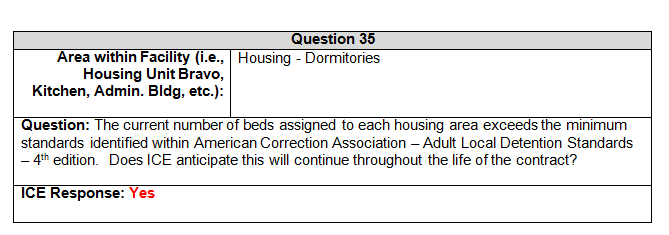
Port Isabel Detention Facility Overcrowded, ICE Vows to Continue Violating Prison Standards, Only 10% Have Convictions


Recent contract documents reveal the Texas Port Isabel Detention Center is subjecting the average 1115 people it locks up each night to overcrowding, and that 90 per cent of them have no criminal records.

On February 11 and 12, 2014 representatives from several private prison firms visited the Port Isabel Facility.  Then they submitted questions, to assist in them preparing bids.   You can read the Q and A here.

The contractor question published here does not mention the precise level of overcrowding but it appears to be a) systemic; and b) of no concern to ICE.

This is important not only because of the inherent problem of subjecting those in civil detention to conditions deemed impermissible for criminal punishment, and not only because of ICE indifference to this.  This is the answer ICE gives to private prison firms, authorizing their violations but it is not the answer ICE gives Congress and the American public.  By ICE insisting that its facilities meet the American Correction Association standards for criminal inmates, for instance, in its Annual Performance Reports to Congress (see U.S. Department of Homeland Security Annual Performance Report for Fiscal Years (FY) 2012 – 2014) ICE is just lying. And when ICE tells the contractors that the agency has no intention of following the ACA standards for bed space, it is sending a signal that the agency may condone violations as well.

 If ICE can't be trusted to adhere to basic quantifiable standards such as bed occupancy, and to accurately represent their non-compliance in their communications with Congress, including their budget proposals, this is further evidence of the need for ending detention under immigration laws altogether.

The demonstrable problem is too many beds, but absent their actual use there would appear to be no reason for ICE's commitment to the noncompliant infrastructure. Moreover, ICE can't credibly tout its adherence to ACA standards and then slough off those that it deems superfluous.

On the one side of the practice are the harms being committed every day by the government, including false imprisonment of U.S citizens and their banishment, as well as corrosion of the rule of law.  On the other side, well, immigrants, economists, and human rights professionals agree there is no upside to this.

Also, of interest is that 90% of those held at the Port Isabel facility have no criminal history whatsoever.


Definitions (from ICE Statistics):  "Level 1, Level 2, and Level 3 offenders. Level 1 offenders are those aliens convicted of "aggravated felonies," as defined in § 101(a)(43) of the Immigration and Nationality Act, or two or more crimes each punishable by more than one year, commonly referred to as "felonies." Level 2 offenders are aliens convicted of any other felony or three or more crimes each punishable by less than one year, commonly referred to as "misdemeanors." Level 3 offenders are aliens convicted of "misdemeanor" crime(s) punishable by less than one year. Prior to FY 2011, ICE used SC levels 1, 2, and 3 for prioritization purposes."


Monday, April 25, 2011

DHS Falsely Imprisoning George Ibarra, U.S. Citizen, After Wrongful Deportations


On February 23, 2011 Department of Justice adjudicator Richard Phelps ruled in Eloy, Arizona that George Ibarra had by a preponderance of the evidence proven that he is indeed a citizen of the United States.

Rather than rely on this determination and apologize to Mr. Ibarra for previously wrongfully deporting him, the Department of Homeland Security (DHS) is holding Mr. Ibarra in solitary confinement at the Eloy Detention Center, in clear violation of the U.S. Constitution and a memorandum requiring Immigration and Customs Enforcement (ICE) to release anyone with "probative evidence" of U.S. citizenship.

Mr. Ibarra, 46, was born in Mexico but was raised since infancy in Arizona. In his late 20s he enlisted in the Marines and served three years on active duty, including time in Iraq, before being honorably discharged.

According to attorney Kara Hartzler of the non-profit Florence Project, Mr. Ibarra suffers from nerve damage sustained from time in combat as well as Post Traumatic Stress Disorder.

Moreover, his convictions, the trigger for him coming to the attention of ICE, were for actions whose criminalization is senseless in the first place, the sale of methamphetamines and the possession of drug paraphernalia, violations far less harmful than the government's kidnapping and false imprisonment of Mr. Ibarra.

In repayment for Mr. Ibarra's suffering in Iraq, Mexico, and now in the Eloy immigration prison the government's prosecutor Brett Day is appealing the adjudicator's decision and claiming that Mr. Ibarra's mother's U.S. Certificate of Citizenship and other documents that verify Mr. Ibarra's U.S. citizenship to the satisfaction of an immigration judge are not credible, arguments the adjudicator rejected:

The Court therefore concludes that the evidence offered ...to rebut the presumption of Alienage as occasioned by his foreign birth is both substantial and credible and sufficient to rebut that presumption. In the absence of any further evidence of Alienage from the Department, the Court must conclude that the removal proceedings must be terminate.
While Mr. Day's decision to appeal this decision may be very poor judgment, Mr. Day's failure to ensure Mr. Ibarra's immediate release from the Eloy Detention Center in its aftermath pending a final determination by the Board of Immigration Appeals is unlawful. ICE has a policy of not imprisoning anyone with probative evidence of U.S. citizenship, a standard that is lower than that of the "preponderance of evidence" for this found by the immigration judge.

The day that Mr. Phelps terminated Mr. Ibarra's deportation order on grounds of his U.S. citizenship was the day that the law required Mr. Day to ensure Mr. Ibarra's release from Eloy, as have other DHS attorneys in similar situations. By failing to do so Mr. Day raises very serious questions about his commitment to the rule of law and thus of whether the U.S. government should continue to put in his hands such life and death questions as the confinement of U.S. residents. ICE's negligence in failing to ensure Mr. Ibarra's release provides further evidence of the horrors that result when the government tries to distinguish U.S. citizens from "illegals" and deport U.S. residents on the basis of antiquated fantasies about birth and lineage.

UPDATE, May 4, 2011: DHS releases Mr. Ibarra!!! On May 3 DHS released Mr. Ibarra from the Eloy Detention Center. For details, click here.

Please note as well comments from anonymous ICE trial attorneys below suggesting that DHS is not legally obligated to abide by DOJ's analyses when evaluating whether someone in their custody has proferred "probative evidence" of US citizenship, a chilling claim that violates the letter and spirit of the John Morton memorandum of November, 2009 which states: "In all cases, any uncertainty about about whether evidence is probative of U.S. citizenship should weigh against detention." If an immigration judge's determines that a respondent has proven U.S. citizenship by a "preponderance of the evidence" and this does not create at least uncertainty of the respondent's citizenship claim in the mind of an ICE attorney, then this is evidence of a strong and unprofessional bias against respondents inconsistent with not only ICE rules but the rule of law more generally.

Sunday, September 26, 2010

Kidnapped Canadian, Part V: ICE Holds Kenneth Murray in Arizona For Weeks After DOJ Authorizes His Release

Drawing from recently obtained immigration court records, this is the fifth of five pieces describing how U.S. immigration agents turned a Canadian couple's vacation into a nightmarish trip through the labyrinth of immigration deportation proceedings. Part I here; part II is here (arrest in Sweetgrass, Montana); part three here (first immigration court hearing), and part four is here (second immigration court hearing). For entire series, click here and read from bottom up.

The image above is the Florence Correctional Center, run by the Corrections Corporation of America. Kenneth Danard was unlawfully held here from November 26, 2008 to January 20, 2009, wearing what he said his podmates in the custody of Immigration and Customs Enforcement (ICE) called "chicken yellow" jumpsuits .

On December 29, 2008 Bruce Taylor, an adjudicator employed by the Executive Office of Immigration Review, an agency of the Department of Justice, issued an order that ICE release Mr. Danard under the terms of a voluntary departure. Mr. Danard's wife Rachel immediately purchased a plane ticket and provided the confirmation number to his deportation officer for the purpose of arranging a trip to the Phoenix airport and a direct flight to Edmonton as soon as possible.

ICE ignored this information, and two subsequent notes from Mr. Danard pleading for a trip to the airport so he could leave his confinement, paid for of course by U.S. taxpayers.

(The eventual monetary cost of the FCC incarceration would be about $5,400, a figure that does not include the ancillary labor costs for the attorneys, immigration court adjudicators and staff, and other administrative expenses, including the time of the Canadian embassy staff. The costs to Mr. Danard's business also are not figured here, nor the incalculable price of the loss of his and his wife Rachel's faith in justice and fair play.)

ICE records released to the Canadian government and then to the Danards show that on January 8 and January 9 Mr. Danard's deportation officer (the name appears to be Schlung), responded to Mr. Danard's queries about his departure by saying arrangements were being made and he would leave "soon."

Under the terms of a "voluntary departure" a respondent agrees to leave the country at his own expense, usually a very expensive open ticket, so that ICE can arrange the trip to the airport at its own convenience. The incentive for this and not a "removal order" is that the latter not only imposes more stringent requirements for attempting to return but it also leaves one at the whim of the government-paid flights organized by the U.S. Marshals. By granting Mr. Danard voluntary departure the adjudicator was attempting to hold up his end of the coerced deal (see previous post) and allow a speedy return.

Mr. Taylor, when he gave ICE until January 20 or "any extensions as may be granted by the District Director, Department of Homeland Security" envisioned this outside date as allowing Mr. Danard the maximum flexibility in obtaining his plane ticket--not purchasing a ticket by the stated date would violate the terms of the voluntary departure agreement and allow ICE to remove Mr. Danard on its own planes and with more stringent conditions for his return.

ICE took advantage of the regulation's demonstrably unfounded assumption that ICE would not deliberately incarcerate at taxpayer expense someone who had the legal authority and means of leaving the country, and waited until January 20, three weeks after the hearing, before giving Mr. Danard his freedom.

ICE RESPONSE
Last month I sent ICE's Ernestine Fobbs a few questions about Mr. Danard's case, along with a privacy waiver signed by Mr. Danard. I asked if it was consistent with agency policy for ICE attorneys to file a motion to reopen without evidence sufficient to overcome a termination order, and also whether it was consistent with ICE policy to hold people for several weeks after they had procured an order for voluntary departure and a plane ticket to their home country.

Ms. Fobbs replied:
It is ICE's policy that we do not comment on ongoing investigations and
pending legal actions. However, for the information that you are
requesting you can submit a FOIA request.
http://www.ice.gov/foia/index.htm/.
In my response I pointed out that "ongoing investigations" and "pending legal actions" are two separate matters and asked which one specifically was the alleged grounds for not replying. And I mentioned that her last sentence appeared to be an error: "I am not sure how you understand that this is a request covered by the FOIA. The FOIA does not require agencies to produce new information about policies, as the
questions I posed anticipate."

The Freedom of Information Act covers only systems records, i.e., documents the government already has on file so to speak. The Public Affairs office is the appropriate office for reaching out to agency officials for answering policy questions.

Ms. Fobbs did not reply nor did she respond to two phone messages requesting elaboration. Moreover, in early September Mr. Danard finally received his DHS file in response to his own FOIA request. It is a 118 pages. 109 pages are blacked out. The FOIA exemption cited was a law enforcement investigation.

I recently noticed in correspondence forwarded to me by the Danards that in March, 2009 the Department of Homeland Security's Office for Civil Rights and Civil Liberties replied to the Danard's complaint about their treatment by stating that their letter was being forwarded to ICE's Office of Professional Responsibility (OPR), as this was the component appropriate for reviewing their concerns.

Rachel wrote that she tried to follow-up but nothing happened:
I phoned a few times, to inquire on our case. They kept telling me they never recieved my complaint, and I gave up, guessing that's what thay were tring to
accomplish, another DHS win.
The letter stating the matter was forwarded to the OPR would be seen by the FOIA office folks who would immediately flag that as a reason not to release the file, even if there was no actual investigation.

The DHS's abuse of the FOIA exemptions is not a situation unique to the Danards. In the case of Mark Lyttle, a North Carolina native who speaks no Spanish and whom ICE deported to Mexico, ICE refuses to respond to a FOIA request for his own hand-written grievances written while he was unlawfully locked up in the Stewart Detention Center in Lumpkin, Georgia. The office did confirm that he submitted eight grievances totaling 20 pages between November and December, 2008.

In Mr. Lyttle's case ICE is not even claiming that it has initiated an investigation but only that one is "pending," a position the DHS Office of the General Counsel upheld after I appealed it. (I stated that the time-lag between the events in question and the "pending investigation" was not consistent with any legitimate law enforcement efforts--what sort of inquiry is going to happen almost two years after the fact?--but was consistent with hiding behind this FOIA exemption to avoid transparency and accountability. (It is of course impossible to know if an investigation is actually pending until it actually happens; all we know for certain at this point is there is a possibly pending investigation. This obfuscation is typical of ICE, which refuses to provide a time frame for falsifying its assertion of a pending investigation.)

Mr. Danard writes, "John Lennon summed it up when he said our leaders are all insane."

CONCLUSIONS
Many of Mr. Danard's problems occurred because bad laws authorized a context for empowering ICE and border patrol agents to think they could behave unlawfully as well. For instance, a law that authorizes the government to keep people locked up WITH NO REGULATIONS governing their treatment is going to empower the people running these places to feel authorized to do anything at all, as is a law that allows the government to lock up foreigners without assigning them legal counsel.

Likewise, a law whose purpose is to give special privileges to Canadians needs to be rewritten when its effect is to deprive them of their liberty, and the same for the voluntary departure regulations.

Still, there are at least two moments of Mr. Danard's apprehension and incarceration in which the government clearly broke even the flimsy laws that might have protected him:

1) The Border Patrol agents in Canada deliberately provided false and misleading information on the charging document--they only had legal grounds for charging him with being inadmissible at their own port of Sweetgrass, Montana, and not El Paso, the port indicated on the Notice to Appear. Instead, knowing that Mr. Danard had left the U.S. and therefore requiring him to apply to re-enter from Canada, and knowing that he never entered El Paso as a B-1 visitor, these agents deliberately omitted crucial information that would exonerate him and stated false information consistent with immigration violations that were the basis of a false arrest.

DHS components have the authority to hold someone who is inadmissible at the border, but DHS components do not have the authority to do so under false pretenses and deny those in their custody due process rights, most importantly the right to know why one is being held.

2) No one from DHS at the port, in transit, or even when Mr. Danard was in ICE custody for 9 weeks, gave him a copy of the charges against him, nor did his deportation officer meet with him even once. (ICE claims deportation officers meet with incarcerated people at least once weekly, a statement that people who are being held find a joke. I have never encountered anyone in ICE custody whose deportation officer has met with them weekly.)

If someone is held without legal authority and moved across state lines without his consent, this is kidnapping. Mr. Danard's legal custody by ICE requires that it follows certain steps, including most importantly, allowing him to know the conditions under which he is being held and giving him a list of people who might provide legal assistance. The officers signing off on the lines verifying Mr. Danard's receipt of these documents, including his alleged request for a hearing as opposed to waiving this right, say these documents were "refused," evidence consistent with Mr. Danard's claim they were never provided to him. (Further evidence of this is that the Canadian officials had to obtain the charges from the U.S. government and share them with Rachel, weeks after Mr. Danard's arrest.)

It is one more black mark on the immigration courts in ICE jails that not one but two adjudicators, including Bruce Taylor, who made a big show of Mr. Danard's "rights advisals" at the beginning of the hearing, failed to ascertain that through the course of two hearings, and eventually his entire time in ICE custody, Mr. Danard had never received a copy of his charges. ICE agents know these are systemic failures and rely on the incompetence of the adjudicators to cover-up their document fraud.

3. ICE is abusing the FOIA exemptions for law enforcement investigations, not surprising in light of the darkness advocated by the White House and Attorney General more generally.

Finally, the Danards are furious at their own government as well, for not pressing harder on the U.S. to assist in Mr. Danard's release. However, Canada has its own border policies and is upsetting U.S. citizens who, for instance, are refused admission because of drunk driving records--one of the few countries to make this grounds for inadmissibility--or for left media affiliations. Canada makes mistakes and holds people at their own ports for hours and even longer, posing significant hurdles to travel that perhaps gives the Canadian government pause when it comes to questioning the egregious practices of its neighbor.

Mr. Danard writes, "As to all this immigration nonsense, it bothered me watching my European counterparts deporting so many folks whose ancestral roots were at least American, be it north, central or south. Most of us are immigrants. I raised three Ojibwa step-sons. Maybe one day they will deport us back to Europe."

Monday, September 20, 2010

Kidnapped Canadian, Part II, Border Patrol Fabricates Evidence


Drawing from recently obtained immigration court records, this is the second of five pieces describing how U.S. immigration agents turned a Canadian couple's vacation into a nightmarish trip through the labyrinth of immigration deportation proceedings. To read Part I, click here.

The photo shows Murray Danard, a field machinist, in his shop in Alberta. "It's a small town and knowledge of my arrest has been damaging to my business," Mr. Danard said.


On November 20, 2008, Kenneth Murray Danard, who lives in Whitecourt outside Edmonton, Canada with his wife, Rachel, was unlawfully locked up in the Sweetgrass, Montana Border Patrol office based on trumped up charges and then held in solitary confinement for two days at the Shelby Jail in Montana under the authority of the Department of Homeland Security (DHS). Then he was shipped to a prison in Florence, Arizona, all without ever being notified of the charges against him, and pursuant to a truly insane effort to imprison him during deportation proceedings in Arizona when his only wish was to go home immediately to Canada.

A "Notice to Appear" is the legal document DHS uses for explaining why someone is being placed in deportation proceedings. It is supposed to include the respondent's signature verifying receipt of this document. Instead of Mr. Danard's signature, Larry Allen, a Customs and Border Patrol (CBP) officer, wrote above the signature line "Refused," an assertion inconsistent not only with Mr. Danard's detailed narrative of making repeated inquiries of ICE officers as to why he was being held, but also inconsistent with the document itself.

Officer Allen did not even bother to fill out the space on the top of the box for the notice that indicates the date. A properly executed attempt to serve a document would at least include the date attempted, even if the document itself were not signed and helps explain why Mr. Danard felt he was being kidnapped.

Perhaps one reason the CBP officers did not give Mr. Danard a copy of his charges is that they were based on a fictional narrative of his comings and goings. If the officers followed the law and informed Mr. Danard of their claims against him he would have been able to better defend himself, something that the DHS seemed intent on preventing. Knowledge of these charges also would have assisted Rachel, who was soon in touch with the Canadian consulate in Los Angeles.

According to Mr. Danard's charging document, the agent who signed off on Officer Allen's statement that Mr. Danard had refused to sign this paper was Tiffany Throckmorton, the Chief Officer at the Port of Sweetgrass.

The November 20, 2008 document charges Mr. Danard with being admitted into the United States at El Paso on November 11 as a B-1 visitor, meaning someone entering the country for doing business, and then claims that he is inadmissible because of the 1984 burglary conviction and therefore subject to being held for deportation proceedings.

The fact is that Mr. Danard returned from Mexico via El Paso as a tourist, someone who would be classified for a B-2 visa if these were required of Canadians, which they are not. And, Mr. Danard had demonstrably left the United States from Montana and was attempting to re-enter at Sweetgrass, Montana, as indicated by the fact that the CBP officials required him to complete new paperwork to re-enter the country. "When we attempted to re-enter the States," Mr. Danard explained, "the officer on the US side wanted me to fill out a form inside the building, saying that I had technically left the US and was required to apply for admission again."

Nothing in Mr. Danard's passport or the government records indicate he was ever given a B-1 visa, much less that it was used to enter El Paso. His passport does contain an erroneous B-2 visa stamp that was inserted in his passport in Arizona in October, while he was in the airport in transit to Mexico. (Canadians do not require visas and if he were to have received one, it should have been a transit visa, not a tourist visa.) [Update, 9/27/10, please see bottom for more information on Canadians and C-1 transit visas.]

The reason for the fake paperwork illegally hidden from Mr. Danard's inspection is that the CBP is not supposed to arrest people and charge them with being in the country illegally if they are only trying to enter the country. 8 CFR 235.4 gives CBP the authority to allow inadmissible immigrants to withdraw applications for admission, rather than face arrest. The CBP Field Manual provides the guidelines for its agents to do this:
Aliens who are inadmissible because their NIV has been canceled under section 222(g)(1) of the Act may be offered the opportunity to voluntarily withdraw their application for admission, unless there are other related underlying reasons for proceeding with expedited removal, such as long-term or repeated overstays, or other egregious immigration violations.
Because Mr. Danard did not meet any of the criteria for being arrested and not turned around, the CBP agents, eager to crank up their arrests but not interested in drawing attention from their superiors for doing this based on inadmissibility at the border and not unlawful presence, filled out a form to make it appear as though Mr. Danard was continuously in the U.S. (Again, the only reason Mr. Danard was filling out a form asking about his arrest history was because CBP in Sweetgrass was telling Mr. Danard to apply for admission.)

Border Patrol did have the authority to arrest him and put him through deportation proceedings, but perhaps because the agency policy discourages this, the officers tried to cover-up what actually had occurred and thus manufactured a false arrest.

The government's secret filing of immigration charges is part of a pattern of I have observed across the country, notable in immigration court when the adjudicators, who have copies of the Notices to Appear (NTA), tell the respondents that they had refused to sign them, and the respondents spontaneously and indignantly reply that they were never shown these documents. This frequently happens when ICE decides to deport people in jails based only on the fact that the folks imprisoned are foreign-born.

The practice results in effective kidnappings in these instances as well, as people believe they are being released from jail or prison and instead find themselves in the back of an unmarked white van heading to a destination unknown to even them, much less their friends and family.

Moreover, the Executive Office of Immigration Review's recently announced policy of requiring the dates from the Notices to Appear in order to obtain information about immigration hearings means that respondents and their attorneys are further at the mercy of ICE deportation officers, who can arrange for people to be deported just by not bringing them to the hearings, and the incarcerated respondents or attorneys won't know they've missed them.

MORE to come: Immigration Judge terminates proceedings, ICE reserves appeal, DHS common pattern of using detention to extort false confession clearly documented, weeks more of incarceration.

UPDATE, 9/27/10: Thanks to Dan Kowalski for sharing more information on C-1 visas for Canadians: "99.999% of Canadians are properly admitted as B-1s or B-2s. C-1 Transit Visas are quite rare, and [difficult] to apply for:
http://travel.state.gov/visa/temp/types/types_4383.html
In theory he might have qualified, but no sane Canadian would apply for C-1 unless necessary.
[They are] mostly for guys who work on cargo ships who fly into LA from Manila, then "transit" from LAX to their ship docked in Long Beach..."

(Mr. Danard received a B-2 stamp in an Arizona airport while he was going from one terminal to another en route to Mexico.)