Showing posts with label Guzman. Show all posts

Thursday, July 15, 2010

U.S. Citizens Detained and Deported: 2010 Fact Sheet

FACT SHEET ON THE U.S. GOVERNMENT

DETAINING AND DEPORTING U.S. CITIZENS

This fact sheet is a response to recent requests for original data.

Findings based on this research have been published in The Nation magazine, States Without Nations: Citizenship for Mortals (Columbia University Press, 2009), and on this blog (see tag ICE Deporting US Citizens).

.In January, 2011 the Virginia Journal of Social Policy and the Law will be publishing “U.S. Government Detaining and Deporting U.S. Citizens as Aliens,” a 78-page typescript.

"It is better that many Chinese immigrants should be improperly admitted than that one natural born citizen of the United States should be permanently excluded from his country."

--U.S. Supreme Court Judge John Clark, majority decision in Fat v. White 253 U.S. 454, 464 (1920).

Key Findings

#1 In 2010 The Department of Homeland Security (DHS) Bureau of Immigration of Customs Enforcement(ICE) continues to unlawfully detain and deport U.S. citizens and to issue false and misleading statements about these activities.

#2 The agency running the immigration courts, the Department of Justice's (DOJ) Executive Office of Immigration Review (EOIR), is a paranoid and bureaucratic backwater beset by cronyism, malfeasance, and close ties to the DHS, rendering many immigration courts, especially those hearing detained respondents, incapable of providing checks on ICE lawbreaking, including ICE's detention and deportation of U.S. citizens.

FINDING #1

RATE OF U.S. CITIZENS DETAINED IN MAJOR LEGAL ORIENTATION PROGRAM SERVICE AREA

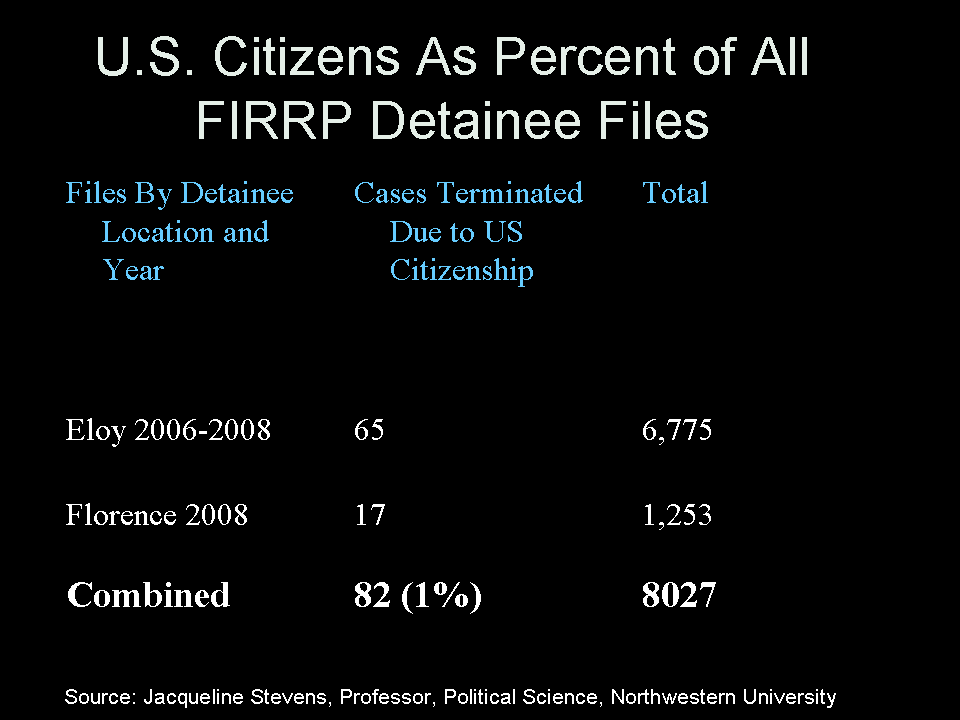
From 2006 to 2008 one percent of people in ICE detention centers in Southern Arizona who consulted with attorneys funded by the Department of Justice Legal Orientation Program had their cases terminated by immigration judges because they were U.S. citizens (82 out of 8,027).

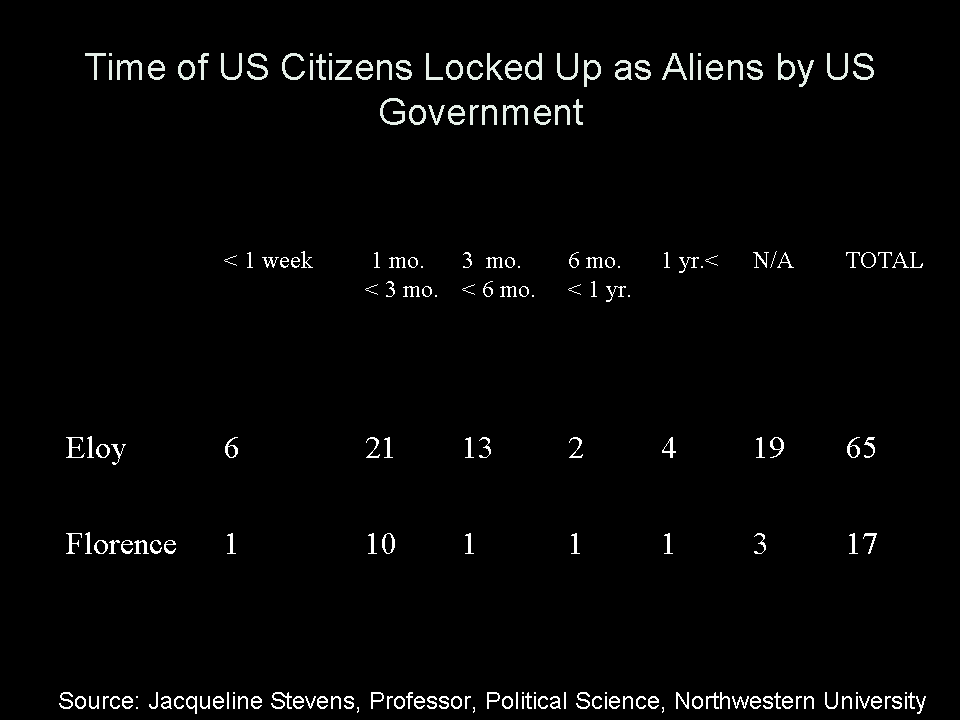
(For chart indicating length of time U.S. citizens held in Arizona jails please go here.)

Only a handful of detainees who were U.S. citizens in ICE detention had been convicted of violent crimes; the majority were reported to ICE while serving sentences for drug convictions.

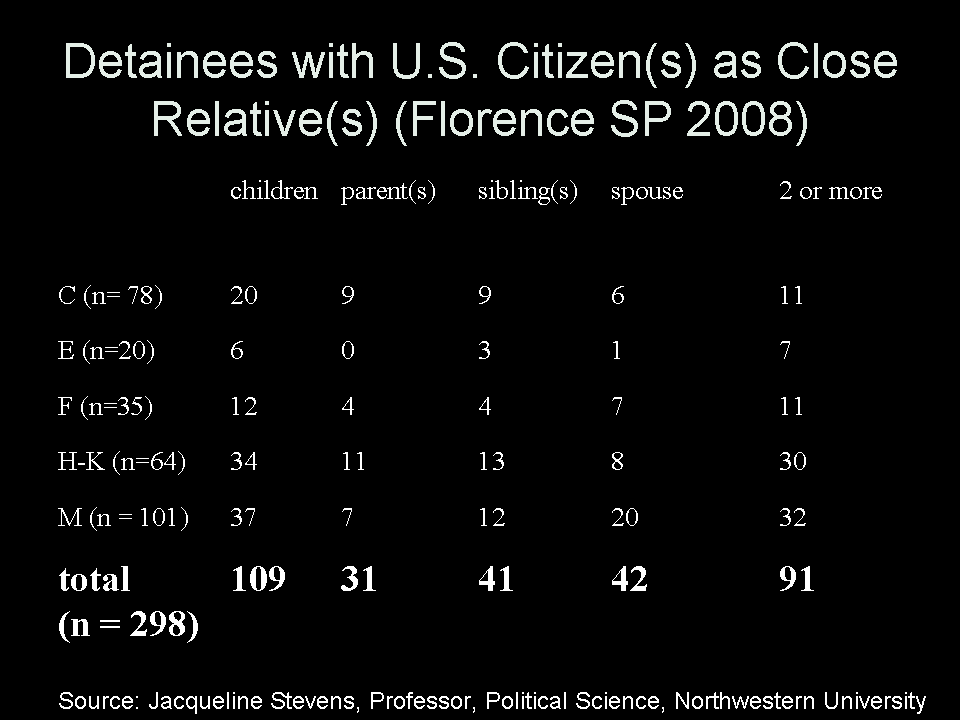
This population of Southern Arizona detainees for the most part originates in California prisons and jails, and accounts for approximately 10 per cent of all detainees nationwide; it appears to be broadly representative of people held in other detention centers. About 30% of the people detained who were not U.S. citizens nonetheless had two or more close relatives who were U.S. citizens.

A 2009 report by the City Bar Justice Center's NYC Know Your Rights Project noted that eight per cent of people who were held in the Varick Detention when they conducted a survey had apparently valid claims to U.S. citizenship.

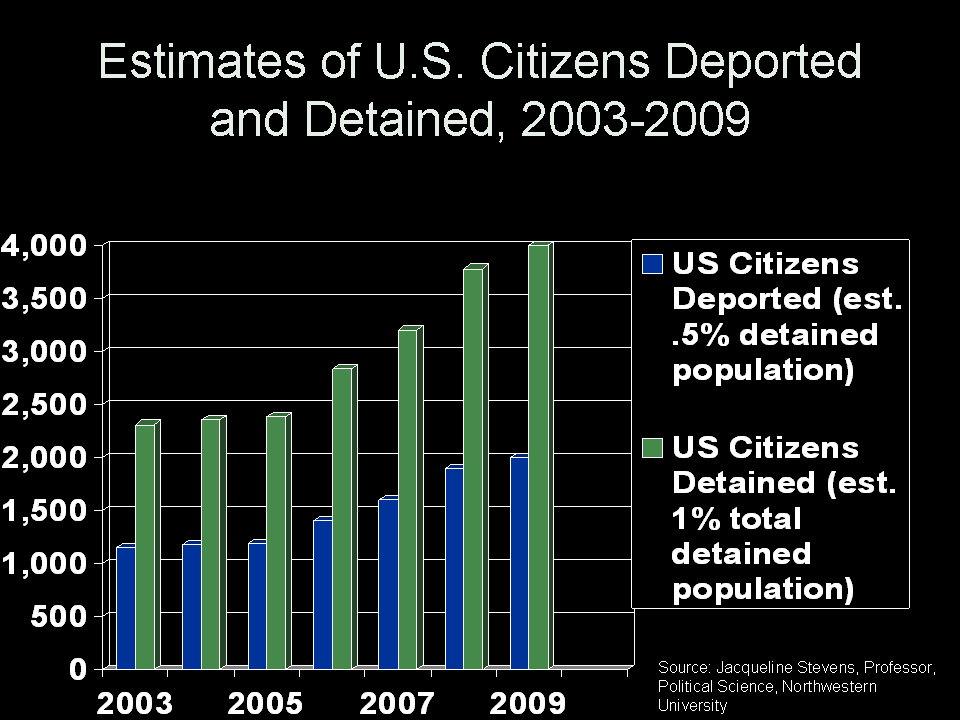
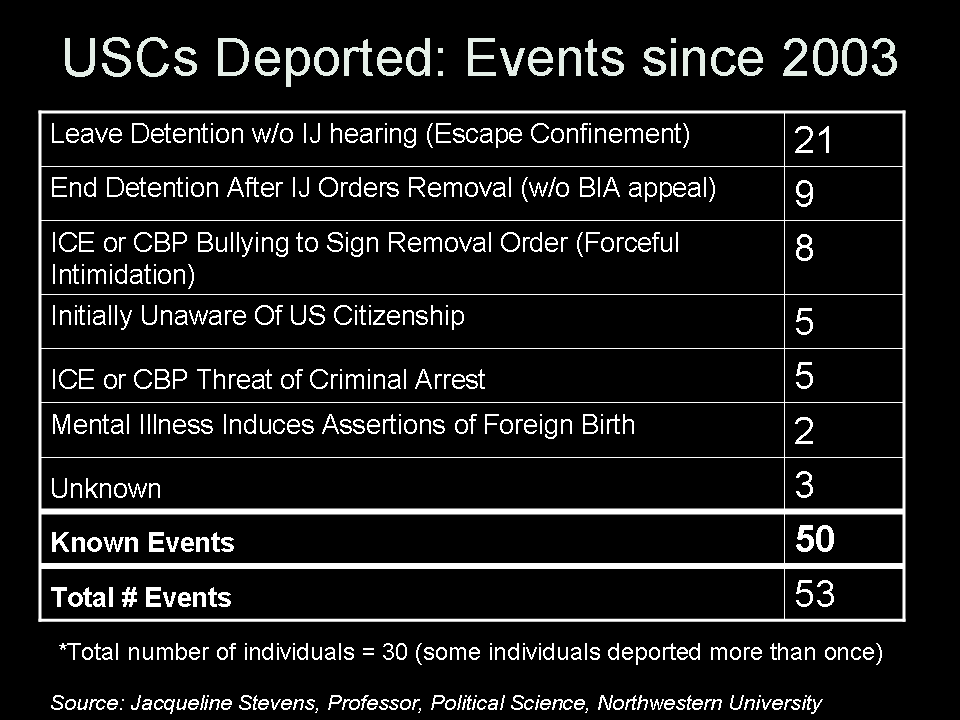
Last year ICE held over 400,000 individuals, including approximately 4,000 U.S. citizens. (See chart for 2003 to 2009.)

RECENT EVENTS
ICE public affairs and other officers are claiming that a November 19, 2009 memorandum issued by ICE Assistant Secretary John Morton has addressed successfully the problem of ICE detaining U.S. citizens.

Far from being evidence of ICE cleaning up its act, such statements to members of Congress and the press are further evidence of government malfeasance and deceptions. As recently as June, 2010, Mr. Luis Delgado, born in Houston, was threatened with prison and turned back to Reynosa, Mexico at the same border crossing where Mr. Mark Lyttle was twice turned away 18 months earlier.

In a June, 2010 response to my request under the FOIA, an ICE FOIA officer told me he had received a CD with over 4,000 pages of email traffic to its email "drop box" between November 19, 2009 and March 29, 2010. He reviewed and mailed a hard copy of the most recent 100 pages at the time (March 17 - 29, 2010). The reports redact the legal response advised by ICE Headquarters.

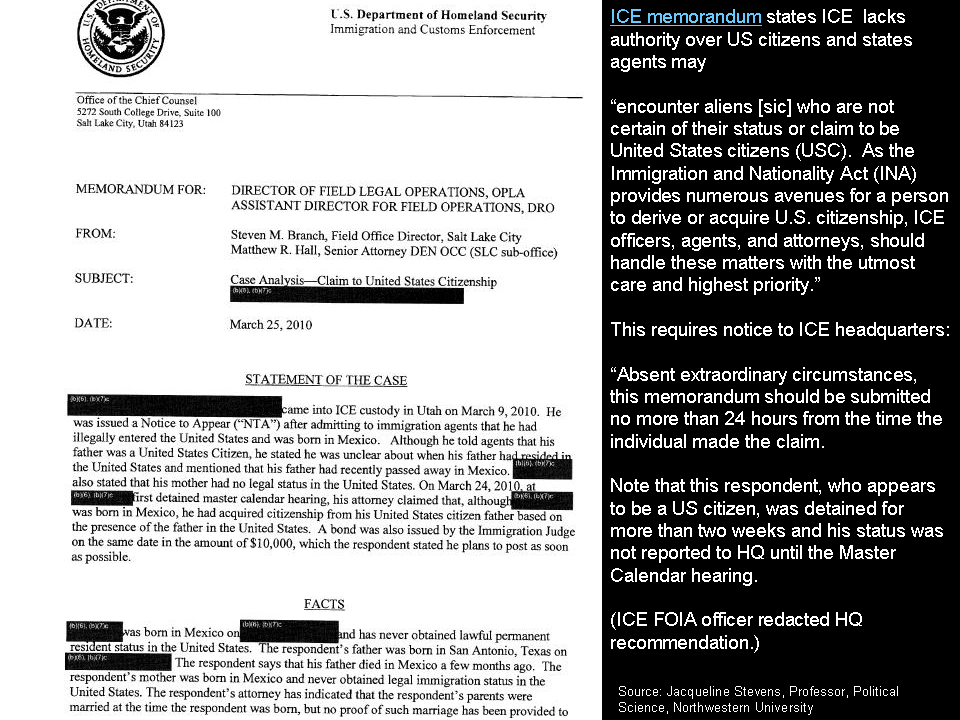
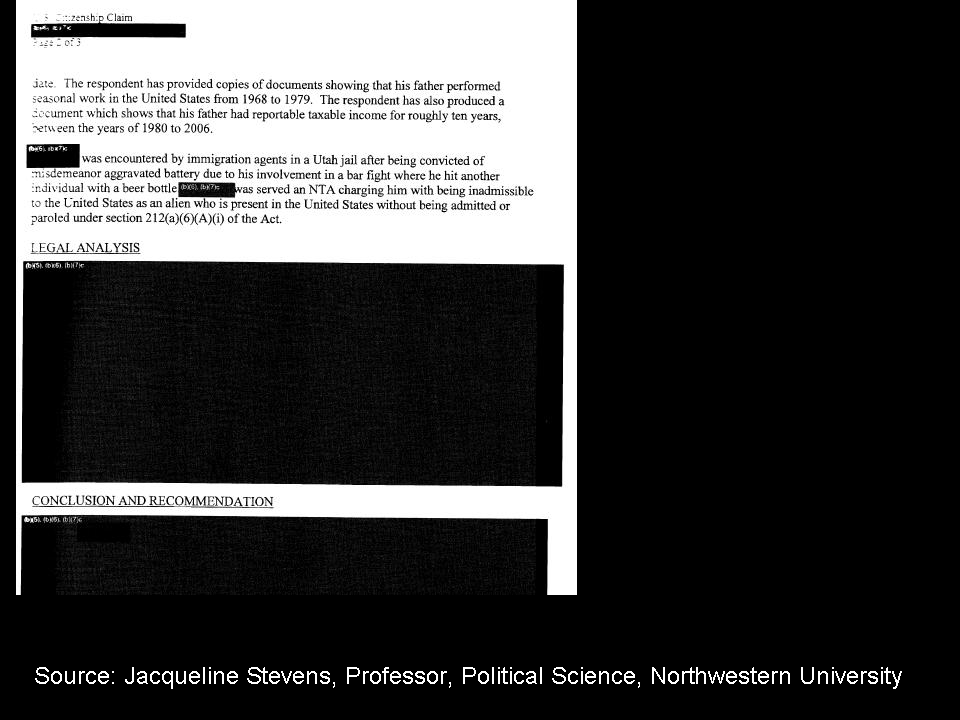
Two inferences are obvious from the documents I received: 1) ICE agents are demonstrably violating the 24 hour requirement by days and even weeks; 2)ICE continues to lock up people with probative evidence of U.S. citizenship.

For an ICE memorandum pertaining to someone claiming US citizenship and held in March, 2010 in violation of ICE procedures and US law, please see PAGE ONE and PAGE TWO.

Also, ICE has not insured its agents know about the new procedures. Therefore the inquiries of the drop box are understating the actual number of cases of detainees who have probative evidence of U.S. citizenship.

In January, 2010 I called a Florence, Arizona deportation officer to find out if Joseph Anderson's original birth certificate (with his USC father's name on it and a recording noting marriage to Joseph's mother as well as noting Joseph's birth as "legitimate") were "probative evidence" of his US citizenship. The deportation officer had no idea what I was talking about and stated he had not heard of this memorandum.

He gave me his email address and I forwarded the ICE memorandum I'd obtain under the FOIA. (After I posted it on my website, ICE posted the Morton memorandum on its website.)

(Mr. Anderson's been locked up in ICE custody at the Pinal County Jail for over two years.) Herbert Flores-Torres, a U.S. citizen, had to endure detention for over four years before ICE complied with the order of a federal judge to recognize his U.S. citizenship and release him. This occurred in December, 2009.

Mr. Anderson told me that when ICE first picked him up, the agent in the Phoenix office told him that the agent didn't know the meaning of "legitimate" in immigration law and was therefore going to detain him.

DEPORTED U.S. CITIZENS
In the 30 cases I have documented in which the U.S. government actually deported U.S. citizens (this does not include the events associated with the recent deportation reported in the Houston Chronicle), the most common factors were U.S. citizens falsely indicating alienage to escape detention, ICE deportation officer threats, and CBP threats and destroying valid legal identification. This has meant years of exile and statelessness (see, e.g., Johann Francis).

-Among the cases I reviewed since 2003 were 19 U.S. citizens who were deported and served prison sentences after being convicted of Personation of a U.S. Citizen (18 U.S.C. 911) or Illegal Reentry (8 U.S.C. 1362), crimes predicated on alienage.

The similarity of the underlying fact patterns in these cases, and their consistency with practices that pervade ICE offices, indicate that the phenonomenon of deporting U.S. citizens is underreported, especially because the government can make it so difficult to falsify the incorrect assignment of alienage.

For instance, on his return from Guatemala after obtaining a U.S. passport through the U.S. Embasssy in Guatemala City, CBP and ICE officials arrested Mr. Lyttle at the Atlanta airport and completed Expedited Removal forms as they, in collaboration with ICE trial attorneys, attempted to deport Mr. Lyttle to Mexico for a fourth time (he was deported twice after he tried re-entering from Mexico).

(For previous reporting on the pattern of CBP tearing up or disregarding U.S. government documents presented by U.S. citizens of apparent Mexican descent, please go here.)

- Nationwide data indicating ICE is holding U.S. citizens include: independent reports from two immigration judges; a 2010 Master Calendar hearing of 105 individuals I observed, which included one U.S. citizen; a survey of pro bono immigration firms listed on a DOJ website for Southern California--in response to inquiries of 15 firms in 2008, 7 replied they had represented one to four U.S. citizens in the last three years.

-Representativeness of Southern Arizona data: The Arizona data may understate the denominator because people who are truly hopeless about their legal status may not meet with the LOP attorneys; but the Arizona data may also understate the total number of U.S. citizens in ICE custody because U.S. citizens are more likely to obtain their own private attorneys and thus would be less likely to meet with LOP attorneys and initiate a file on their cases.


FINDING #2

Immigration courts are run by an agency, the EOIR, whose practices and policies, including unwritten ones restricting access to the courts, are rooted in cronyism and paranoia. EOIR staff nationwide vary in their efforts to follow immigration hearing laws and regulations. Respondents are at the mercy of this decentralized system. The legal counsel at the EOIR headquarters in Falls Church, Virginia have violated FOIA laws, rebuffed inquiries from independent researchers and journalists, and ignored clear evidence of misconduct by EOIR attorneys running the immigration hearings.

William Cassidy and Dan Pelletier, who run hearings for those detained at the Stewart Detention Center, have, according to TRAC at Syracuse University, the highest rate of deportations nationwide and are regularly violating the laws, regulations, and rules for immigration hearings. This incentivizes U.S. citizens, legal residents, and immigrants to give up on legal claims to remain in the United States.

EXAMPLES:

No Check to Ensure Respondents Receive Copy of Government Charging Documents.

If ICE actually allows someone to appeal a removal order by going to an immigration court, a federal regulation requires that the government's basis for seeking removal is shared with the respondent. The first thing that the vast majority of immigration judges do at a Master Calendar hearing is ask the respondents at the hearings if they received this. Judges are also supposed to review the charging document and make sure the respondent has this.

Mr. Cassidy and Mr. Pelletier demonstrably do not do this. Instead, at hearings I have attended and in recordings to which I have listened, the judges TELL the respondents that they were served a "Notice to Appear," a phrase that is itself utterly meaningless. Indeed, one individual, who had been alerted by his attorney about the legal problem of not receiving a Notice to Appear, tried to tell the judge that he had not received this. In this case and others when respondents made inquiries of Mr. Pelletier he ignored their questions and, over the television monitor, barked the next name.

At one hearing that was supposedly a "mass removal" -- everyone has supposedly agreed in advance to be deported and just raises their hands in front of a camera (of course many just sit still with arms folded and show no indication of agreeing with anything Mr. Pelletier is saying on the television screen) -- immediately after Mr. Pelletier adjourned the hearing, several longterm U.S. residents asked the CCA guard when they were going to talk to the judge. The guard ignored the question and was trying to escort them out of the room to lunch. The detainees explained their plight to me and I alerted the ICE trial attorney who requested the judge resume the hearings. It was too late for one detainee who was already outside the court room. I believe that if I had not been present none of them would have spoken with the judge.

Inadequate and Misleading Bond Information.

A key reason people agree to deportation is because they want to escape detention centers. Many are eligible for bond but do not realize this because their deportation officers lie to them and they do not know how to request bond hearings of the EOIR.

Even if they do request a bond hearing, no regulation guarantees this will occur in a timely fashion. Two attorneys who represent clients in the Stewart Detention Center told me of bond hearings being frequently canceled.

At the Eloy Detention Center in southern Arizona, an EOIR attorney presiding over hearings, Mr. Richard Phelps (appointed during the Monica Goodling era), allows those who are resourceful enough to pursue a bond hearing, to hear his TAPE RECORDED INSTRUCTIONS. Following the recording, which is largely incomprehensible to anyone without immigration law training (and concludes with his chit-chat with someone helping him with the recording), the detainees ask questions of the CCA guard prior to Mr. Phelps returning to the court room where he impatiently brushes off the respondents' inquiries.

I encountered one individual who was awaiting a hearing on his green card application following the marriage to his U.S. citizen wife; he had overstayed a tourist visa and had no criminal history. It took three months before he was able to navigate his release on the minimum $1500 bond, an indication of unnecessary detention that cost not only his freedom but also the U.S. taxpayers approximately $9,000.

These experiences encourage U.S. citizens, legal residents, and immigrants to agree to deportation rather than endure the harsh and arbitrary conditions of detention and U.S. immigration courts.

Secret Evidence.
On December 8, 2008, William Cassidy encountered in Mr. Lyttle's "alien file" the ICE arrest report (I-213) showing his claim to be born in North Carolina. As is the case for other EOIR files I have examined, it lacks a "certificate of service" indicating that ICE shared it with Mr. Lyttle, a violation of 8 C.F.R. § 1003.32. During the hearing, Mr. Lyttle asked Mr. Cassidy for a copy of the paper he was reading. Normally a judge will order the ICE attorney to make a copy, but neither the ICE attorney nor the judge did this. Following the judge ignoring his entreaties, Mr. Lyttle filed a grievance requesting a copy of the I-213 but never received it.

I recently obtained an EOIR file for another respondent who appeared in the Stewart Detention Center immigration courts in 2010. It also contains what appears to be deliberately falsified information on an I-213 report that was never shared with the respondent. Mr. Pelletier, the EOIR attorney who presided over the hearing, did not require that the ICE attorney share a copy with the respondent.

Based on my own observations and conversations with practitioners in the area I believe that every EOIR file for those who are in ICE custody and have their hearings at Stewart or Atlata contains I-213s that have not been shared with respondents.

Unlawfully Closed Hearings.
A DOJ regulation states that, specific exceptions notwithstanding, "All hearings, other than exclusion hearings, shall be open to the public..." The EOIR regularly violates this rule by holding hearings in several detention centers where security guards block access. The EOIR also allows immigration judges to close hearings in non-detained buildings without legal reason or penalty. (You can read about this in The Nation and more recent postings about the EOIR on my blog.)

Mr. Cassidy and Cynthia Long, the court administrator in Atlanta, Georgia, have incorrectly told court watchers that a docket listed asylum hearings and therefore they could not attend when the truth was that the docket a) did not include asylum hearings; and b) asylum hearings are only closed at the request of the respondent. This provision is to ensure foreign agents do not retaliate against family members in a respondent's home country. It is a cruel abuse to lie and use the regulation for the purpose of obstructing access to hearings by religious, pro-immigrant observers who want to keep an eye on Mr. Cassidy, a former ICE prosecutor who has one of the highest rates of asylum denial in the country.

The Department of Justice Executive Office of Immigration Review is charged with managing immigration hearings, but its staff in Washington, D.C. also regularly violate federal laws, regulations and rules designed to thwart misconduct. I will be describing these in more detail in a forthcoming article.

Conclusion.
The criminal and regulatory violations perpetrated by the DHS and EOIR vastly overshadow the small infractions of immigration law for which the deportation agencies and their increasingly costly budgets were established.

The government has reporting systems in place that would allow it to systematically track the rate at which deportation orders are terminated because of U.S. citizenship, but ignore Congressional inquiries and fail to collect the requested data. (This could be done easily through by EOIR, if it reported findings of nationality in its Statistical Yearbooks as reported by immigration judges and not ICE attorneys. At present the EOIR's Statistical Yearbook inaccurately lists respondents who are U.S. citizens as having the nationalities ICE ascribes to them and is another indication of the EOIR's poor record-keeping and lack of independence.)

A further problem is that the agency at the DOJ that is supposed to oversee the EOIR, the Office of Professional Responsibility (OPR), is infected by a similar culture. Like the EOIR, OPR is being run by an Acting Director, Mary Patrice Brown, who is a career civil servant. Brown is on leave from her position as a U.S. attorney.

According to the Washington Post's WhoRunsGov.com, Brown has close ties to Attorney General Eric Holder and is rumored to be in line for a position as a federal judge. Brown's appointment seems designed to prevent the OPR from performing as an independent watch dog within DOJ. The OPR is clearly violating the FOIA statute -- in violation of an April 2010 remand from the DOJ Office of Information Policy OPR will not release reports of immigration judge misconduct -- and is so secretive that it refuses to release its 2009 Annual Report.

SOLUTION:

The only way to protect the rights of U.S. citizens and legal residents is to provide an assigned attorney at government expense to anyone arrested by ICE and either held in detention or issued an Expedited Removal Order or an Administrative Removal Order who cannot afford an attorney. Absent this, it is impossible to check the abuses of discretion as well as law-breaking by ICE and border patrol agents.

Expensive? Yes, just as assigned attorneys for indigent people accused of crimes is also costly. This is the cost of doing the nasty business of implementing deportation laws.

If the U.S. public truly wanted to save money, increase jobs, and give a shot to the housing market to boot, it could abandon this parochial cause, as will surely occur eventually. This might seem far-fetched, but not as far-fetched as requiring government documents to travel from the villages to London, or to move within the colonies, as also was deemed imperative for order, the unregulated movement of poor people regarded as a clear threat to stability. Such a policy, once relinquished, now seems a provincial and ridiculous restraint on freedom and justice, not to mention commerce, as will the restriction on movement among countries appear to populations in a few hundred years.

Postscript: In May, 2010 a settlement agreement was reached in which the U.S. government agreed to pay $350,000 to a trust fund for Peter Guzman and his mother because Mr. Guzman was born in Los Angeles and in 2007 the U.S. government deported him. (The agreement has not been finalized by the judge but appears to be on track for this to occur shortly.)

--RSS Subscribers: you received two messages because of time-stamp problem on first one. My apologies for the confusion. (If you are not using the RSS and would like to be notified of new posts on this blog, please click on orange box in right-hand corner of url box.)

Monday, June 28, 2010

U.S. Citizens Detained and Deported: 2010 Fact Sheet

FACT SHEET ON THE U.S. GOVERNMENT

DETAINING AND DEPORTING U.S. CITIZENS

....

July 15, 2010: There was a time-stamp problem. The post for this title is here.

Apologies for any confusion!


Monday, June 16, 2008

Thousands of US Citizens Held or Deported by ICE: Documenting their Cases, Part I


In the article "Thin ICE" published in The Nation magazine (pub. date June 23, 2008), I wrote that since 2004 between 3,500 to 10,000 US citizens had been detained by ICE for one month to five years, and that about half of these citizens had been deported. I also wrote that I had documented 31 of these cases. I have now revised these numbers upward, based on new information on additional cases.

These figures are important because they refute ICE's position that they have deported just one US citizen and that they "do not knowingly detain US citizens." By knowingly detaining US citizens, over whom ICE has no jurisdiction, ICE agents are committing the crime of false imprisonment. When they move US citizens, especially out of the country, against their will, then ICE agents are committing the crime of kidnapping. The attorneys for the people involved have the data from the immigration courts, the prisons, and the documents to back this up. All that is needed is for just a single US attorney to step forward and use this information for a criminal prosecution.

For instance, the case of Neil Rambana's client in Georgia, at the very least has an immigration judge postdating a 2006 order terminating removal proceedings for a US citizen to a 2008 termination order, apparently to justify the continuous illegal incarceration of a US citizen since 2006. He remains incarcerated. (For more on this case, see here and articles tagged David.)

Starting today I will be providing more information on the many cases whose details could not be presented in the Nation article due to space constraints. If anyone wants more information to follow up with the attorneys, please contact me and I can provide that.

There are three types of natural-born citizens, distinct from naturalized citizens. The cases below are all US natural-born citizens, either by birth in the US, or acquired or derived from parents who are US citizens, as was the case for John McCain and George Romney. ICE has no jurisdiction over US citizens.

Under the law anyone telling ICE she was born in the US is presumed to be a US citizen. In order to detain this person, ICE must prove the person is lying. This did not happen in these cases. As you read these, many questions will occur. (For instance, in the case below, why would a police officer write down that someone born in the US was born in Belize?) At some point it may be important to answer these questions--are officers harassing difficult suspects by the use of incorrect place of birth information, knowing this will put people in ICE detention? Are officers racist and trying to deport African-Americans?) The only way to get to the bottom of this is through more local police oversight, Congressional oversight, and, when necessary, civil and criminal prosecutions.

Other cases, with pseudonyms for purpose of easier discussion:

-Eva, Los Angeles resident, African-American woman born in the United States (state unknown) and arrested in February 2008, for a minor drug possession charge. The arresting officer wrote that Eva was born in Belize. Eva has never been to Belize. She was put in ICE custody and taken to the Florence Detention Center in Arizona, where she was held for two months as she saved $1 day from working in the detention center to pay for her birth certificate. (Source: Florence Immigration and Refugee Rights Program social worker)

-MarK, Washington state resident, California-born US citizens. Mark was stopped for minor criminal activity and turned over to ICE. Mark had moved from California to Washington when he was three years old. The ICE agent did not believe this statement and, without any proof, wrote that Mark had emigrated from Mexico to the U.S. when he was three. Mark had never stepped foot in Mexico until he was 20. Mark was was held in Takoma and somewhere in Alabama for a total of 9 months. Even though there were no legal grounds for his detention, he was not released until a court hearing, when his pro bono attorney presented Mark's California vaccination records from when Mark was two. The attorney believes that if his mother had not been able to produce this record, then his client would have been deported. No birth certificate was avaialable because Mark's mother was not in the country legally and, fearful of deportation, gave birth in a private home. (Source: (Source: Jorge Barón, Executive Director, Northwest Immigrant Rights Project [NIRP])

-Jason, U.S. citizenship derived from parents who naturalized before he was 18. Born in Belize. Held in detention in California (Mira Loma, I think) for two months after release from prison. (Source: private immigration attorney, Los Angeles).

-John, U.S. citizenship derived from parents who had naturalized before he was 18. Born in Ethiopia. Detained in Takoma over 6 months, NIRP only found out because a self-styled jailhouse lawyer/detainee brought this case to their attention. (Source: Barón, NIRP)

-Michael, U.S. citizenship derived from mother who naturalized before he was 18. Michael was born in Mexico. Michael was held by ICE for four years during his appeals. The FIRRP attorney advising him, but without the time to appear with him during the hearings, was stunned to learn that the judge did not accept the evidence her staff had assembled that clearly documented his US citizenship. Rather than endure more time in Eloy, after four years Michael gave up and signed the deportation order and was removed to Mexico before the FIRRP attorney could see him again.

TO BE CONTINUED!
The image above is from a 2007 protest against the Takoma Detention Center, where Mark and John, US natural-born citizens, were held for several months. See article at Indymedia, Portland here.

Thursday, March 27, 2008

Rep. Steve King's (R-IA) Crime Control: Deport Native-Born Men

I was just listening to Steven King, the minority member on the House Judiciary Subcommittee on Immigration, Citizenship, Refugees, Border Security, and International Law suggest that although it was a shame that Peter Guzman's mother had to go through the morgues of Tijuana looking for him, relatives in the United States have to go to the morgues, too:
I would point out there are mothers, fathers, brothers, sisters that go to morgues every day in America because of the failure to enforce immigration laws. 27% of inmates in penitentiaries are criminal aliens.

At least as outrageous as trying to downplay the desperation and horror of a mother searching for her U.S.-born, cognitively impaired son in Tijuana morgues, is the insinuation that criminals are more likely to be foreign born than U.S. natives.

Only a small percentage of the total prison population are in federal institutions. Most are held in state and local prisons or jails. According to the Department of Justice, 6.7% of the entire prison population is foreign-born, but about 13% of the U.S. population is foreign-born. This means that King's own demographic of the native born is overrepresented in the prison population.

Indeed an SSRC study using census data also found that within respective ethnic and racial groups, immigrants across the board were less likely than native born citizens to be incarcerated.
Considering that men are 90% of the prison population and that King is a man, perhaps his first step in controlling crime by statistical grandstanding would be to deport himself, maybe to a quiet, remedial math camp somewhere in Europe. (The man on the right in the photo from King's webpage is King.)

Friday, February 29, 2008

ACLU Sues DHS and Others for "Deportation" of Pedro/Peter Guzman


The ACLU complaint on behalf of Peter Guzman filed on February 27, 2008 provides the first clear statement of the activities leading to what the ACLU calls Guzman's "illegal deportation," but might be better viewed as plain and simple criminal kidnapping. What else to call an organized effort to remove someone from the state without their consent? According to the complaint, Guzman was delusional part of the time in custody. Before this occurred and Guzman gave information on his birthplace, the Sheriff's Department correctly recorded this as California.

The complaint provides the first detailed narrative of the U.S. government's failure to obtain Guzman's consent before putting him on a bus on May 11, 2007, without his wallet or California driver's license, and dropping him off in Tijuana, where he knew no one.

Based on the details of this document I am further convinced that the ACLU is being too easy on the government. An "illegal deportation" is an oxymoron, as is the much more common violation of the "illegal arrest." Both of these weight the intentions of state actors in a manner law does not afford private individuals. The actions associated with the "illegal arrest" and even more so for an "illegal deportation" are indistinguishable from kidnapping, which really is the crime (and not just civil claim) that the government should be charging Chertoff et al. with committing. (For an explanation of why Guzman's forcible removal against his will from the USA meets the criteria of kidnapping, read this posting, based on the initial habeas complaint.)

If the state is acting against the law then the putative purpose claimed as the motive for that behavior, i.e., executing the law, is not relevant to defining the state's actions. If a law is not executed lawfully then these actions are not furthering the execution of the law and should be assessed on their own merits.

If I am trying to feed my family and steal food to accomplish that, I am not charged with "illegal caregiving," but theft. If I am unable to accomplish my benign purpose of assisting Mexicans excluded from the U.S. and I drive them into the USA, I am not charged with "illegal job support" but human trafficking.

In other words, state actors should be held accountable for the egregious actions that it commits against people in violation of all of the laws. When a failed execution of a law occurs, then the actions done on its behalf should receive no special protections because they were done by state actors. Indeed, if anything, the scrutiny and punishment of these illegal actions should be much more severe than that directed against private individuals, precisely because of the power these people wield.

Tuesday, August 14, 2007

The Memorandum of Understanding in Action: How L.A. County Jails Screen for Criminal Aliens

I had a very enlightening conversation this morning with Sergent Lightle, who supervises the Classification program in the L.A. County jails. INS has had a Memorandum of Understanding allowing it to train and supervise L.A. County Sheriff employees to screen for undocumented aliens since 2005, although Sergent Lightle said that the INS has been in the jails since 1985.

In the period from January 31, 2006 to August 10, 2007, INS Custody Assistants had interviewed 13,598 inmates who were being released and issued holds on 7,391. These 7,391 could either agree to be removed to their country of origin or request a hearing to appeal this decision. Sergent Lightle did not know the total number of inmates released since January 31, 2006, but since at any given point there are 20,000 inmates, the number actually interviewed would seem to be a small fraction of the total number released.

The question raised by Pedro Guzman's case, a U.S. citizen by birth who was mistakenly deported, is how inmates are selected for these interviews. According to Sargent Lightle, there are three avenues that would lead to an interview. First, the inmate might have self-declared as an alien. An interview would examine whether he or she had legal documentation for residence in the United States. Second, an inmate's fingerprints might produce a match with the those of a known alien based on the FBI's Law Enforcement Fingerprint Database. Or third, and what must have happened with Pedro Guzman (who did not volunteer he was foreign-born before his interview), the Custody Assistant based on a perusal of the inmate's folder, can decide to interview the inmate.

"What in the folder might trigger an officer's interest?" I asked. Sargent Lightle said "whatever criteria they [the custody assistants] select." I wondered if there was a manual that might tell them what to look for. Sargent Lightle said she did not know of such a manual and said that the criteria would come from their training in immigration law by Immigration and Custom Enforcement (ICE)(more on them later). Ethnic profiling is clearly one of the factors Figueras was considering when she decided to interview Guzman, but it couldn't be the only one. Most Latinos born in the United Stated are not selected by custody assistants for an interview.

Once identified for an interview, Sargent Lightle said, the Custody Assistant might request the inmate be held by INS if they "don't speak a word of English and can't answer questions that someone born in the United States could answer in Spanish." Sargent Lightle emphasized that for those who seem to be from Mexico, the whole interview would be done in Spanish." Of course there are many other reasons that someone might not be able to answer questions that most people born in the United States can answer, including mental disabilities. If the INS questions cannot distinguish between people who are mentally disabled (or simply poor civics students) and people who are non-citizens, and if these interviews are the basis for deportation, then this means that the INS may be guilty of kidnapping.

Sargent Lightle did clear up one question that I've been wondering about. As we all know from Paris Hilton's adventure, virtually no one receiving a sentence for time in the L.A. County jails serves the entire sentence. Instead the Sheriff has a number of criteria for early release. Was one of these being identified as an illegal alien? (And therefore, might inmates strategically misstate their nationality in order to be released early and then return to the United States, as has happened in at least one case?) It turns out the answer to this question for the L.A. County jails is no, meaning that Pedro Guzman had no incentive to lie about his country of origin.

One final question that Sargent Lightle was not able to answer: why was the order to hold Pedro Guzman sent to an inn in Colorado instead of the L.A. County Jails, where he was being held? She said that she was not allowed to comment on the Guzman case because of pending litigation, and that any orders for a hold would be the responsibility of the INS.

Wednesday, August 8, 2007

L.A. County Jail Deputy Blames INS for Pedro Guzman's Deportation

Last week, before Pedro Guzman was allowed to enter his homeland, I called the L.A. County Jail to see if I could learn more about the procedures leading to a deportation.

All the legal filings from the government in response to the ACLU lawsuit refer to the screening procedures in the passive voice, i.e., "subject was encountered at L.A. County Jail by Custody Assistant Sandra Figueras as part of routine assigned duties to interview suspected criminal aliens" (from the June 13, 2007 Petitioner's Reply in Support of Ex Parte Application for Temporary Restraining Order). But there is no information as to the substance of these routine duties that would lead to such an encounter.

According to the ACLU, Pedro Guzman was singled out because of race. Either there are rules for profiling in place that the jail followed to initiate the interview with the INS that led to Guzman's confusion and deportation, or this occurred in an ad hoc fashion in violation of the jail rules. Which was it?

Before turning to the interview, a little background: In 2005 the Los Angeles County Jails entered into a Memorandum of Understanding with the Department of Homeland Security, allowing it to train some of its deputies to assist as INS agents in screening and detaining criminal aliens for deportation from the county jail. Sandra Figueras was one of those employees.

The Deputy I spoke to was very forthcoming about the jail procedures, explaining that when inmates are booked they're asked to identify their birthplace. If it's outside the United States, then the jail contacts the INS for an interview to ascertain their legal status. However, it's clear from all the records that Guzman initially identified his birthplace as California, so there would be no reason for the jail to initiate Guzman's INS interview.

I pressed the deputy a bit, asking if they did any screening on their own to ascertain if arrestees lied about their birthplace. He told me that they protect against this through consulting earlier records when the "roll" the arrestees for fingerprints, but if there's nothing there, then they would never call the INS: "We don't do background checks. We just process inmates here. We don't waste our time on that; we don't intervene in any way, unless we see someone who says they're born outside the country."

I then asked if he was familiar with Guzman's deportation--again this was last week--and he was not, so I gave him a summary and asked how Guzman would have come to the attention of the INS. He told me that the INS agents in the jail do their own screenings and he didn't know how those worked. When I told him that Guzman definitely was born in the United States and his mother had the birth certificate to prove it, he said, "That would have been their foul up. The family should have had the opportunity to bring in a birth certificate and clear things up."

This is obviously true, and underlined by the fact that all of the Guzman's documents in his criminal record indicate that he was born in California. Indeed, if the judge who sentenced Guzman to 90 days in jail on April 19, 2007 had the slightest idea that Guzman would be deported as a criminal alien he would not also have sentenced Guzman to 3 years probation, and the state would not have issued a warrant for his arrest for missing the probation hearing, which, ironically, appears to be why the DHS finally allowed him back into the country. In other words, there was plenty of information available to any interested parties that would indicate Guzman's nationality.

In reflecting about the above confusion over the missed probation hearings--why wouldn't the L.A. Sheriff process the paperwork indicating Guzman had been deported, which would render the probation hearings moot?--it seems possible that the incorrectly addressed "Immigration Detainer--Notice of Action" issued by Sandra Figueras on April 26 could be the culprit. Perhaps absent this piece of paperwork, inexplicably addressed to an inn in Colorado with which Guzman had no connection and which knew nothing of Guzman, it was easier for L.A. jail to drop the ball when it came to tracking Guzman's legal whereabouts. Again, hard to know because the DHS is not talking.

(Believe me, I tried. No one in the Santa Ana Detention and Removal office would answer the first question: "how do the INS agents in the jails decide whom to interview?" even though these are the folks making these decisions. They did not refuse to answer the question but the passed me around to numerous people until a gentleman named Leo said he had to ask his supervisor about speaking to me, and then left me on hold for 15 minutes, at which point I hung up and called back. At that point, all the numbers I had been given had turned on their voice mail. )

In any case, it's not surprising that this happened, given that the DHS is recruiting from...Craigslist. The heading from the L.A. posting for August 1, 2007 says, "TAKE CHARGE OF YOUR CAREER PROTECTING AMERICA’S BORDERS" and tells potential applicants they can look forward to working in an "exciting environment with wide-open spaces..." Perhaps it was someone responding to one of these ads who ignored the alerts the DHS sent to its field offices telling them to allow Guzman into the country if he presented himself and turned him away, back into Mexico. Maybe they were surfing for used ping-pong tables.

Pedro Guzman Detained in Colorado Inn

Pedro Guzman is not the only one with an interesting story we have yet to hear (for previous postings, click on Guzman tag at bottom). ICE and their minions in the L.A. County jail need to come forward with a much better story about what happened than the one they've been sticking to so far, which is that Guzman said he was born in Mexico and requested to be sent there.

Among the many questions that deserve answers: why did the L.A. Custody Assistant routing Guzman out of the country address the Immigration Detention notice to "1st Choice Inns" in Glenwood Springs, Colorado?

This notice is generally sent to law enforcement agencies by the INS. The INS, often illegally, instructs jails and prisons to hold those suspected of being in the USA without documentation until the inmate is taken into custody by the INS.

This particular form for Pedro Guzman tells the addressee, which presumably should have been the L.A. County Jail, to "detain the alien...to provide adequate time for the INS to assume custody"; to "Notify this office of the time of release at least 30 days prior to release or as far in advance as possible"; and to "Notify this office in the event of the inmate's death or transfer to another institution."

Perhaps, I thought, 1st Choice Inns rents out space as a holding facility for the County jails or DHS. Perhaps one result of the new privatization of the government is that misidentified criminal aliens are sent to inns. So I looked up 1st Choice Inns online and gave them a call.

I asked to speak to a manager. The person who answered the phone identified herself as Natalie in Accounting and was very happy to answer my questions. According to her the Inn has never had any contracts with any government agency to house anyone. "We just wouldn't be prepared for that sort of thing," she said. I told her about the notice I was looking at, addressed to them and she confirmed the address and said she did not recall receiving such a notice and that if she had she probably would have thrown it away.

If this is just some sort of clerical error by the Sheriff's Department then at best it is a sign that they are sloppy in general and in the particulars of this case.

The DHS is not offering any explanation beyond their court filings. More on what the L.A. County Sheriff told me soon.

Tuesday, August 7, 2007

Pedro Guzman, Welcome Home!

According to an AP story, Pedro Guzman
"ate out of garbage cans, bathed in rivers and was repeatedly turned away by U.S. border agents when he tried to return to California, his family said Tuesday. Pedro Guzman, 29, was picked up at the Calexico border crossing over the weekend and released to his family on Tuesday. Guzman was shaking, stuttering and appeared traumatized, his family said at a news conference. The family said it planned to seek medical attention for Guzman, who was not at the news conference. 'They took him whole, but only returned half of him to me,' his mother, Maria Carbajal, said in Spanish while crying. 'The government is responsible for this.'"

He apparently had several encounters with border guards but despite the Department of Homeland Security alert to be looking for Guzman and allow him entry, he had been turned away from his homeland on several occasions.

There still is no clear narrative from Guzman about what exactly happened during his deportation interview. I'll be posting more on this tomorrow.

Tuesday, July 17, 2007

Best Reporting on Pedro Guzman Deportation

Daniel Hernandez of the LA Weekly has been to Tijuana with Pedro Guzman's mother and spent time with his family in Lancaster. Here's an excerpt:
“They say, ‘Oh, I’ve seen him, I’ve seen him, I’ll come back.’ And they never come back,” says Maria Carbajal, 49, in Spanish. It’s a Wednesday in June, one of several times I am with Carbajal on her search. “Look, here are some alleys. There are two guys there lying down. Let’s go look.”....In the news, Guzman’s case sounded like a real-life version of the 1987 Cheech Marin movie Born in East L.A., in which Marin’s character is accidentally deported and spends most of the film comically searching for a return home from Tijuana. But it wasn’t the first time such a real and not-so-funny case had made the papers. In September 1977, a U.S. citizen named Daniel Cardona was wrongfully deported from Clovis, near Fresno. The L.A. Times reported in 1981: “The mentally-disturbed young man, who is unable to care for himself, wandered the streets of Tijuana for almost five months before his frantic family found him. He had to be hospitalized for two weeks before he was allowed back into the country.”

Hernadez's story points out the anguish the deportation is causing for Guzman's family, and also the persisting mystery of how this happened; it's a fascinating read. Hernandez writes that even the ACLU attorney given access to overseeing the Memorandum of Understanding allowing ICE to deport from the LA jails does not know the process for how this happens and, in the excerpt above, points out that a wrongful deportation occurred at least once, in 1977. Perhaps if more were known of the interview and statement signing process ICE oversees then Guzman's particular case would be less confusing. Image from "Born in East L.A." movie poster.

Sunday, July 15, 2007

If the ACLU is Right, Chertoff is Running a Kidnapping Ring

The legal briefs filed by both sides in the case of Guzman v. Chertoff et al., decided by Judge Dean Pregerson on June 14, 2007 present numerous disputes of fact and law. The initial brief authored on behalf of Pedro Guzman "by and through his next friend, Juan Carlos Chabes," a legal device to use his step-brother to sue because Guzman is missing, states three causes of action:

1) Violation of the Fifth and Fourteenth Amendments--"DHS's deportation of Pedro Guzman and its refusal to find him and return him to the United States violates Mr. Guzman's...rights to procedural and substantive due process and equal protection."
2) Violation of the Eighth Amendment--the DHS deportation "constitutes banishment in violation of the Eighth Amendment's prohibition against cruel or unusual punishment" (because punishment of citizens must take the form of fines or imprisonment, not exile).
3) Mandamus, when the courts order the Executive Branch to perform certain actions consistent with the intent of the law: "Respondents have a nondiscretionary duty not to deport United States citizens and to ensure their return if they are wrongfully deported."

The judge noted in his decision that because the DHS was recognizing Guzman as a citizen and because the circumstances of the deportation were not clear, he would not issue any findings against the DHS, including granting emergency relief, on the grounds that executive agencies' "decisions about how to allocate its on-the-ground human resources is quintessentially within such discretion." This is a judgment call, and while Pregerson cites cases making this point, other courts have made opposite determinations. I'll discuss the cases for both sides in another posting, but want to make a more basic observation about what seems to be really at stake in this case, whether Guzman was kidnapped.

As has been noted before here, the situation seems surreal, with the judge clearly disturbed by what happened and yet not buying the legal arguments advanced on Guzman's behalf. Perhaps this is because they are coming from specialists in immigration law and Guzman is not an immigrant. If Guzman was, as the brief claims, taken against his will and removed to another country, then this is first and foremost a kidnapping case. Treating it as a case involving violation of the immigration laws tacitly if not overtly accedes to the Government's prerogative to treat him as a wrongfully self-identified immigrant, as opposed to a citizen the government kidnapped and brought to Tijuana against his will. The ACLU is right to say that the government cannot deport citizens, but at least as importantly, the government cannot kidnap its citizens.

None of the immigration cases cited by the plaintiff are closely related to the facts the Guzman brief alleges, that of an individual whom the June 10, 2007 statement says is "developmentally disabled and has mental health problems" and who "did not knowingly and voluntarily authorize federal officials to deport him to Mexico." Perhaps the reason that the immigration decision seems "surreal" is that this is not an immigration case, but a potential kidnapping case and the Guzman family and their advocates might want to enlist a local prosecutor on Pedro Guzman's behalf.

California Penal Code section 207 defines kidnapping as follows:
a) Every person who forcibly, or by any other means of instilling fear, steals or takes, or holds, detains, or arrests any person in this state, and carries the person into another country, state, or county, or into another part of the same county, is guilty of kidnapping.

(b) Every person, who for the purpose of committing any act defined in Section 288, hires, persuades, entices, decoys, or seduces by false promises, misrepresentations, or the like, any child under the age of 14 years to go out of this country, state, or county, or into another part of the same county, is guilty of kidnapping.

(c) Every person who forcibly, or by any other means of instilling fear, takes or holds, detains, or arrests any person, with a design to take the person out of this state, without having established a claim, according to the laws of the United States, or of this state, or who hires, persuades, entices, decoys, or seduces by false promises, misrepresentations, or the like, any person to go out of this state, or to be taken or removed therefrom, for the purpose and with the intent to sell that person into slavery or involuntary servitude, or otherwise to employ that person for his or her own use, or to the use of another, without the free will and consent of that persuaded person, is guilty of kidnapping.

(d) Every person who, being out of this state, abducts or takes by force or fraud any person contrary to the law of the place where that act is committed, and brings, sends, or conveys that person within the limits of this state, and is afterwards found within the limits thereof, is guilty of kidnapping.

Because the Plaintiff's brief treated the DHS wrongdoing as a violation of Guzman's rights, and not as a violation of the criminal code, Judge Pregerson was able to confine his analysis to the bureaucratic question of whether the DHS was following its policies and could ignore the bigger picture, which is that even if the DHS were following its policies, if these policies resulted in the deception of someone with the end of taking him to another country, then this would be a violation of the criminal law against kidnapping and a judge would have to weigh the Congressional authorization of DHS latitude in deportation against the federal and state laws against the desire to limit kidnapping.

If as a result of kidnapping the victim is missing, this does not preclude a trial on the facts of the abduction, with discovery and deposition of government witnesses in order to build a case. The definition of kidnapping does not require the use of overt force but occurs if the accused "instill[s] fear," which is plausible for a jail situation involving someone with limited mental capacities. It would be the responsibility of the jail and DHS to ensure that the deportation was a result of a freely given admission of Mexican citizenship untainted by fear, taking into account that this will vary among those incarcerated. If through discovery the prosecution unearthed evidence that Guzman agreed to deportation out of fear, then using his consent obtained on this basis to remove him to Mexico would constitute kidnapping.

Naming what the DHS and the LA County Jail did to Guzman as a crime, if the facts are as the ACLU states, raises the bar for all sides to delve into the evidence and make a determination. The government should not violate our Constitutional rights, no doubt, but if they do so in the course of kidnapping citizens, then this certainly should provoke immediate investigation and possibly criminal charges.

The image is from the cover of Robert Louis Stevenson's novel Kidnapped(1886), which is about an uncle tricking his nephew into going on a ship Covenant, the beginning of his treacherous meanderings resulting from the uncle's efforts to deny the boy his inheritance.

Thursday, July 12, 2007

Waiting for Pedro Guzman

On May 12, 2007 U.S.-citizen Pedro Guzman was oxymoronically if not illegally deported from Los Angeles to Tijuana. (You can find earlier posts on the details of the deportation by clicking on the Guzman tag to the right.) He's still gone and we're still waiting for him to be found.

The title here recalls Samuel Beckett's absurdist play "Waiting for Godot" (1939), about... well, we don't quite know and neither do the characters, whose relation to Godot is unclear. We're led to believe Godot's arrival is imminent and important, as well as impossible and irrelevant.


I talked by phone yesterday with Michael Soller, spokesperson for the ACLU in Southern California, which is representing Guzman's family in an effort to pressure the U.S. government to locate him. Guzman is still missing, despite the services of a private investigative firm now searching for him. "The family gets tips that haven't panned out," Soller said. The latest is "from a truck driver who thinks he may have hired Pedro Guzman in Tijuana and taken him to Juarez. It's one theory that we're looking into right now."

Soller conveyed that the family's position is that Pedro Guzman is not fully functional and that any document he signed consenting to his deportation after he served his jail sentence in the L.A. county jail was a result of confusion and illiteracy, not a premeditated statement of an incorrect nationality. This raises questions about how to evaluate mental competence, a tricky matter in general and especially fraught when the person in question is absent.

Is Guzman in Mexico because he wants to be, for his own personal reasons, and we are waiting for someone who would prefer us to forget about him so he can quietly return on his own terms, or is Guzman a lost soul who requires the resources of the U.S. government if he is to be reunited with his family? This controversy about Guzman is not of his doing--he did not set out to make a point about the idiocy of U.S. deportation policies--and may not even be his preference.

The ACLU is advancing a claim of Guzman's incompetence, in its public statements as well as legal briefs. Soller mentioned in our phone call that Guzman's family says he can drive only by following other people and that he doesn't have his brother's cellphone number memorized, but can call only after consulting a piece of paper where he has it in writing. Pedro Guzman's brother told the ACLU that Pedro held a job requiring few skills (laying cement) and was able to pass a driver's license test by memorizing the answers. Moreover, as I wrote earlier, the manager of the Lancaster airport where Guzman was initially arrested, who knew nothing of the deportation controversy, told me that his behavior on March 31, 2007 fell under the "category of mental illness." (Guzman tried boarding a charter airplane preparing to leave and persisted until the police arrived.)

Of course without my cellphone I too would require a scrap of paper to call people; and I have a few friends with PhDs who have not been able to perform the memorization feats mastered by Guzman and can only go wherever their friends or a bus driver take them. I asked Soller why he thought Guzman was able to call his brother on May 12, but did not call again. Soller said he did not know why that was but that he had heard Guzman was "aloof" and therefore unlikely to impose on strangers--though of course at one point he did use someone else's cell phone.
Guzman's actual mental state notwithstanding, one pattern does seem apparent.

Lying behind Guzman's unrequested notoriety are the acts of someone who was doing his best to leave Lancaster: he was arrested for barging onto a charter airplane and refusing to leave; and then for whatever reason, when he was released after serving jail time he ends up leaving town by becoming--willingly or not--an alien. This does not mean that Guzman is doing this in a calculated, logical fashion, but at some level his behavior perhaps suggests a desire to be elsewhere.

This speculation interests me but I also believe that, right or wrong, it is deeply problematic. Instead of focusing on Guzman's motivations, attention should be directed to the mindset behind our immigration laws and the second-class legal status afforded those who are not born here. At several points Soller used the word "surreal" to describe the legal landscape of Guzman's case, including the contradiction between the Judge's verbal statements of concern and his written opinion letting the DHS do what it please.

Soller's right. It is surreal that a country of immigrants should be quizzing anyone, including jail inmates, on their place of birth and then using this information to move them outside the borders of where they live. The irrationality and dysfunctionality requiring serious investigation is not that of Pedro Guzman, but the population management policies of the U.S. government. As I mentioned in a previous post, U.S.-Americans have been known to use nationality strategically--by falsely representing their citizenship. If it turns out that Guzman did so, that would not inoculate the U.S. government from charges of wrong-doing, but be evidence of a more hilarious culpability, that the paranoia around citizenship would turn into an early release from jail and a free one-way ticket to Mexico.

To be very clear, there is no evidence that this is what happened with Guzman, but there is nothing in our law or the record of how Guzman was handled that would contravene this possibility. To expect a legal system that is insanely xenophobic to responsibly determine anyone's mental competence is like asking Hannibal Lecter to give out Eagle Scout badges, and anyone who deports a resident is not entirely sane but someone with a widely shared mental incapacity. As thousands of academic studies--from history to economics--indicate, it is lunatic policy to make people live here or there because of place of birth; people who insist on this are not of sound mind.


In the event, I now have what I believe is a complete set of all the court filings associated Guzman v. Chertoff, the government's case history, so to speak, and I will be reviewing the legal arguments both sides are making tomorrow. The motives of the government's actions toward all residents, aliens and citizens alike, are far more important than the unknown and possibly unknowable circumstances of Guzman's deportation.

As for the facts on the ground, stay tuned as LA Weekly reporter Daniel Hernandez soon will be writing in that publication on his travels to Tijuana with Guzman's mother. We spoke a couple of days ago and he has an interesting story to tell.

Thursday, June 21, 2007

Guzman Wanted to Fly

Yesterday I obtained from ICE all the documents the Federal government has filed in response to the ACLU lawsuit Guzman v. Chertoff et al. I need to reprint them before scanning in the relevant portions because they include paperwork that says "for office use only" and I do not want to violate Pedro Guzman's privacy. (Background on Pedro Guzman, a citizen deported from the United States, 
is here: #1#2#3.)

From the perspective of ICE the case seems to be about a man who deliberately lied about his citizenship status, effectively tricking the government into sending him to Tijuana. Although one early document raises questions about the authenticity of his birth certificate, the premise in general is that Guzman is a U.S. citizen and that he fabricated an elaborate story leading to his deportation:


The gist is that on April 26, 2007 Mr. Guzman "was referred" to ICE for questioning on his immigrant status. All of the filings from the government use this passive tense, without indicating exactly who in the L.A. County jail referred Mr. Guzman for this interview and the grounds for taking this action. This seems to be the first (mis)step toward his deportation.

According to a sworn statement by Sandra Figueras, who has been working as a Custody Assistant with the Los Angeles County Jail since January, 2000, Mr. Guzman not only told her that he was born in Nayarit, Mexico, but he also said that he had entered the United States illegally at a specific time and place.

The confusion seems to be due to the fact that around that time, Mr. Guzman went with his family from California to visit Mexico, and returned. If he were asked when he was last in Nayarit, he might have indicated this time frame. (My speculation here is based on statements also in this document from Mr. Guzman's brothers, Juan Chabes and Michael Guzman, who told an ICE field investigator that he had last visited Nayarit when he was 11, which would have been 1988.)


One major source of dispute is whether Mr. Guzman is mentally disabled (his family's claim) or whether this is just a fancy idea placed in their heads by a meddlesome journalist. According to an ICE Deportation Officer Jorge Field, Jr., "it was not until a reporter asked them about his mental capacity and suggested there may be a problem that they ever thought about Pedro Guzman in this manner."

The police report of the event leading to Mr. Guzman's arrest and eventually his deportation indicates that on March 30, 2007 Mr. Guzman tried to board a plane at the Lancaster Airport without paying; the charge was vandalism. He also was arrested for driving a stolen vehicle.


Curious about the details, I called the Lancaster Airport and spoke to the manager, Steve Irving. He told me that Mr. Guzman was in his car and followed a fuel truck onto the tarmac. Mr. Guzman left his car and tried boarding a charter plane that was about to take-off. I asked Mr. Irving if Guzman gave any explanation as to why he was trying to fly, and Mr. Irving said no. I said that it seemed a bit odd that someone would do this and what did he think the motive was. Mr. Irving, who had no idea of the legal contest now pending, did his best to be helpful: "It falls under the category of mental illness."

This is interesting, and the analysis seems consistent not only with the lawsuit's claims but also with the police response. Think about it: a post 9-11 event involving a guy trying to board a plane, refusing to leave; the police arrive and charge him only with vandalism and not a more serious federal felony of attempted hijacking or other terrorist-related crimes. Sounds like the police might have been in agreement with Mr. Irving.

Wednesday, June 20, 2007

Pedro Guzman Still Missing

for current posts on Guzman, click on Guzman link on the right.
I spoke this morning by phone with Omar Jadwat, Immigration Rights Project staff attorney at the ACLU offices in New York City about Pedro Guzman, a U.S. citizen ICE accidentally deported from the L.A. County jail on May 10, 2007 and now missing in Mexico (other posts with details on the event are here, and on the legal context here).

Excerpts from my typed transcription of the conversation with Mr. Jadwat:

JS: What is the current status of Pedro Guzman? Has he been located?

OJ: No. We have asked the judge for another status conference. We believe the government is not taking substantial steps to rectify the consequences of their horrible mistake.

JS: Have they done anything other than circulate posters?

OJ: Sometime back they inquired of shelters.

JS: What else would you like them to do?

OJ: They're obligated to make their best efforts to locate Mr. Guzman, and they haven't even begun.


JS: When is this hearing scheduled?

OJ: We're not sure. We have been asking the court to schedule [a hearing] and we hope the court would order one shortly. Time is of the essence here. Getting a ruling from the court is not an end in itself, merely a way to get the government to fix its mixtake and to help this family desperate to find this guy who was taken from them.

JS: Do you know why Guzman was singled out for this questioning? Was it based on race? Is ICE interviewing everyone in the L.A. jail to find out of they're a citizen?

OJ: The cooperation between the sheriff's department and ICE is supposed to governed by a memorandum of understanding (MOU). To what extent the MOU actually describes details on the ground and how typical his treatment is of how people are processed in the county jail will become clearer as case moves on. The fact that this happened and that we have a system that's so devoid of safeguards to due process that a U.S. citizen can be deported in this manner is really both an indictment of the system if it works and a reason to avoid having this kind of cooperation as a typical feature of how jails operate. It's a really horrific result. No matter what he said or his mental capacity there's something wrong with a system that allows this to happen, and no justification for the L.A. County Sheriff's Department or any jail to try participate in a system where things like this happen.

JS: Is there other litigation contemplated for the Guzman case?

OJ: The priority is to get Mr. Guzman home. That will continue to be the priority until he's located.

JS: Does the ACLU believe that under present law immigrants have the same legal rights as citizens?

OJ: The ACLU spent the years between 1996 and 2001 litigating attempts in 1996 to limit judicial review for non-citizens [Illegal Immigration Reform and Responsibility Act of 1996] and we succeeded in preserving some review of important issues, despite what the legislation was understood to be saying. It's an ongoing fight that involves trying to continue to preserve judicial review. The whole issue of what process people get when they're facing removal from this country, and also detention and other things that happen [to aliens] is a core issue for us. Without due process any other guarantees are really meaningless and there's no check on what the government can do.

Tuesday, June 19, 2007

Guzman v. Chertoff et al.

On June 10, 2007 lawyers from several offices of the ACLU as well as a San Francisco immigration law firm filed a lawsuit against Michael Chertoff, Secretary of the Department of Homeland Security; James T. Hayes, Field Office Director, U.S. Immigration and Customs Enforcement; Ronald J. Crame, Consul General of the United States; Leroy Baca, the Los Angeles County Sheriff-Who-Released-Paris-Hilton; and Robert Olmsted, Captain, Los Angeles County Men's Central Jail.

The suit states that there are "no circumstances under which an American citizen may lawfully be deported from this country," which brings up a difficult question pertaining to the Guzman lawsuit. It's bad enough that Guzman may have been deported illegally, but what if the deportation is legal?

The major precedent that the plaintiffs cite is Rivera v. Ashcroft, 394 F. 3d 1129, a case whose facts would have added another twist to the film Babel: Salvador Rivera is born in Portland, Oregon and has a birth certificate, but by the time he's 18 his legal history in this country is not a pretty one and he decides to start a new life as a Mexican immigrant, so in 1997 he buys a fake Mexican birth certificate with an invented last name and uses this as his official identification, including in the United States as a means of obtaining a Washington state driver's license and identity card.

The new identity brought Salvador no new luck. About a year later he was apprehended by the Border Patrol as an illegal alien. Rather than give his true identity and face prosecution, he maintained his cover as a Mexican and was deported in 1998, but returned to the USA shortly thereafter. Here's what happened next, according to the Ninth Circuit Appellate Court opinion:
Over a year and a half later, a Border Patrol agent interviewed Rivera at Skagit County jail in Washington. Salvador told the agent that he had previously been deported under the name Salvador Galvan-Gaspar, but that he was actually a U.S. citizen.

On December 12, 2000, Rivera was arrested by Border Patrol agents when he appeared for a parole hearing with the Washington State Department of Corrections. Rivera told the agents that he was a U.S. citizen, and that he had purchased a birth certificate in Mexico in the name of "Salvador Galvan-Gaspar." Rivera initially agreed to give a sworn statement to the agents as to his identity, but then refused after reading the list of questions that he was to answer. That same day, the INS issued a "Notice to Appear" alleging that Rivera was not a U.S. citizen.

To make a long story somewhat shorter, the INS decided that Salvador Rivera was not Salvador Rivera and that he was an imposter. As the Court pointed out in rebuking the INS:

First, the INS did not present its own version of the facts of Rivera's birth, presumably because, on the evidence before the IJ [Immigration Judge, in this case, Anna Ho], there was no other version that was plausible. No party has disputed that the Oregon birth certificate is an authentic State document; the only question is whether it belongs to Rivera or to some other person. The Mexican birth certificate is too similar to the Oregon birth certificate to also be authentic. The birth dates are the same, the mother's name (Eloisa Gaspar) is the same, and the first name "Salvador" is the same. Moreover, the other last name on the Mexican birth certificate, Galvan, is Eloisa's married name. If it were the INS's position that the Mexican document was Rivera's real birth certificate, and the Oregon birth certificate belonged to someone else, the coincidences would be staggering. The INS story would have to be that Mexican citizens "Eloisa Gaspar" and her son, "Salvador Galvan-Gaspar," went to the United States and discovered that another woman named "Eloisa Gaspar" had a son named "Salvador Rivera" born in Oregon on exactly the same date, and contrived to obtain "Salvador Rivera's" birth certificate. This set of circumstances is not out of the realm of imagination, but it is incredibly unlikely. Far more plausible is the explanation that the Oregon birth certificate belongs to Rivera, and that he simply had a Mexican birth certificate created with his own birthdate and own mother on it, but changed his last name to his mother's married name.

In the end, the Court used strong language to rule in favor of Salvador Rivera:

In short, a U.S. citizen cannot lose that status unless the government can prove that the person intended to relinquish citizenship. We can think of no reason why citizens illegally deported by the government should be exempt from that rule. Acceptance of deportation after an administrative hearing is not, in and of itself, proof that a person wishes to relinquish citizenship.

While the tone of indignation about the stupidity of the INS (now ICE) seems to bode well for Pedro Guzman, the case points out the dangers of the procedural wasteland in which U.S. law leaves aliens.

The cases are different because although Guzman was deported, ICE is not sticking to this view of Guzman's status and has conceded the validity of his birth certificate and hence the authenticity of his U.S. citizenship. In the one area where Guzman is claiming relief (via the suit filed by his brother), it is on the grounds of his denial of his Constitutional rights, especially to due process and habeas corpus.

The Rivera opinion points out that the Court's overturning of the INS determination was consistent with other cases in which they had deferred to the administrative decisions, and this is the part that is tricky for Guzman and any other U.S. citizen unfortunate enough not to have 24/7 legal counsel and the ability to stand up to guys with guns dragging them out of the country: actions taken by ICE do not require judicial review if the person against whom they are directed waives appeal and signs a document consenting to the deportation. As the Court notes in Rivera v. Ashcroft, describing the deportation of an alien:

Citing § 2241's [of 28 U.S.C.] requirements that a petitioner must be "in custody," we held in Miranda that a petitioner who has already been removed "cannot avail himself of habeas corpus jurisdiction." 238 F.3d at 1158. We also noted an exception to this rule: "under extreme circumstances," we have held that an immigrant already removed may still receive habeas review.

But the "extreme circumstances" refers to the violation of the judge's order, and not violation of the rights of a U.S. citizen:

The extreme circumstances exception arose in our decision in Singh v. Waters, 87 F.3d 346 (9th Cir. 1996). The INS had removed Singh in violation of a stay of deportation by the immigration judge and after interfering with Singh's right to counsel.

In short, Pedro Guzman was treated inhumanely, indecently, and clearly unjustly. But because he never insisted on a judicial review of his case, the decisions cited by Rivera v. Ashcroft seem to suggest that his habeas corpus rights may not have been violated.

The reason for this reveals the deep problem with immigration law, a special, partial law that kicks in once the government determines that someone is an alien, a status that puts them into a realm of medieval orders and despotic decisions. One final quote:

The Fifth Amendment right to judicial review of non-frivolous citizenship claims and the Fourteenth Amendment right to U.S. citizenship (absent voluntary relinquishment) are not violated when an alien making a frivolous citizenship claim is deported after administrative proceedings.

But the entire purpose of judicial proceedings is precisely to distinguish the "frivolous" claim from the legitimate one, a task that when left only to the idiots at ICE violates due process, at least if the person deported is a citizen. Clearly, as long as due process is only for citizens, not even citizens will be able to obtain this. Indeed it is telling of the utter breakdown of the rule of law that Guzman's own case is being handled by immigration lawyers, since of course Guzman is not an immigrant.

If the United States is willing to commit to international law for human rights, then there is something very strange in denying everyone in its borders equal treatment under a law that treats everyone equally. One easy way to change this is to grant everyone claiming citizenship the right to a trial. Expensive? Difficult to manage? Well, that's the cost of justice, and as St. Augustine said, "Without justice, what are kingdoms but great robbers?" On a more pragmatic note, it's still cheaper than preventing free movement. (Image of cathedral in the Prague castle Kafka made famous.)