Showing posts with label Stewart Immigration Court. Show all posts

Wednesday, October 15, 2014

EOIR Refuses to Investigate Lying Adjudicator William Cassidy: DOJ Needs to Re-read Edward Coke


Edward Coke is the genius behind independent judicial review and thus the rule of law.  Familiar with the king's courts, Coke would recognize the immigration courts as a poor excuse for the real thing. (More at bottom)

New Filings in Lawsuit against EOIR for Bivens Remedy and Injunctive Relief

October 14, 2014, Case 1:12-cv-01352-ODE:


These are the most recent motions in the lawsuit I filed April 18, 2012 after receiving information proving that Atlanta's William Cassidy indeed ordered a guard over whom he had no legal authority to push me out of a building lobby where I was writing in my notebook.  Cassidy then lied about this in a formal response to his friend Gary Smith's sham investigation of my misconduct complaint.   (Immigration judges have no authority over building guards, so Cassidy and Smith decided to put together a record suggesting this never happened.)  

In Cassidy's sworn affidavit, produced after the guard confirmed Cassidy had ordered my removal, he no longer denies the order and is just silent on the event altogether.

A few highlights from discovery and filings not under any request for a protective order are: 

-The guard who initially accosted me admitted to the Paragon Security firm lawyers that Cassidy had told him to have me removed from the building;

-MaryBeth Keller, in charge of immigration judge misconduct investigations for EOIR, as soon as she received my formal complaint, called a meeting with the people whom Cassidy's pal Gary Smith was organizing to ban me from the immigration court to "avoid a right-hand/left-hand scenario," as she instructed in the email, and she assigned Smith to coordinate the sham investigation of my complaint. 

Even when confronted with clear evidence of Cassidy lying, and conceding that this was a concern, Keller is refusing to investigate at this point because of "litigation."  

Keller used to run EOIR's Office of General Counsel and her statement reflects the worst of professional ethics --one would think that especially someone who is employed by an agency of the Department of Justice would view verification of illegal conduct brought to the agency's attention by any means, especially a lawsuit, would be a reason for firing someone.  For Keller, it's a reason to sit on her hands.

It is a blight on the DOJ and the immigration courts that MaryBeth Keller is in charge of misconduct complaints; a cursory review of their incomplete release responsive to the lawsuit brought by AILA and Public Citizen shows she is running an operation that is largely toothless. Complaints take hundreds and even thousands of days between the date of the incidents and being closed.  If you want action, file your complaint against an IJ with the respective state bar and instruct them NOT to forward it to EOIR.  

Keller  is still a defendant in the lawsuit's claim for a Bivens remedy and injunctive relief; she, like Smith, are claiming that the job title "Assistant Chief Immigration Judge" gives them judicial immunity. Our filing yesterday explains why this position is ridiculous.  

-Gary Smith, who had spoken with Cassidy shortly after Cassidy ordered me pushed out of the building and presumably knew all along what happened, failed to obtain statements from the two eye-witnesses to Cassidy's order and exchange with me (Paragon guard Nathaniel Hayes and Cassidy's assistant), and did not acknowledge that other accounts contradicted the one Cassidy gave and backed up my account.  (Shortly after I filed my lawsuit Smith retired and is now living in Georgia; he also remains a defendant in the Bivens claim.)

-Frances Mooney said she also heard that Cassidy had ordered the guards to remove me from the building.  (Mooney was a defendant Judge Orinda Evans dropped from my lawsuit because my amended complaint didn't include enough details about her specific actions; that's too bad because the record shows she was using her KGB-like position of managing the immigration courts' building security and public affairs to try to ban me and admitted that the reason I was targeted for surveillance and banning was because of what I wrote.)

-Cynthia Long is still the court administrator in Atlanta.  A highlight was her claim that before I had ever set foot in that building she circulated an email to a bunch of folks in EOIR headquarters and all the staff and IJs in Atlanta announcing Mark Lyttle and I would be arriving and might try to observe hearings.  She acknowledged that "in the history of the world" she had never sent another such an email on the occasion of someone picking up a file.  And she acknowledged I was singled out for needing special permission to enter the immigration courts.

Long was also dismissed from the lawsuit because of lack of specificity in the First Amended Complaint but the email and deposition make it obvious she was involved in unlawful restrictions on my observing hearings throughout the entire time frame; the statements and actions of which her supervisors are well aware violate the regulations and the First Amendment. The Atlanta immigration court is an object of derision and, save the fact that Long used to work in Falls Church headquarters and is part of the crony culture there, her persistence in that position would be a mystery.

-Lauren Alder Reid, who runs the public affairs office under the supervision of Frances Mooney, is someone whom I rightly suspected also played a role in working to ban me from immigration courts.  I did not name her in my lawsuit because, unlike Cassidy, Smith, and Keller, she was the only one who turned over email responsive to my FOIA request before I filed the lawsuit and I was grateful to her for this. (This was before I was litigating under the FOIA statute.) 

Alder Reid's email gave me information I needed to file the complaint.  I think the reason she is the one who coughed up her email is that I had filed a misconduct complaint against her previously because she had been giving me the run around about the access policy for immigration courts and then when I finally FOIAd it and I learned she was the one the who wrote it I realized she'd been lying to me.  

Alder Reid claims that the OIG investigated my complaint and found it baseless; she said her source for this information was a telephone conversation with a man whose name she could not recall; I have a letter from OIG saying that they never conducted an investigation and referred my complaint back to EOIR, and I have a phone message recording on my answering machine I saved from EOIR saying the agency never investigated my complaint.

Alder Reid also claims that my misconduct complaint had nothing to do with her decision to turn over email and that this was just a result of her open and forthcoming habits. Based on releases in discovery I find this disingenuous.  Judge Evans denied the government's request for a protective order a while back but I'm not sure of the current status of some documents for which they have requested this since then and will wait before going into this further.

-Cassidy has withheld responsive email and also seems to prefer the phone to a digital trail.  But his pals sell him out:  immediately after hanging up, the folks with whom he speaks send emails to each other.  The picture that emerges is him coordinating with the court administrators Long and Ray Bethune to mask his hearings from me by not posting his dockets, or avoiding hearings when I'm around.  Again, his job security seems due to his longtime ties with folks in agency headquarters; other IJs have been forced out for less egregious actions.  One of the problems is that the misconduct complaints against him were for a long time handled by Smith and Keller, who were covering up violations much more egregious than those about which I was complaining.  

Finally, to Attorney Bruce Brown, for being such a smart guy and terrific attorney: Thank you!!!

 Coke was the Attorney General under Elizabeth and when he supervised the courts under James I he challenged the legality of a ruling in the King's court on behalf of James, and was fired.  But a few years later, from Parliament, Coke brought 23 corruption charges against his nemesis, the Royalist Francis Bacon, then Lord Chancellor (in charge of all courts).  The charges stuck and Bacon was fired and spent a brief time in the Tower of London.  Thomas Hobbes prepared Bacon's work for publication in the few years between the conviction and Bacon's death in 1626.  (I was just lecturing on Coke in my political theory class and was tickled to see my attorney Bruce Brown had referenced a decision by Coke in the motion below.)

Friday, October 12, 2012

US Citizen Mark Lyttle Settles Lawsuit for Deportation, Government Conducts Sham Investigation

 Mark Lyttle at Indian Springs State Park, Georgia, 2011

 I
Mark Daniel Lyttle recently signed the paper work clearing the way for the federal government to cut him a check for $175,000 in exchange for dropping his Federal Tort Claims Act and Bivens lawsuit that for the most part had survived the government's motion to dismiss. Lyttle was born in Rowan County, North Carolina, and deported to Mexico.  The government did lots of things that were unlawful, and then they papered them over with an "investigation into misconduct" coordinated with the government legal team that was claiming no such misconduct existed.

The settlement amount is incommensurate not only with the hardships Lyttle endured, but also with the strength of the lawsuit at that point, as evident in the passion on display in Judge Clay Land's March, 2012  93-page decision castigating ICE and other employees in the deportation branch of the government, including the immigration court judge William Cassidy, for trampling on Lyttle's Constitutional rights.

Why did Lyttle settle for such a relatively small sum? For instance, Ernesto Galarza recently received $25,000 for just three days of detention, a per diem rate of $8,333/day in contrast with the $1,011/day Lyttle received in compensation for weeks in ICE custody and months of stateless migration in Latin America, where he was deported from Mexico as well as Honduras before making his way to the U.S. embassy in Guatemala and then to the Atlanta airport, where the U.S. government again attempted to deport Mr. Lyttle back to Mexico.

It's been more than two years since the lawsuit was filed.  As Lyttle told his attorneys, as well as me, and as poor clients have told attorneys doing this work for decades, "I really need the money."  $175,000 is a lot of money, especially for Lyttle, even after the $10,000 that he will be paying to reimburse some of the costs incurred by the the ACLU and his intrepid attorneys Brian Watt and Michael Johnson at Troutman Sanders

In another post I will suggest some hypotheses to explain the variation in these settlements but for now I want to focus on the reports and affidavits about Lyttle's deportation released to me on September 28, 2012 in response to a request I submitted under the Freedom of Information Act (FOIA).  The report is sad evidence of an agency that has a complete lack of integrity.  The problem is partly the agents, most of whom are at best evasive.  But the biggest problem is the cover-up operation being run out of the Immigration and Customs Enforcement (ICE) Office of Professional Responsibility (OPR), which, were there truth-in-labeling, would be called the Office of Professionals Covering Their Asses.  It is one of the strongest arguments I've seen for a constitutional right to an assigned attorney in deportation proceedings, one appointed at government expense if the individual cannot afford one.

What becomes clear in this report is that once Lyttle, who has a long, well-documented record in the criminal databases as a U.S. citizen, indicates he wants to go to Mexico -- initially with his girlfriend, another U.S. citizen -- and so agrees that he is from Mexico and tells the ICE agent at a jail where he is classified as bipolar that he wants her to set it all up, the train has left the station, so  to speak.

When Lyttle tries to straighten this out with specific details of his adoption and U.S. citizenship a few weeks later, the ICE agents fail to follow up properly, but claim otherwise, and they withhold from his ICE arrest report crucial information about his U.S. citizenship appearing in the databases.

It is ironic that the agents make such a big deal about Lyttle not having on his person documents indicating he is a U.S. citizen.   At least there are documents in the federal and state databases indicating Lyttle is a U.S. citizen.  None exist that state he is otherwise.  The only evidence to suggest he is a Mexican citizen is a statement he signed to this effect without understanding its legal meaning, and that he attempted to recant on several occasions before giving up and going along with the government nonsense so he could get out of the Stewart Detention Center and not have to wait months or even years for an appeal, as has been the case for others who chose to stick it out and eventually had their U.S. citizenship recognized while they were in ICE custody.

The report frequently references the recording from Cassidy's televideo hearing in which Lyttle is not heard objecting to being deported, using this to suggest that Lyttle was not challenging his deportation: I have a copy of this recording; it is obvious Cassidy is recording only one portion of the entire hearing.  The investigative report, however, never states that Cassidy is turning the recording on and off, thus leading the reader to believe that the failure to hear Lyttle speak on the recording means Lyttle did not speak at the hearing.  At one point Cassidy actually says to someone who is speaking out against being deported, "we'll speak to him privately," a clear violation of EOIR policy and one for which Cassidy has been rebuked on several previous occasions.  Lyttle told me he brought up his U.S. citizenship with the guard and the guard brought this to Cassidy's attention after the other bits that were recorded, perhaps when this other individual was discussing his unrecorded objections as well. 

Moreover, by that point, Lyttle's arrest report, which Cassidy possessed, indicated Lyttle had sworn he was  a U.S. citizen; immigration judges have an affirmative obligation to explore the possibility of U.S. citizenship with pro se respondents. Silence on this matter is a damning indictment of Cassidy: either there was an exchange and Cassidy failed to record it and then lied by telling folks afterward that it did not occur--I have email in which Cassidy is reported to have gone to considerable lengths to invent stories out of thin cloth about other matters I personally witnessed, so I know he is capable of blatant deceit -- or Cassidy never bothered to read the information that was in Lyttle's file, nor to ascertain whether Lyttle had seen it (he had not)-- all of which are flagrant violations of the law, not to mention his job description.  His bosses at the EOIR of course know all this and so do the respondents and attorneys who appear before him, many of whom have shared with me their incredulity that their government could so blatantly ignore the rule of law by not firing him for his persistent misconduct.

In Their Own Words

The investigation into deportation officer misconduct was triggered on January 20, 2010, when an attorney in the ICE Office of Principal Legal Advisor (OPLA) referenced the administrative complaint Lyttle's attorneys sent to them on a form one must complete before filing a lawsuit under the Federal Torts Claims Act. 

Ten months later...
12/01/2010 - Case agent reviewed the files and has identified the employees that need to be interviewed.  No investigative steps have been taken due to civil litigation.  This file will be held in abeyance; pending the outcome.
 A year later, while the lawsuit was still ongoing, an investigation commenced. Agents were interviewed over three years after the events in question.

Instead of an independent investigation the agency coordinated a bizarre buck-passing exercise in bureaucratese with the attorneys who were defending the government against Lyttle's lawsuit.
12/12/2011 - RAC [Resident Agent in Charge] conversed with DOJ Attorney [] in December 2010.  (202)616[].  Fax (202) 616-4314.  All investigative activity will be coordinated w. [] ongoing Civil/Tort lawsuit.
As a result of an investigation that prioritized avoiding liability for the government and appears to be a way of the Department of Justice figuring out what was going on with their own case before discovery, the investigators failed to follow up on the numerous discrepancies in the agent statements and red flags of actions that were clearly unlawful.  The investigation was initiated following receipt of the administrative complaint and then held in abeyance until AFTER the actual lawsuit was filed. The final report distorts information obtained by their own investigators, and fails to present key evidence.

This report is itself an object study in how law enforcement agencies in the federal government are evading accountability through abusing processes of the very agencies Congress established to serve watchdog functions, leaving the federal courts the only venue for redress.  On the one hand, the Department of Justice is, rightly, going after local sheriffs and police, e.g., Maricopa County and East Haven, but on the other hand, federal agents are colluding in misconduct in their own backyard.

To their credit, the investigators did interview  the key players who signed paperwork to deport Lyttle in North Carolina and Georgia in 2008, and in Texas and Atlanta following his efforts to return in 2009.   Also to their credit, the government released this to me.  One of the problems with the litigation was that Lyttle's attorneys never were able to pursue discovery.  If it were not for the Freedom of Information Act, most of the important events associated with Lyttle's deportation and other government misconduct would remain secret.

I'll be going over the report in a few posts, beginning with Lyttle's first encounter with an ICE agent, in the Neuse Correctional Institution, in Goldsboro, North Carolina.  Nothing in these reports is inconsistent with the information I've posted previously -- based on the file I received and reviewed with Judy Rabinovitz at the ACLU in 2009 -- but the agents' admissions and inconsistencies are interesting nonetheless.

NORTH CAROLINA
From the ICE deportation officer Deshanta Faucette, who interviewed Lyttle at the Neuse jail where he was finishing up a sentence for violating probation after he'd been released following a conviction and serving a 100 day prison sentence for Assault on a Female.
Q.  Where did you encounter LYTTLE and what was your role? 
A.  I made the initial contact with Mr. Lyttle at Neuse Correctional Facility[in Septebmber 2008].   I was a Deportation Officer for Immigration and Customs Enforcement working the CAP [Criminal Alien Program] program for the Raleigh, NC office at that time.  I had several inmates to interview that particular day -- I believe about 12-14 and I went out to the area where they were all waiting.  I asked who spoke English and the ones that raised their hands were first on my list to be interviewed.  This was easier for me because my Spanish is not so good and I usually would read the Spanish translations and this took a little longer...
So now we know that people are being deported by someone who cannot understand what she is saying, much less what they might be saying in response.

Faucette continues:
During the interview Mr. Lyttle asked me if his girlfriend could come with him to Mexico.  I asked him if his girlfriend was illegal as well and was she incarcerated.  He replied, "No" to both questions.  I told him that I could not deport her but she could obtain a passport and visit him at leisure.  He also asked me about obtaining his mail once he got to Mexico.  I told him that as long as he left a forwarding address we would be able to forward his mail to him.  He seemed eager to be deported and wanted to get the process over as quickly as possible. 
Much of the interview centers on Lyttle's name, since it becomes clear that the interviewers are thinking Faucette should have realized that since she had listed as the father "Deceased Thomas Lyttle" and the mother as "Jennie Lyttle (Kentucky)" it seemed strange to imagine that Mark Lyttle's true name was "Jose Thomas."  Faucette admits that when Lyttle said his mother was named Lyttle and living in Kentucky and that Lyttle had been adopted that "maybe he could be a U.S. Citizen so I asked a few more questions. I asked did he have a birth certificate and he said no because he came here at age 3 illegally.  He also said he wasn't in contact with his family and he had no papers."

Except for the part about being born in Mexico, the rest of this is true, and for various reasons Lyttle also has believed he had a father who was Mexican.  In 2007 Lyttle's mother had dropped him off at group home and then settled in Kentucky; as Lyttle moved in and out of different homes and jail, they lost track of each other.  Lyttle's mother tried to find him but was foiled and she told me that she was concerned that Mark would feel abandoned.

The scenario here may seem anomalous, but the jails are filled with people like Lyttle--poor, unrooted, U.S. citizens who do not understand citizenship law, their own biographies, or the meaning of deportation-- and ICE's official position in this report is that it's okay to deport them.  We know these folks are turning up by thousands in our immigration courts because the EOIR is now releasing data stating that 1% of adjournments in 2008 and 2010 were because individuals were asserting U.S. citizenship.

Adjournments are not terminations.  The EOIR previously denied it maintained data on cases terminated due to U.S. citizenship, but I have noted a code for this and will be requesting this under the FOIA.  (I thought that the EOIR, which was coding for "country of origin" in its Statistical Yearbook, should have the data indicating the United States as the "country of origin" for some number of people who appeared in immigration courts and whose deportation orders were terminated on these grounds, as eventually occurred in the case of Lyttle.  EOIR public affairs officer Elaine Komis informed me that the EOIR relied on the DHS for this data, in keeping with its reliance on this agency's representation for other matters as well.  I took her at her word but no longer believe this is the case.  I do not believe Komis realized that she was being given inaccurate information to pass along to me but simply repeated what she had been told.)

 Another important point: Faucette misstated the policy on forwarding mail.

Here is the number of all the letters I've sent to people in detention center who received them after they were deported: 0.  The policy is "return to sender."

This was actually an important deception: if Lyttle had been told that ICE would not forward his government disability check to him in Reynosa, and that he would be entirely stripped of these benefits if he conceded alienage, Lyttle never would have signed those papers.
Q.  Please specify the form(s) used to document immigration status or citizenship.
A.  To document a person's immigration statuts we use an I213 and a sworn statement.  To determine citizenship we would use a birth certificate.  Those are the most accurate forms.
 Q.  What is the procedure for ERO employees when a United States Citizen is encountered? 
A.  If a United States Citizen is encountered, we need for the inmate to prove it.  It is not enough for them to simply state it.  We would need to ask questions--where were you born, what hospital, what city?  What school did you go to?  Several questions and ask for proof.  I would also notify my supervisor.
The procedures Faucette describes are NOT the standard of proof for anyone who is born in the United States--the burden of proof in that case is on the government to prove alienage, and not as Faucette maintains, the opposite -- and yet no one analyzing this information points this out much less holds her culpable.  Moreover, these are not the legal procedures, even in 2008, for investigating assertions of U.S. citizenship, even for those who are foreign-born, as she assumed was the case for Lyttle.  (These are not the standards in the so-called Hayes Memorandumr; this requires the agency to affirmatively to investigate these claims, "“investigation may include vital records searches, family interviews, and other appropriate investigative measures.”  This is different from saying "we need the inmate to prove it.")

Even if Lyttle's story of being born in Mexico is taken at face value, the fact that he has been adopted by two U.S. citizens and his prison record states in 8 places he has U.S. citizenship also should have flagged his case for her attention.

The investigators address this.
Q.  Did you run CIS records, criminal history checks, NCIC records before interviewing Lyttle?  If not, why?
A.  I don't believe that I ran any checks before I went out to interview Mr. Lyttle.  That was something that was normally done but for some reason, I did not do the preliminary work.  This was not my normal assignment.  I believe I was covering for someone.  I was a fillin. 
 On the matter of the adoption,
 Q.  Did you ask Lyttle if he had any adoption paperwork?
A.  Yes, I asked him if he had adoption paperwork...He just said no he did not and that he was no longer in contact with him family.
 So that's how Lyttle, a cognitively disabled, bipolar 30 year-old who had lived since the age of 9 in various institutionalized living facilities convinced an ICE agent to help him out in getting over to Mexico for what he told me might be something like a "field trip," despite the fact, she said, "He used one name and signed another...He looked like he could have been American but he was insisting he was Mexican."
 
Faucette is now working in ICE headquarters.  It is a shame that she was never deposed by Lyttle's attorneys. 

The supervisor of the CAP office at Cary, North Carolina --the unmarked subfield office in an office park adjacent an Oxford University printing press -- was also interviewed.

16.  Did you ever observe a fingerprint card for LYTTLE completed by DO [] [redacted but probably Faucette] on September 2, 2008?  If so, when?

The card was most likely a document in the alien file when I reviewed it, however, I don't specifically remember viewing it.

17.  Based on the completed fingerprint card for LYTTLE a/k/a [] [the agency is redacting "Jose Thomas," a fictitious name] it reflected a handwritten notation "Dropped - United States Citizen" on the back of the fingerprint card, under criminal charge disposition.  Do you know the meaning of the aforementioned notation?

No - never saw that before.
I will return to this notation in a subsequent post.  Everyone is asked about this and no one admits to either writing it or seeing it.
18.  According to the documentation in the alien file, LYTTLE claimed that he changed his name in South Carolina.  What steps did you take to verify LYTTLE's claim regarding his name change?

I have never seen such document and none of that information was available to my group while we handled the case.
Was there any indication at the time your office in Raleigh encountered LYTTLE, that he could have been a United States Citizen?  Why not?

None...My office had no knowledge of his family members or the fact that he had been adopted. 
Faucette is part of the Cary, CAP group and her affidavit shows not only that this information about the name change and adoption was available to her, but also that she wrote it down.

(The investigators, working with the attorneys who are defending these same agents again Lyttle's lawsuit, do not follow up on this, or any other discrepancy.)
After this September 2, 2008 interview, when Lyttle announced his great accomplishment of arranging for his Mexican field trip to his cellmates, they discouraged him, "Dude, you don't speak any Spanish," Lyttle said.  And an ICE deportation officer confirms that when he first arrived at the Stewart Detention Center in Georgia he was telling the guards he was a U.S. citizen and two days later he signed a sworn statement to this effect, stating as well, and accurately, that he was born in Rowan County, North Carolina. 

TO BE CONTINUED

Also upcoming:
-update on Esteban Tiznado, govt. denied his valid claim to US citizenship, never revealed it had evidence refuting its claim his father was born in Mexico.  Esteban locked up since May after IJ keeps postponing hearing over objections of Tiznado and his attorney David Ouimette.
-update on Stevens v. Holder, William Cassidy et al.;
-immigration judge in Florida unlawfully closing hearings;
-interview with Ernesto Galarza's attorney, Jonathan Feinberg
-leaked email on "Operation Secure Streets," predecessor to "Secure Communities"

Thursday, July 15, 2010

U.S. Citizens Detained and Deported: 2010 Fact Sheet

FACT SHEET ON THE U.S. GOVERNMENT

DETAINING AND DEPORTING U.S. CITIZENS

This fact sheet is a response to recent requests for original data.

Findings based on this research have been published in The Nation magazine, States Without Nations: Citizenship for Mortals (Columbia University Press, 2009), and on this blog (see tag ICE Deporting US Citizens).

.In January, 2011 the Virginia Journal of Social Policy and the Law will be publishing “U.S. Government Detaining and Deporting U.S. Citizens as Aliens,” a 78-page typescript.

"It is better that many Chinese immigrants should be improperly admitted than that one natural born citizen of the United States should be permanently excluded from his country."

--U.S. Supreme Court Judge John Clark, majority decision in Fat v. White 253 U.S. 454, 464 (1920).

Key Findings

#1 In 2010 The Department of Homeland Security (DHS) Bureau of Immigration of Customs Enforcement(ICE) continues to unlawfully detain and deport U.S. citizens and to issue false and misleading statements about these activities.

#2 The agency running the immigration courts, the Department of Justice's (DOJ) Executive Office of Immigration Review (EOIR), is a paranoid and bureaucratic backwater beset by cronyism, malfeasance, and close ties to the DHS, rendering many immigration courts, especially those hearing detained respondents, incapable of providing checks on ICE lawbreaking, including ICE's detention and deportation of U.S. citizens.

FINDING #1

RATE OF U.S. CITIZENS DETAINED IN MAJOR LEGAL ORIENTATION PROGRAM SERVICE AREA

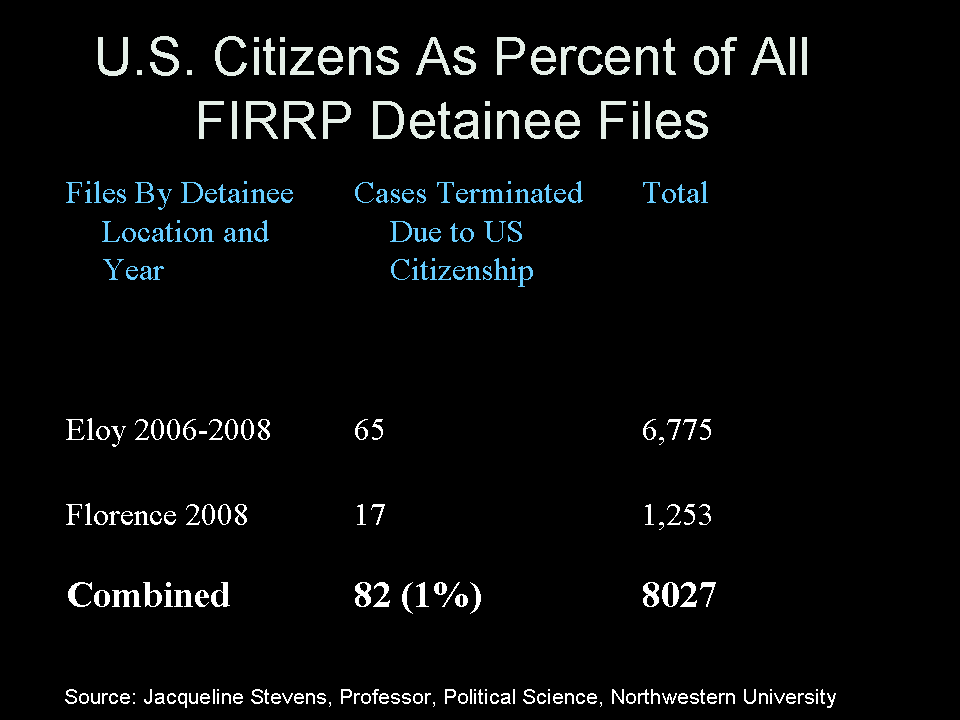
From 2006 to 2008 one percent of people in ICE detention centers in Southern Arizona who consulted with attorneys funded by the Department of Justice Legal Orientation Program had their cases terminated by immigration judges because they were U.S. citizens (82 out of 8,027).

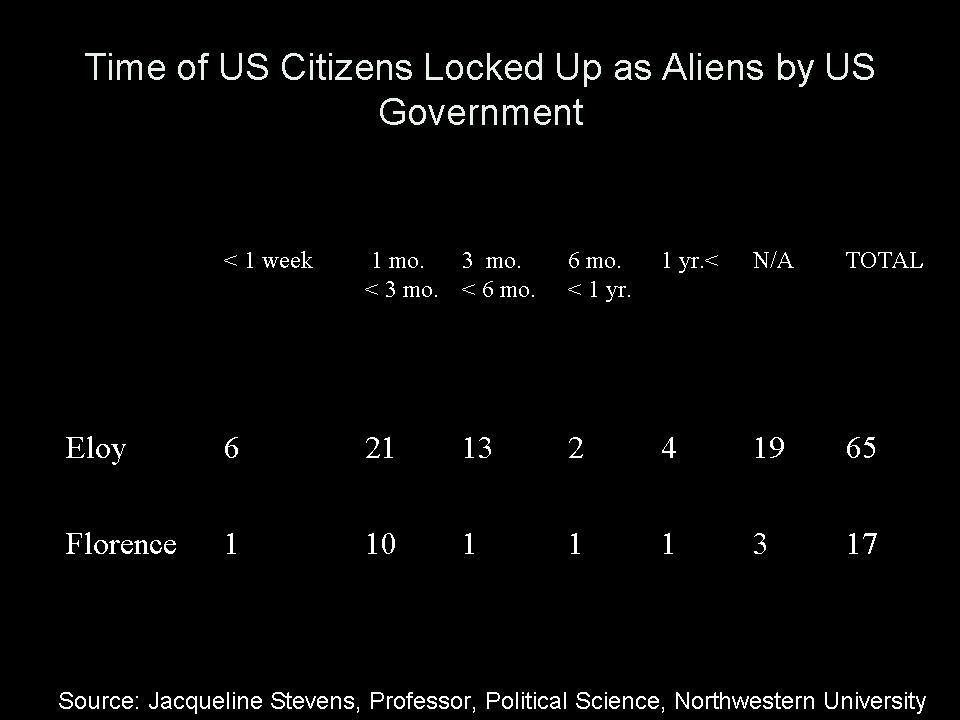
(For chart indicating length of time U.S. citizens held in Arizona jails please go here.)

Only a handful of detainees who were U.S. citizens in ICE detention had been convicted of violent crimes; the majority were reported to ICE while serving sentences for drug convictions.

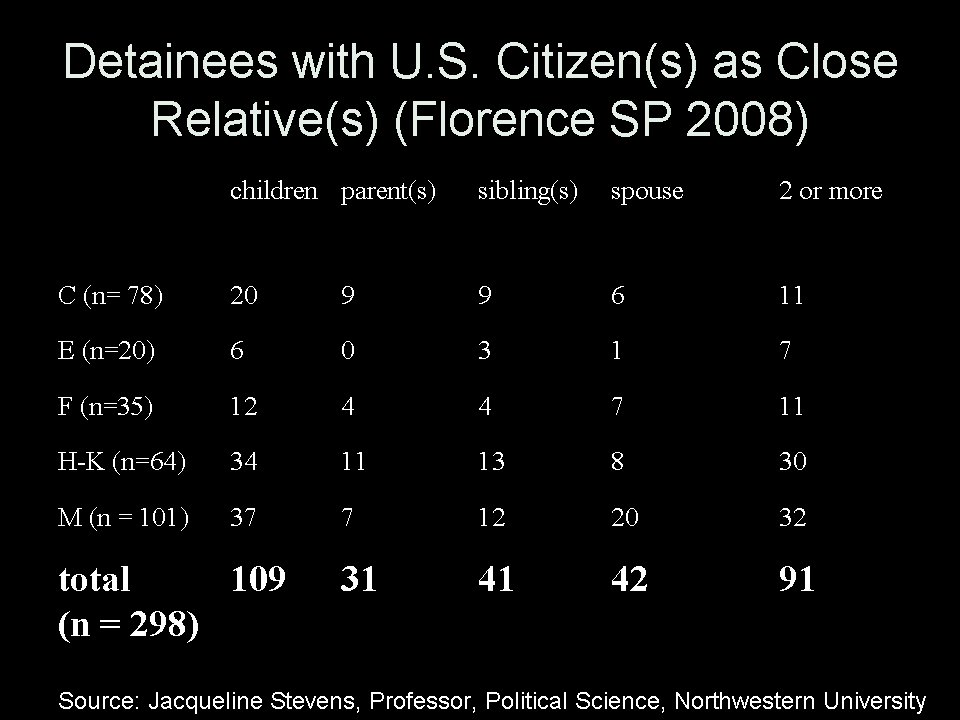
This population of Southern Arizona detainees for the most part originates in California prisons and jails, and accounts for approximately 10 per cent of all detainees nationwide; it appears to be broadly representative of people held in other detention centers. About 30% of the people detained who were not U.S. citizens nonetheless had two or more close relatives who were U.S. citizens.

A 2009 report by the City Bar Justice Center's NYC Know Your Rights Project noted that eight per cent of people who were held in the Varick Detention when they conducted a survey had apparently valid claims to U.S. citizenship.

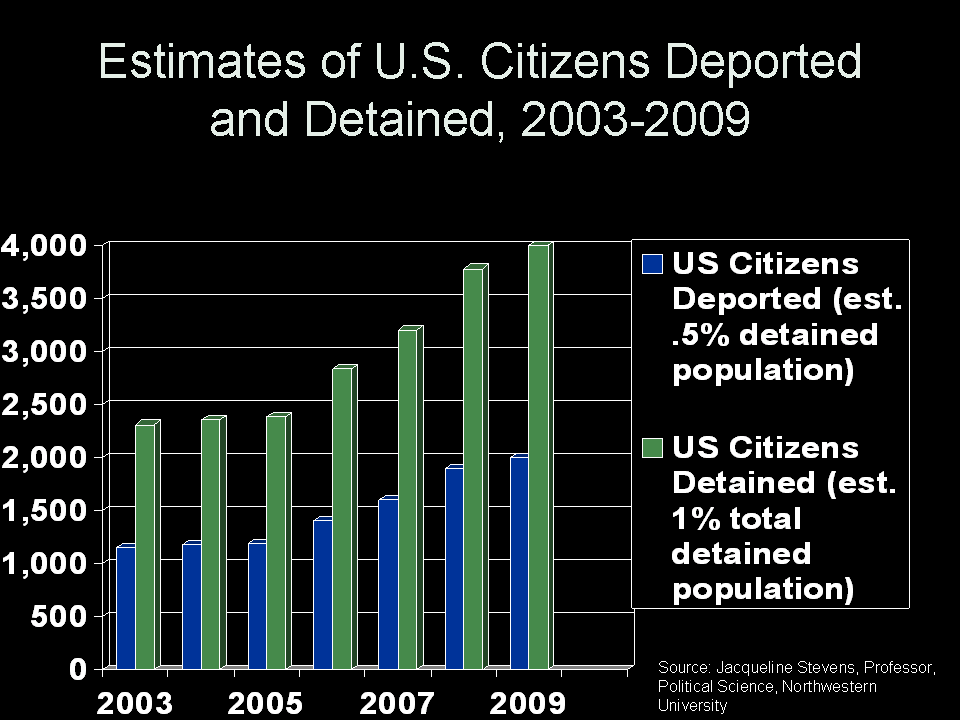
Last year ICE held over 400,000 individuals, including approximately 4,000 U.S. citizens. (See chart for 2003 to 2009.)

RECENT EVENTS
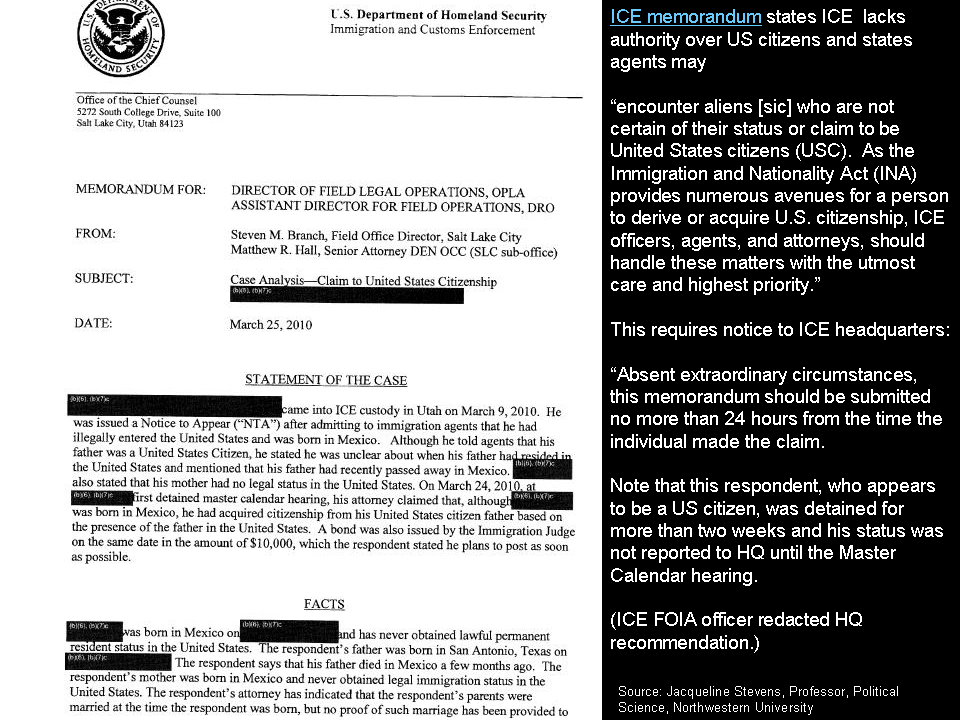
ICE public affairs and other officers are claiming that a November 19, 2009 memorandum issued by ICE Assistant Secretary John Morton has addressed successfully the problem of ICE detaining U.S. citizens.

Far from being evidence of ICE cleaning up its act, such statements to members of Congress and the press are further evidence of government malfeasance and deceptions. As recently as June, 2010, Mr. Luis Delgado, born in Houston, was threatened with prison and turned back to Reynosa, Mexico at the same border crossing where Mr. Mark Lyttle was twice turned away 18 months earlier.

In a June, 2010 response to my request under the FOIA, an ICE FOIA officer told me he had received a CD with over 4,000 pages of email traffic to its email "drop box" between November 19, 2009 and March 29, 2010. He reviewed and mailed a hard copy of the most recent 100 pages at the time (March 17 - 29, 2010). The reports redact the legal response advised by ICE Headquarters.

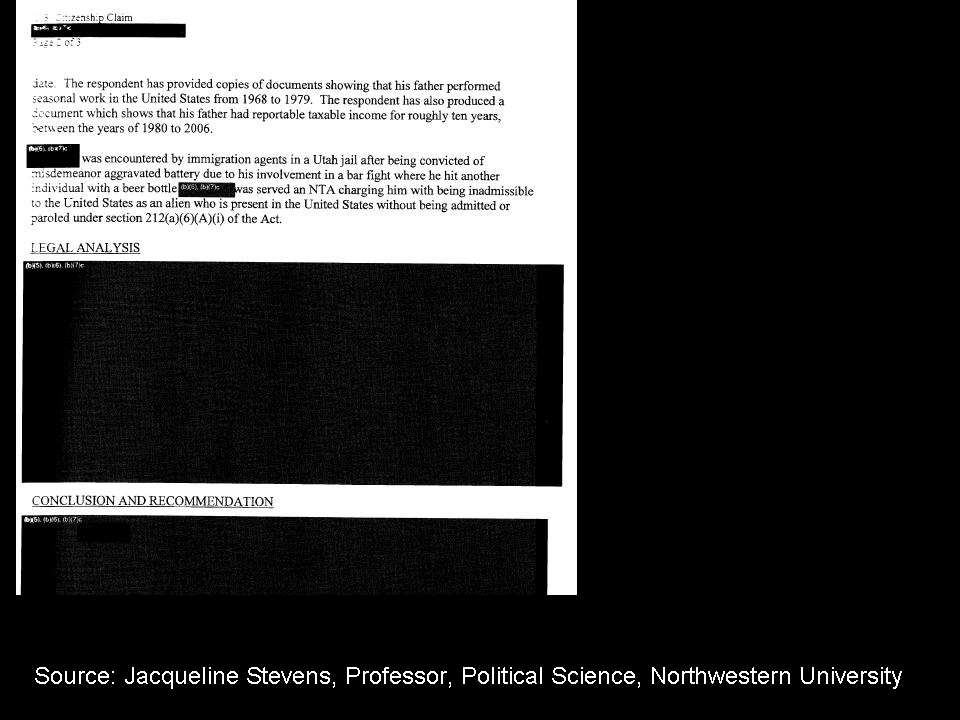
Two inferences are obvious from the documents I received: 1) ICE agents are demonstrably violating the 24 hour requirement by days and even weeks; 2)ICE continues to lock up people with probative evidence of U.S. citizenship.

For an ICE memorandum pertaining to someone claiming US citizenship and held in March, 2010 in violation of ICE procedures and US law, please see PAGE ONE and PAGE TWO.

Also, ICE has not insured its agents know about the new procedures. Therefore the inquiries of the drop box are understating the actual number of cases of detainees who have probative evidence of U.S. citizenship.

In January, 2010 I called a Florence, Arizona deportation officer to find out if Joseph Anderson's original birth certificate (with his USC father's name on it and a recording noting marriage to Joseph's mother as well as noting Joseph's birth as "legitimate") were "probative evidence" of his US citizenship. The deportation officer had no idea what I was talking about and stated he had not heard of this memorandum.

He gave me his email address and I forwarded the ICE memorandum I'd obtain under the FOIA. (After I posted it on my website, ICE posted the Morton memorandum on its website.)

(Mr. Anderson's been locked up in ICE custody at the Pinal County Jail for over two years.) Herbert Flores-Torres, a U.S. citizen, had to endure detention for over four years before ICE complied with the order of a federal judge to recognize his U.S. citizenship and release him. This occurred in December, 2009.

Mr. Anderson told me that when ICE first picked him up, the agent in the Phoenix office told him that the agent didn't know the meaning of "legitimate" in immigration law and was therefore going to detain him.

DEPORTED U.S. CITIZENS
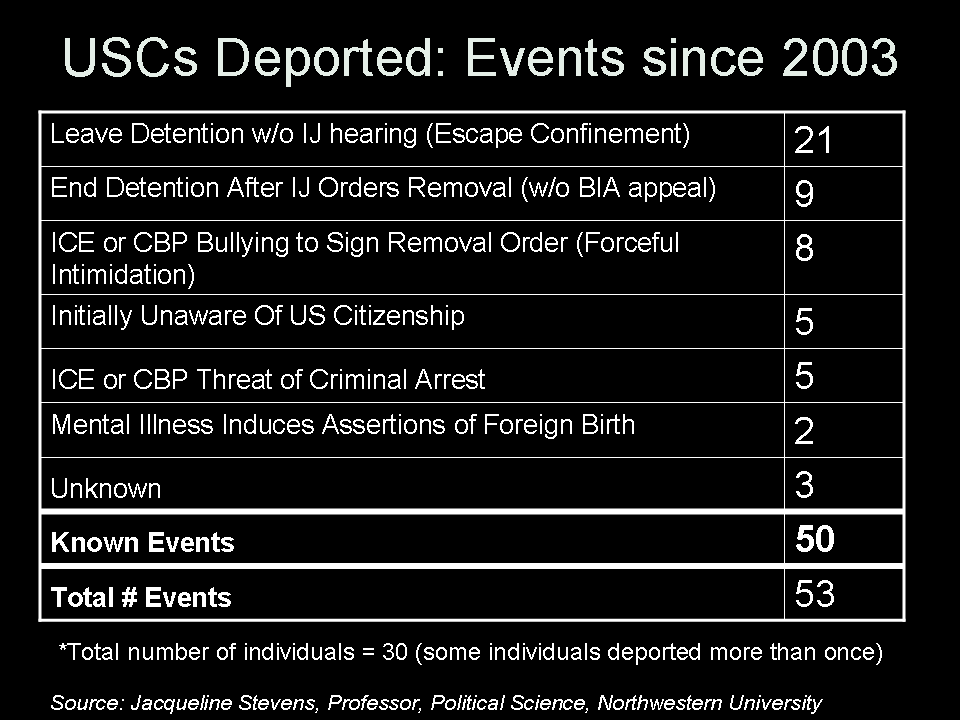
In the 30 cases I have documented in which the U.S. government actually deported U.S. citizens (this does not include the events associated with the recent deportation reported in the Houston Chronicle), the most common factors were U.S. citizens falsely indicating alienage to escape detention, ICE deportation officer threats, and CBP threats and destroying valid legal identification. This has meant years of exile and statelessness (see, e.g., Johann Francis).

-Among the cases I reviewed since 2003 were 19 U.S. citizens who were deported and served prison sentences after being convicted of Personation of a U.S. Citizen (18 U.S.C. 911) or Illegal Reentry (8 U.S.C. 1362), crimes predicated on alienage.

The similarity of the underlying fact patterns in these cases, and their consistency with practices that pervade ICE offices, indicate that the phenonomenon of deporting U.S. citizens is underreported, especially because the government can make it so difficult to falsify the incorrect assignment of alienage.

For instance, on his return from Guatemala after obtaining a U.S. passport through the U.S. Embasssy in Guatemala City, CBP and ICE officials arrested Mr. Lyttle at the Atlanta airport and completed Expedited Removal forms as they, in collaboration with ICE trial attorneys, attempted to deport Mr. Lyttle to Mexico for a fourth time (he was deported twice after he tried re-entering from Mexico).

(For previous reporting on the pattern of CBP tearing up or disregarding U.S. government documents presented by U.S. citizens of apparent Mexican descent, please go here.)

- Nationwide data indicating ICE is holding U.S. citizens include: independent reports from two immigration judges; a 2010 Master Calendar hearing of 105 individuals I observed, which included one U.S. citizen; a survey of pro bono immigration firms listed on a DOJ website for Southern California--in response to inquiries of 15 firms in 2008, 7 replied they had represented one to four U.S. citizens in the last three years.

-Representativeness of Southern Arizona data: The Arizona data may understate the denominator because people who are truly hopeless about their legal status may not meet with the LOP attorneys; but the Arizona data may also understate the total number of U.S. citizens in ICE custody because U.S. citizens are more likely to obtain their own private attorneys and thus would be less likely to meet with LOP attorneys and initiate a file on their cases.


FINDING #2

Immigration courts are run by an agency, the EOIR, whose practices and policies, including unwritten ones restricting access to the courts, are rooted in cronyism and paranoia. EOIR staff nationwide vary in their efforts to follow immigration hearing laws and regulations. Respondents are at the mercy of this decentralized system. The legal counsel at the EOIR headquarters in Falls Church, Virginia have violated FOIA laws, rebuffed inquiries from independent researchers and journalists, and ignored clear evidence of misconduct by EOIR attorneys running the immigration hearings.

William Cassidy and Dan Pelletier, who run hearings for those detained at the Stewart Detention Center, have, according to TRAC at Syracuse University, the highest rate of deportations nationwide and are regularly violating the laws, regulations, and rules for immigration hearings. This incentivizes U.S. citizens, legal residents, and immigrants to give up on legal claims to remain in the United States.

EXAMPLES:

No Check to Ensure Respondents Receive Copy of Government Charging Documents.

If ICE actually allows someone to appeal a removal order by going to an immigration court, a federal regulation requires that the government's basis for seeking removal is shared with the respondent. The first thing that the vast majority of immigration judges do at a Master Calendar hearing is ask the respondents at the hearings if they received this. Judges are also supposed to review the charging document and make sure the respondent has this.

Mr. Cassidy and Mr. Pelletier demonstrably do not do this. Instead, at hearings I have attended and in recordings to which I have listened, the judges TELL the respondents that they were served a "Notice to Appear," a phrase that is itself utterly meaningless. Indeed, one individual, who had been alerted by his attorney about the legal problem of not receiving a Notice to Appear, tried to tell the judge that he had not received this. In this case and others when respondents made inquiries of Mr. Pelletier he ignored their questions and, over the television monitor, barked the next name.

At one hearing that was supposedly a "mass removal" -- everyone has supposedly agreed in advance to be deported and just raises their hands in front of a camera (of course many just sit still with arms folded and show no indication of agreeing with anything Mr. Pelletier is saying on the television screen) -- immediately after Mr. Pelletier adjourned the hearing, several longterm U.S. residents asked the CCA guard when they were going to talk to the judge. The guard ignored the question and was trying to escort them out of the room to lunch. The detainees explained their plight to me and I alerted the ICE trial attorney who requested the judge resume the hearings. It was too late for one detainee who was already outside the court room. I believe that if I had not been present none of them would have spoken with the judge.

Inadequate and Misleading Bond Information.

A key reason people agree to deportation is because they want to escape detention centers. Many are eligible for bond but do not realize this because their deportation officers lie to them and they do not know how to request bond hearings of the EOIR.

Even if they do request a bond hearing, no regulation guarantees this will occur in a timely fashion. Two attorneys who represent clients in the Stewart Detention Center told me of bond hearings being frequently canceled.

At the Eloy Detention Center in southern Arizona, an EOIR attorney presiding over hearings, Mr. Richard Phelps (appointed during the Monica Goodling era), allows those who are resourceful enough to pursue a bond hearing, to hear his TAPE RECORDED INSTRUCTIONS. Following the recording, which is largely incomprehensible to anyone without immigration law training (and concludes with his chit-chat with someone helping him with the recording), the detainees ask questions of the CCA guard prior to Mr. Phelps returning to the court room where he impatiently brushes off the respondents' inquiries.

I encountered one individual who was awaiting a hearing on his green card application following the marriage to his U.S. citizen wife; he had overstayed a tourist visa and had no criminal history. It took three months before he was able to navigate his release on the minimum $1500 bond, an indication of unnecessary detention that cost not only his freedom but also the U.S. taxpayers approximately $9,000.

These experiences encourage U.S. citizens, legal residents, and immigrants to agree to deportation rather than endure the harsh and arbitrary conditions of detention and U.S. immigration courts.

Secret Evidence.
On December 8, 2008, William Cassidy encountered in Mr. Lyttle's "alien file" the ICE arrest report (I-213) showing his claim to be born in North Carolina. As is the case for other EOIR files I have examined, it lacks a "certificate of service" indicating that ICE shared it with Mr. Lyttle, a violation of 8 C.F.R. § 1003.32. During the hearing, Mr. Lyttle asked Mr. Cassidy for a copy of the paper he was reading. Normally a judge will order the ICE attorney to make a copy, but neither the ICE attorney nor the judge did this. Following the judge ignoring his entreaties, Mr. Lyttle filed a grievance requesting a copy of the I-213 but never received it.

I recently obtained an EOIR file for another respondent who appeared in the Stewart Detention Center immigration courts in 2010. It also contains what appears to be deliberately falsified information on an I-213 report that was never shared with the respondent. Mr. Pelletier, the EOIR attorney who presided over the hearing, did not require that the ICE attorney share a copy with the respondent.

Based on my own observations and conversations with practitioners in the area I believe that every EOIR file for those who are in ICE custody and have their hearings at Stewart or Atlata contains I-213s that have not been shared with respondents.

Unlawfully Closed Hearings.
A DOJ regulation states that, specific exceptions notwithstanding, "All hearings, other than exclusion hearings, shall be open to the public..." The EOIR regularly violates this rule by holding hearings in several detention centers where security guards block access. The EOIR also allows immigration judges to close hearings in non-detained buildings without legal reason or penalty. (You can read about this in The Nation and more recent postings about the EOIR on my blog.)

Mr. Cassidy and Cynthia Long, the court administrator in Atlanta, Georgia, have incorrectly told court watchers that a docket listed asylum hearings and therefore they could not attend when the truth was that the docket a) did not include asylum hearings; and b) asylum hearings are only closed at the request of the respondent. This provision is to ensure foreign agents do not retaliate against family members in a respondent's home country. It is a cruel abuse to lie and use the regulation for the purpose of obstructing access to hearings by religious, pro-immigrant observers who want to keep an eye on Mr. Cassidy, a former ICE prosecutor who has one of the highest rates of asylum denial in the country.

The Department of Justice Executive Office of Immigration Review is charged with managing immigration hearings, but its staff in Washington, D.C. also regularly violate federal laws, regulations and rules designed to thwart misconduct. I will be describing these in more detail in a forthcoming article.

Conclusion.
The criminal and regulatory violations perpetrated by the DHS and EOIR vastly overshadow the small infractions of immigration law for which the deportation agencies and their increasingly costly budgets were established.

The government has reporting systems in place that would allow it to systematically track the rate at which deportation orders are terminated because of U.S. citizenship, but ignore Congressional inquiries and fail to collect the requested data. (This could be done easily through by EOIR, if it reported findings of nationality in its Statistical Yearbooks as reported by immigration judges and not ICE attorneys. At present the EOIR's Statistical Yearbook inaccurately lists respondents who are U.S. citizens as having the nationalities ICE ascribes to them and is another indication of the EOIR's poor record-keeping and lack of independence.)

A further problem is that the agency at the DOJ that is supposed to oversee the EOIR, the Office of Professional Responsibility (OPR), is infected by a similar culture. Like the EOIR, OPR is being run by an Acting Director, Mary Patrice Brown, who is a career civil servant. Brown is on leave from her position as a U.S. attorney.

According to the Washington Post's WhoRunsGov.com, Brown has close ties to Attorney General Eric Holder and is rumored to be in line for a position as a federal judge. Brown's appointment seems designed to prevent the OPR from performing as an independent watch dog within DOJ. The OPR is clearly violating the FOIA statute -- in violation of an April 2010 remand from the DOJ Office of Information Policy OPR will not release reports of immigration judge misconduct -- and is so secretive that it refuses to release its 2009 Annual Report.

SOLUTION:

The only way to protect the rights of U.S. citizens and legal residents is to provide an assigned attorney at government expense to anyone arrested by ICE and either held in detention or issued an Expedited Removal Order or an Administrative Removal Order who cannot afford an attorney. Absent this, it is impossible to check the abuses of discretion as well as law-breaking by ICE and border patrol agents.

Expensive? Yes, just as assigned attorneys for indigent people accused of crimes is also costly. This is the cost of doing the nasty business of implementing deportation laws.

If the U.S. public truly wanted to save money, increase jobs, and give a shot to the housing market to boot, it could abandon this parochial cause, as will surely occur eventually. This might seem far-fetched, but not as far-fetched as requiring government documents to travel from the villages to London, or to move within the colonies, as also was deemed imperative for order, the unregulated movement of poor people regarded as a clear threat to stability. Such a policy, once relinquished, now seems a provincial and ridiculous restraint on freedom and justice, not to mention commerce, as will the restriction on movement among countries appear to populations in a few hundred years.

Postscript: In May, 2010 a settlement agreement was reached in which the U.S. government agreed to pay $350,000 to a trust fund for Peter Guzman and his mother because Mr. Guzman was born in Los Angeles and in 2007 the U.S. government deported him. (The agreement has not been finalized by the judge but appears to be on track for this to occur shortly.)

--RSS Subscribers: you received two messages because of time-stamp problem on first one. My apologies for the confusion. (If you are not using the RSS and would like to be notified of new posts on this blog, please click on orange box in right-hand corner of url box.)

Sunday, April 25, 2010

Atlanta Immigration Judge Sics Guards on Professor/Writer Who Revealed Improprieties


ABLE, an interfaith group that does court observing, holding a vigil in front of a building housing the Atlanta Immigration Courts and ICE
 
 UPDATE (May 6, 2012):  On April 18, 2012,  I filed a lawsuit against 9 named individuals.

"Unbelievable," "incredible," "crazy" are frequent responses to the story of how Mark Lyttle, born in North Carolina, was illegally ordered deported to Mexico on December 9, 2008 with the imprimatur of William Cassidy, a former ICE attorney who presides as an immigration judge over hearings for people detained in southern Georgia. He is employed as an attorney by the Executive Office of Immigration Review (EOIR), an agency in the Department of Justice (DOJ).

Similarly surreal, unreal, too real, calling to mind Alice as well as Kafka, were the events on Monday, April 19 at the Atlanta federal building on 180 Spring St. SW, where a phalanx of private security guards stormed the waiting room where I was writing notes on Mr. Cassidy's most recent bizarre behavior, discussed below. A private security guard told me I had to leave. I asked him why. Backed by others in his gang, he repeated his "order" and then he took out hand cuffs.

(It's a LONG story, but the punchline is fairly simple: Many but not all employees of EOIR and ICE have no interest in the rule of law; when folks try to hold them to account, they lash out. Both EOIR and ICE are grumpy about me writing on behalf of the U.S. residents whose rights the government is violating. The only thing surprising about the events described below is that Mr. Cassidy's character behaves in ways that are too cliched to be easily believable. And yet...)

I had a plane to catch and decided to go along with the young thugs in front of me. I walked out of the waiting room and asked the guy doing the talking for his name. "Officer Out the Front Door," he replied. As I turned, still walking, to look at his name tag on his right side he twisted away to hide it from my view, placed his hands on me and forced me to walk more quickly, suggesting more force if I paused to examine his identification more carefully. (The building is full of cameras and I have requested Federal Protective Services (FPS) preserve relevant video.)

(The name tag that he was trying to hide said T. Hayes or Hays; an Atlanta supervisor for Federal Protective Services (FPS), a branch of Department of Homeland Security (DHS) that handles security for federal buildings, told me the company handling security at the site is Paragon Systems.)

Hayes shouted to additional guards in the lobby that he was acting at the behest of Mr. Cassidy: "Judge Cassidy wants her out of here! He wants her out of the building!"

But Lauren Alder Reid, Legal Counsel for the EOIR's Office of Public Affairs explained to me that same day that as an employee of the DOJ, Mr. Cassidy has no legal authority over employees of the DHS.

Oops.

I guess a guy deporting a U.S. citizen without authority might not be so squeamish about ejecting a court observer from a federal building without authority.

Atlanta Immigration Courts: "The Worst in the Country."
Mr. Cassidy has a long record of poor judgment and unlawful actions reaching back to the 1990s. I have published some of this information; he knows I have more. In addition to deporting Mark, Mr. Cassidy has held at least one ex parte conversation with an ICE attorney in which he said he would rule against a respondent even though he thought this would be overturned, filed baseless retaliatory complaints against immigration attorneys, failed to record hearings properly, backdated a court record, accepted into evidence materials that have not been served on both parties, and unlawfully closed proceedings to Mark and me in October on the strength of a lie conveyed by the court administrator, Cynthia Long, who said she was acting on the instructions of "the ju" -- and then stopped, apparently attempting to keep this a secret.

It was Mr. Cassidy's email to Jennifer Barnes in the EOIR's Office of General Counsel in late April, 2009, contemporaneous with Mr. Cassidy vacating his deportation order following Mark's return, that cemented my view of Mr. Cassidy as a classic bully, someone who kisses up to those who have power and influence, including certain Atlanta immigration attorneys, and kicks down those who do not--and I wrote as much in an affidavit that was copied to Mr. Cassidy in a case involving what I considered a frivolous, baseless, irrational misconduct complaint he filed and that the state bar to which it was referred closed without taking any action.

(Mr. Cassidy claims Mark was silent about his U.S. citizenship during the master calendar hearing, while Mark, who had never been in an immigration court before, offered in our first conversation, within days of his return, a very detailed narrative of their exchange and that of others in Mr. Cassidy's court, none of which are on the digital audio recording (DAR) Mr. Cassidy is charged with maintaining; instead the DAR has obvious stops and starts with the intervening conversations not recorded. Instead of letting the EOIR investigate a deportation order that appears to display at best gross incompetence, Mr. Cassidy wrote an absurd complaint against an attorney who had nothing to do with the events in Mr. Cassidy's court room the day he deported Mark as a vehicle to assert to the EOIR upper brass that Mark never spoke up.)

The EOIR, in addition to tolerating Mr. Cassidy's persisting in conduct violating federal regulations, the Immigration Practice Manual and the Immigration Judge Benchbook, also has failed to admonish the Atlanta EOIR for requiring the public to "check in" before attending court hearings, an unauthorized restriction on court access that my interviews with observers as well as my own experience demonstrates has been abused to close hearings that should be open to the public. EOIR Public Affairs Officer Susan Eastwood told me last October that it is not EOIR policy for visitors to "check in" before they may attend hearings.

Moreover, the Atlanta EOIR court office appears to have committed document destruction, a violation of various policies not to mention the Freedom of Information Act. In order to document that Ms. Long and Mr. Cassidy were unlawfully closing his hearings I requested a copy of the docket the day I was turned away, by filing a FOIA request.

Only one of the three cases appearing on Mr. Cassidy's 1 pm docket posted in the waiting area October 7, 2009 appeared on the docket printed on December 16, 2009.

The cover letter, dated January 25, 2010 (far beyond the FOIA deadlines for a request submitted mid-October, another symptom of EOIR trying to cover up or delay exposure of misconduct) states: "Please be advised that the original Immigration Court calendar could not be located. However, the enclosed Immigration Court calendar was obtained from the Immigration Court database."

Each court's dockets are maintained in a computer database whose output may be accessed in Washington, D.C. and the local court. A court administrator elsewhere told me that the only way to explain the disappearance of the two cases would be if someone in the Atlanta EOIR office deleted these, a procedure this employee said was technically "easy." (EOIR staff elsewhere have noted different examples of incompetence on the part of the Atlanta court, including a failure to send files in a timely fashion after venue has been changed, leading to delays and confusion. One employee told me, "They're the worst." The Atlanta EOIR staff appear to be spending so much time chasing out the public and covering up misconduct that they are unable to perform basic tasks like sending files.)

When he is in court, Mr. Cassidy still fails to perform the duties of an immigration judge. He does not record significant portions of hearings, fails to note which portions are on and off the record, and does not summarize off-the-record exchanges when going back on the record--all required by the Immigration Judge Benchbook. He also fails to provide the name of the interpreter at the beginning of each proceeding. (The Immigration Judge Benchbook is online and is the EOIR's helpful response to critics who were pointing out the poor habits of some immigration judges. The fact that Mr. Cassidy and EOIR attorney and administrative judge Dan Pelletier (another former ICE trial attorney), also in Atlanta, fail to follow what is basically a script that any high school student could read suggests their disrespect for court rules and respondent rights are deeply ingrained; the EOIR clearly needs to do more than lead these horses to the water.

Other Peculiarities for those in Mr. Cassidy's Court
Most of the morning was taken up with bond hearings, an occasion that allowed for interesting insights by the ICE trial attorney (located in Stewart) into Mr. Cassidy's approach to full hearings. He repeatedly told attorneys he would not negotiate bond because their motions did not include attachments with ten years of income tax returns and, absent these, Mr. Cassidy had a categorical policy of denying relief. Since the ICE attorney was so certain that Mr. Cassidy would deny relief without considering any other factors, the ICE attorney was opposing bond.

(Bond is possible for those in ICE custody as long as their imprisonment is not ordered by Congress -- "mandatory detention." Whether an ICE attorney goes along with this will depend on various factors, including the possibility of relief from being deported, either on the merits of the order or because the immigration judge may use discretion and grant relief; the trial attorney's claim on Monday was that absent ten years of income tax returns, relief in Mr. Cassidy's court would be impossible. Like other actions in immigration court, ICE has more power in this matter than the immigration judge: if the judge orders bond and a family has the funds, ICE can continue to hold the respondent in custody pending an ICE appeal of the immigration judge's order, effectively nullifying the whole point of a bond. Therefore, it is effectively ICE, not the immigration judge, setting bond for those in ICE custody.)

The ICE attorney's rationale for denying bond violates a due process expectation that a bond hearing is different from merit hearings; if the trial attorney were in fact correct in surmising that Mr. Cassidy would never consider relief absent ten years of tax returns, this is a pretty grim summary of Mr. Cassidy's judicial temperment. But unless the ICE attorney expects respondents to know of Mr. Cassidy's strange proclivities on this point, legally available routes for relief should be sufficient to induce respondents to attend a future hearing and hence weigh on the side of granting bond.

By second-guessing the respondents' mindset when faced with a judge who writes his decisions by-the-numbers and not individual circumstances--what if the tenth year were not filed because the respondent was suffering from an injury sustained after carrying NY fire fighters from the World Trade Center?--the ICE trial attorney forecloses the opportunity for such a respondent to appear in court (not by televideo) during the full hearing and present his case as a full human being, not a blurry monitor figure in orange uniform, or grey, if the monitor is not fully working.

(The morning televideo feed was in black-and-white--a poor image drawing notice by an attorney once it was observed that Mr. Cassidy was receiving affirmative responses to a voluntary deportation order by someone other than her client; the individual he believed he was addressing had actually left the room. The interpreter later said to the attorney that she had remained silent despite noticing the switch because Mr. Cassidy 'tells me to stop interfering so much.')

For the record, when he returned to the court room following one of these discussions Mr. Cassidy affirmed that the ICE attorney had accurately represented his rigid requirement for ten years of income tax returns.

More On Mr. Cassidy and his Gang
Other than to tell me that DOJ employees have no authority over DHS employees, EOIR's Ms. Reid, on behalf of Mr. Cassidy, provided no account for his rounding up his pals at Paragon. Mr. Cassidy also has not replied to previous telephone and email messages seeking comment on his deportation of Mark and the events in October.

The immediate trigger for Mr. Cassidy's ordering private guards to have me removed appears to be an exchange we had shortly after 3 pm. I was the sole observer as he left the bench and, out of the camera's line of vision, walked toward me and asked me to leave. I asked him why. He said he had the authority to close hearings. I said that immigration hearings were generally open to the public subject to certain exceptions. I asked him if the respondent had requested a closed hearing. He said "No, the respondent is pro se," meaning without an attorney.

Mr. Cassidy also said he could order me removed. I asked if he would give me a reason for why he was closing the hearing. He thought for a few seconds and then said, "No," and told me he was getting the regulation on closing hearings and that I should wait. I told him I was familiar with the regulation. He nonetheless left the court through the rear exit.

Concerned about his implied threat earlier and also not interested in continuing this exchange I told the interpreter and administrator that I was going to the front office and that if the respondent happened to have understood what was happening and wanted me back, I would be there. The entire episode occurred in about 90 seconds.

The reason I was concerned about the respondent is that Mr. Cassidy, according to Syracuse University TRAC analysis, has among the highest rates of denying asylum applications in the country. For 2004 through the end of 2008 he denied 88% of asylum applications, compared to 57 per cent nationwide; in 2008, the most recent year for data, the TRAC chart appears to indicate that he denied 100% of asylum applications.

The regulation and rules allowing judges to close hearings to protect respondents in asylum applications are for the purpose of protecting people from retaliation by government agents from their home countries. Mr. Cassidy's high rate of denials suggests that in Mr. Cassidy's court, the respondents may have more to fear from him as an agent of the U.S. government than an undercover agent from Burma hiding behind court benches, for example.

The relevant rule in the Immigration Practice Manual states:
Evidentiary hearings involving an application for asylum or withholding of removal (“restriction on removal”), or a claim brought under the Convention Against Torture and Other Cruel, Inhuman, or Degrading Treatment or Punishment, are open to
the public unless the respondent expressly requests that the hearing be closed. In cases involving these applications or claims, the Immigration Judge inquires whether the respondent requests such closure.
At no point did Mr. Cassidy include either the ICE attorney or the respondent in this discussion. He certainly did not inquire whether the respondent requested a closed hearing.

In the front office I spoke with Ms. Long's replacement for the day, Marion Crosby. I told her what had transpired. She left, then returned and informed me that this was indeed an asylum hearing. (The Stewart docket is posted at that location, and is not available in the Atlanta EOIR front office so I was unable to verify this.)

Ms. Crosby and I had a conversation about whether discretion in closing a hearing entailed legal reasons being provided contemporaneously. Since the DOJ has interpreted the regulation on public access to require a respondent's assent to closing an asylum hearing, it appears that Mr. Cassidy simply broke a rule. If he in fact were weighing other factors, then he needs to state these. The regulation does not authorize immigration judges evading all accountability, especially an EOIR attorney with the record of Mr. Cassidy.

Fortunately, a real federal judge (see below) has ruled on this question. Here's what Sixth Circuit Judge Damon Keith wrote when the EOIR tried to block the press from attending so-called deportation cases in immigration courts by invoking a "special interest" exemption and claiming the same broad latitude Mr. Cassidy was asserting:
Today, the Executive Branch seeks to take this safeguard away from the public by placing its actions beyond public scrutiny. Against non-citizens, it seeks the power to secretly deport a class if it unilaterally calls them "special interest" cases. The Executive Branch seeks to uproot people's lives, outside the public eye, and behind a closed door. Democracies die behind closed doors. The First Amendment, through a free press, protects the people's right to know that their government acts fairly, lawfully, and accurately in deportation proceedings. When government begins closing doors, it selectively controls information rightfully belonging to the people. Selective information is misinformation. The Framers of the First Amendment "did not trust any government to separate the true from the false for us." Kleindienst v. Mandel, 408 U.S. 753, 773, 92 S.Ct. 2576, 33 L.Ed.2d 683 (1972) (quoting Thomas v. Collins 323 U.S. 516, 545, 65 S.Ct. 315, 89 L.Ed. 430 (Jackson, J., concurring)). They protected the people against secret government.
The decision as a whole is a great read, and demolishes the claims shared with me by Ms. Reid and Ms. Crosby that an immigration judge has unreviewable discretion to close hearings without providing a reason. (From the decision above, e.g., "... the Government contends ... Congress took the INS's discretion away for exclusion hearings and specifically gave them discretion to open or close deportation hearings. We find the Government's reading unpersuasive.")

Coda
On Tuesday afternoon I spoke with FPS Central District Commander Darren Summers. FPS is the DHS agency that contracts with the Paragon guards. After quizzing me on why I was "hanging out" at the immigration courts and asking who had "detailed" me to Atlanta for my research, Mr. Summers told me the guards had responded to an "order of a federal judge." Mr. Cassidy is not a federal judge but an administrative judge. I told Mr. Summers that Mr. Cassidy was employed by the DOJ and asked him how an employee of the DOJ could have authority over employees of the DHS.

Mr. Summers, his voice dripping with condescension, said that I needed to do more research, as this would show me that "immigration courts are part of the Department of Homeland Security."

This statement, so indecorous as to ignore the thin legal veil between EOIR and ICE, is also pretty awesome for illustrating the actual overlapping personnel and missions of the EOIR and ICE. (Three of the four EOIR attorneys in Atlanta are former ICE trial attorneys.) This blurring of legal authority between DOJ and DHS has consequences far more harmful than wrongfully removing a scholar/reporter from a building and committing battery.

It pervades the atmosphere in which EOIR attorneys are rubber-stamping ICE attorneys' claims that are demonstrably lies and evidence of agent misconduct, including faked fingerprint reports, false assertions on ICE arrest reports, and illegally hiding exonerating evidence from respondents' and their attorneys.

Most immigration judges, especially those who oversee hearings for non-detained populations, follow the rules and suffer the consequences of being overworked and underappreciated for their judicial temperment. Immigration judges with whom I've spoken mention only quantitative, not qualitative assessments, and believe that all EOIR HQ notices is their pace of hearings, and not the quality of their decisions. The fact that EOIR has continued to employ Mr. Cassidy, and colleagues who also show a long record of ignoring rules and regulations--more on others later!--seems to confirm this assessment.

The actions initiated by Mr. Cassidy violated not only my civil rights, but are also a crime. Under Georgia law, misdemeanor simple battery is when an assailant "Makes intentional contact of an insulting or provoking nature with the person of another," which is a great definition of what happened. Mr. Cassidy appears to be running a criminal gang, one that is using force and threats of force to harm the public. I have asked FPS to retain a copy of the video and I have been in contact with the Atlanta police exploring the possibilities for filing charges.

--------------
UPDATE, Monday, April 26: thanks so much for the comments (below) supporting filing criminal complaints against the guards and William Cassidy. I'd like to do this but am not in Atlanta. My understanding from the Atlanta police is that an attorney would need to file an affidavit written by me at a downtown office. If there's someone in the Atlanta vicinity willing to help out with this, please shoot me an email: jstevens AT law.berkeley.edu
---------------

(The photo is a vigil organized by Atlantans Building Leadership for Empowerment in front of the building from which I was removed. In addition to the immigration courts, it houses DHS agencies including ICE and FPS.)
-----------------
Correction 4/27/10: The original post said of Mark's comments to me on April 24, 2009, "Mark, who has never been in an immigration court before..." This was a mistake I just caught. It is corrected to read "had" since Mark has come with me to immigration court hearings in Stewart on a few occasions in 2010, long after the account he gave and I posted two days after he returned. You can read that here.