Monday, October 22, 2012

Immigration Judge Sylvia Arellano Ignores Ninth Circuit Precedent


Today, Monday, October 22, Esteban Tiznado was supposed to be attending his hearing in an immigration court in Florence, Arizona.  And his pro bono attorney David Ouimette was supposed to be presenting evidence of his client's U.S. citizenship.  But it's not going to happen.


In April, 2012, Esteban Tiznado, a U.S. citizen, at least according to an Arizona jury, was once again placed in removal proceedings.  Since then he's been locked up in the portion of the Pinal County Jail rented out to Immigration and Customs Enforcement (ICE) after an initial offer to release him on bond during the proceedings was made by ICE.  Tiznado's family has no funds for this and ICE refused Ouimette's request that the government release Tiznado on his own recognizance.  A hearing scheduled for July 16, 2012 never happened, and subsequent hearings also were cancelled.

As the screenshot above indicates, Tiznado is losing hope and thinking that the only escape from his purgatory might be another ICE bus ride to Mexico, from where he will return.  The bar against Double Jeopardy means he cannot be charged with Illegal Reentry but it also means constantly looking over his shoulder in fear of being held as is he right now.  (For the details of Tiznado's case, including evidence of his U.S. citizenship, please go here.)

Of the second cancelled hearing:
"I show up in Florence on August 21" said David Ouimette, Tiznado's pro bono attorney, and [Sylvia Arellano, the recently hired attorney working for the Executive Office of Immigration Review], tells me, "We scheduled two things at the same time again and I don't have time for this, and so we're going to postpone it," supposedly to October 22, today.  This time it was Ouimette as well who was being wrongfully detained by Arellano, whose failure to notify him in advance of this conflict meant a long commutes from Phoenix, a waste of most of the day. 

I.  Arellano v. Ninth Circuit June 10, 2012
Arellano's handling of Tiznado's citizenship rights is as adept as her clock management skills.  During the master calendar hearing she joined forces with those immigration judges whom an American Immigration Council Legal Action Center advisory points out are blatantly ignoring the Ninth Circuit mandate requiring ICE to hand over to respondents their so-call "alien" files.

In Dent v. Holder, 627 F.3d 365 (9th Cir. 2010), the opinion noted that the government had been withholding documents that were consistent with Dent's assertion of his U.S. citizenship.  The same is true for Tiznado's case. (I received portions of this from a FOIA response and it shows that the government had various Certificados de Inexistencia for Jesus Tiznado's birth, thus falsifying the government's assertion that Jesus was born in Mexico and not, as the state of Arizona states, Topawa, Arizona.)

The analysis in Dent v. Holder observes that the Constitution embodies the intuition that people have a right to evidence that will be used against them, and that the immigration court rulings that ignore this cannot be shielded by a law that would normally preclude review of their decisions:
 The law does not, however, interpret this rule absurdly, so that injustice may be done if the government successfully shields its documents from a person who ought to have access to them, particularly when the documents might change the result of the proceedings.
The opinion in Dent, in which the word "Kafkaesque" appears, notes:
 in the critical proceedings before the IJ neither the IJ nor the BIA nor Dent was furnished with the relevant documents. We have no idea why not. The only justification the government offers for why we all should have been left rooting around in the dark is in its 28(j) letter, arguing that the law did not require them to furnish the A-file. The government offers no reason why the A-file should not be furnished.
So you'd think that during the master calendar hearing, when Ouimette requested the entire contents of Tiznado's file, that Arellano would order exactly this.  Here's what happened instead:
Ouimette:   July 16 at 1 oclock would be acceptable your honor.

Arellano:   I would like for you to be personally present please.

Ouimette:  Yes.  With respect to the respondent's  A file, we've made a request for the file under the Dent v. Holder case and the counsel's response was that we needed to make a Freedom of Information Act request, which in my reading is clearly contrary to Dent v. Holder.  So we'd ask the court's assistance in getting access to the a file.

Arellano:  Mr. Morwood?
Dion Morwood [DHS attorney]:  Your honor, we have received the respondent counsel's Dent request and in reviewing that we note that, in regard to specific documents we will and I believe we have complied with that request. However, it appears that he's also requested the entire A file. And with regard to that request I would note the following. It is the Department's position that neither the respondent nor his counsel is entitled to full access to the A file because there is certain confidential, classified information that would not be discoverable such as attorney client or attorney work product documents, etc. However, the majority of the A file is available to the respondent but that's done through a FOIA request.
That's the proper method. there is a method for respondent's counsel that respondent himself will need to sign under penalty of perjury indicating that his file may be released to counsel. In addition to that he would need to submit a hearing notice stating that the next hearing date will be on the 16th of July and specifically in the request indicate that the respondent is detained in the Florence Detention Center.

Arellano:  Anything additional Mr. Ouimette.

Ouimette:  Yes, I believe that suggested procedure is clearly contrary to the Dent case, which says that a FOIA request is not necessary  to get access to the file. And that's a case which is precisely similar to this one. It's a removal case.

Arellano:  I'm familiar with it sir. My ruling is that you will need to make a FOIA request.  Anything else sir?

Ouimette:  I would just note my objection on the record and make a request with respect to the filing of written materials prior to the hearing, since I still don't have access to the A file I request that I be allowed to do that one week prior to the hearing.

Arellano:  Um, that's a little tight for my purposes. But thank you for reminding me the document due date would be July 5th for both parties.
In the meantime, Ouimette says, the DHS did not release the entire file but did eventually release to him some of its supposed evidence that Tiznado's father is not a U.S. citizen.  According to Ouimette  "There were several transcripts of birth certificates of numerous siblings, some stating Jesus’ birth in Mexico, and some stating his birth in Arizona."  In light of the extensive other documentation, these transcripts--no original were provided--seem much less relevant than the numerous records from the Mexican government at different time periods directly stating Jesus Tiznado was NOT registered anywhere as born in Mexico.

Moreover, nothing at all was turned over that would support an earlier government contention that other documents had been fraudulently altered.

October 22, 2012
Ouimette is confident of his client's case and wants a hearing so Tiznado can be released.  However, today all Tiznado will be facing another grim day of mistreatment at the hands of a guard who, Tiznado informs me, verbally abuses and literally spits on U.S. residents from Mexico who are locked up there, himself included.

In the meantime, Ouimette received a notice from the EOIR in the mail stating without explanation that Tiznado's hearing was rescheduled for December 11, and a new attorney assigned, immigration judge Quynh Vu Bain based in the EOIR's Falls Church headquarters.  The EOIR spokesperson tells me that an immigration judge in Florence retired and that may explain the docket shuffling, but Tiznado says other folks have not had their hearings postponed like this.  Moreover, a retirement is something that the EOIR would know in advance. Since the EOIR cannot manage to schedule a hearing, perhaps the EOIR should put up the bond.

II.  Unconstitutional Delays?
I made a request of the EOIR last week for information about why the case was being reassigned.  A spokesperson looked up up the case and said the database provided no entries that would explain the rescheduling. [UPDATE 5:30 p.m.--Here's what she sent me today from the EOIR database on Tiznado's hearings:
In terms of type of hearings, this case appears to have a master reset scheduled for 7/16/2012; an individual detainee hearing scheduled for 8/21/12; an individual hearing and a master reset scheduled for 10/22/12; and finally an individual hearing scheduled for 12/11/12. 
To be clear, none of these hearings occurred, and there is no explanation for how a master hearig could be adjourned to an individual hearing and then to a master hearing and then to an individual hearing with no motions or reasons given.

The spokesperson appears to notice these discrepancies as well:

Given that you’ve worked with Mr. Tiznado-Reyna’s attorney, before he may be able to shed more light on the specific reasons for these changes.

But Ouimette in our interview used words like "confusing" and "cockamanie" and couldn't account for this.

Tiznado has asked that I inform people of his plight; his mother is elderly and extremely ill--in fact this was a major motive for him to reenter last year and once again face removal proceedings.  Tiznado is shocked that he would have to stay locked up for nine months before a hearing.


It's true that Tiznado is receiving more legal assistance than if he were locked up in an area that lacked the vigilant support of folks at the Florence Project and its network of pro bono attorneys, including Ouimette, one in a small band of attorneys trying to shore up the rule of law against a flood of abuses as best they can.  Clearly an assigned government attorney who had the same extensive experience and resources in immigration courts as the DHS attorney (this is Ouimette's first case in an immigration court since several he handled in the 1980s), including the full contents of the DHS file, would substantially alter the playing field.

It would indeed appear that the logic of Zadyvas v. Davis might apply: if it is unconstitutional to keep people locked up  indefinitely, or just more than six months, if they concede removability, then it would seem to be unconstitutional to hold someone indefinitely who is amenable to a hearing and is prevented from this only because the government itself cannot be bothered  to show up. 

A habeas motion?  Right, well, like Dent, a habeas motion was indeed filed on Tiznado's behalf.  A gaping Constitutional black hole is now apparent: it is taking federal judges months and even a year to decide on these habeas cases.   A scary scenario is unfolding whereby if the legislative and administrative branches pursue actions that are violating our rights on a sufficiently massive scale by keeping us locked up without a hearing, then waiting in line for a court date to appeal this turns into another iteration of the harm that is being challenged by that habeas appeal.

The only way to crack this through the courts would appear to be some form of queue jumping to an appellate court on the grounds that failure to rule within six months on a well-founded habeas claim by someone who is locked up in an immigration jail could be construed as an effective denial of rights established under Zadyvas v. Davis (2005), although even if a few lucky individuals miraculously prevailed, the next cohort would presumably clog the appellate courts as well. 

Tiznado is being held under a law that requires mandatory detention of criminal aliens, except that he wants to prove he is a U.S. citizen.   As far as being a flight risk: the only person who has failed to attend his hearings in the immigration courts has been Arellano.  Esteban Tiznado never made a single decision in his life that resulted in someone being wrongfully locked up for a minute.


Correction: An earlier version stated Ouimette had driven twice to Florence.  Ouimette was notified in advance that the July 16 hearing was cancelled, but was not alerted to the cancellation of the August 21 hearing.  

Friday, October 12, 2012

US Citizen Mark Lyttle Settles Lawsuit for Deportation, Government Conducts Sham Investigation

 Mark Lyttle at Indian Springs State Park, Georgia, 2011

 I
Mark Daniel Lyttle recently signed the paper work clearing the way for the federal government to cut him a check for $175,000 in exchange for dropping his Federal Tort Claims Act and Bivens lawsuit that for the most part had survived the government's motion to dismiss. Lyttle was born in Rowan County, North Carolina, and deported to Mexico.  The government did lots of things that were unlawful, and then they papered them over with an "investigation into misconduct" coordinated with the government legal team that was claiming no such misconduct existed.

The settlement amount is incommensurate not only with the hardships Lyttle endured, but also with the strength of the lawsuit at that point, as evident in the passion on display in Judge Clay Land's March, 2012  93-page decision castigating ICE and other employees in the deportation branch of the government, including the immigration court judge William Cassidy, for trampling on Lyttle's Constitutional rights.

Why did Lyttle settle for such a relatively small sum? For instance, Ernesto Galarza recently received $25,000 for just three days of detention, a per diem rate of $8,333/day in contrast with the $1,011/day Lyttle received in compensation for weeks in ICE custody and months of stateless migration in Latin America, where he was deported from Mexico as well as Honduras before making his way to the U.S. embassy in Guatemala and then to the Atlanta airport, where the U.S. government again attempted to deport Mr. Lyttle back to Mexico.

It's been more than two years since the lawsuit was filed.  As Lyttle told his attorneys, as well as me, and as poor clients have told attorneys doing this work for decades, "I really need the money."  $175,000 is a lot of money, especially for Lyttle, even after the $10,000 that he will be paying to reimburse some of the costs incurred by the the ACLU and his intrepid attorneys Brian Watt and Michael Johnson at Troutman Sanders

In another post I will suggest some hypotheses to explain the variation in these settlements but for now I want to focus on the reports and affidavits about Lyttle's deportation released to me on September 28, 2012 in response to a request I submitted under the Freedom of Information Act (FOIA).  The report is sad evidence of an agency that has a complete lack of integrity.  The problem is partly the agents, most of whom are at best evasive.  But the biggest problem is the cover-up operation being run out of the Immigration and Customs Enforcement (ICE) Office of Professional Responsibility (OPR), which, were there truth-in-labeling, would be called the Office of Professionals Covering Their Asses.  It is one of the strongest arguments I've seen for a constitutional right to an assigned attorney in deportation proceedings, one appointed at government expense if the individual cannot afford one.

What becomes clear in this report is that once Lyttle, who has a long, well-documented record in the criminal databases as a U.S. citizen, indicates he wants to go to Mexico -- initially with his girlfriend, another U.S. citizen -- and so agrees that he is from Mexico and tells the ICE agent at a jail where he is classified as bipolar that he wants her to set it all up, the train has left the station, so  to speak.

When Lyttle tries to straighten this out with specific details of his adoption and U.S. citizenship a few weeks later, the ICE agents fail to follow up properly, but claim otherwise, and they withhold from his ICE arrest report crucial information about his U.S. citizenship appearing in the databases.

It is ironic that the agents make such a big deal about Lyttle not having on his person documents indicating he is a U.S. citizen.   At least there are documents in the federal and state databases indicating Lyttle is a U.S. citizen.  None exist that state he is otherwise.  The only evidence to suggest he is a Mexican citizen is a statement he signed to this effect without understanding its legal meaning, and that he attempted to recant on several occasions before giving up and going along with the government nonsense so he could get out of the Stewart Detention Center and not have to wait months or even years for an appeal, as has been the case for others who chose to stick it out and eventually had their U.S. citizenship recognized while they were in ICE custody.

The report frequently references the recording from Cassidy's televideo hearing in which Lyttle is not heard objecting to being deported, using this to suggest that Lyttle was not challenging his deportation: I have a copy of this recording; it is obvious Cassidy is recording only one portion of the entire hearing.  The investigative report, however, never states that Cassidy is turning the recording on and off, thus leading the reader to believe that the failure to hear Lyttle speak on the recording means Lyttle did not speak at the hearing.  At one point Cassidy actually says to someone who is speaking out against being deported, "we'll speak to him privately," a clear violation of EOIR policy and one for which Cassidy has been rebuked on several previous occasions.  Lyttle told me he brought up his U.S. citizenship with the guard and the guard brought this to Cassidy's attention after the other bits that were recorded, perhaps when this other individual was discussing his unrecorded objections as well. 

Moreover, by that point, Lyttle's arrest report, which Cassidy possessed, indicated Lyttle had sworn he was  a U.S. citizen; immigration judges have an affirmative obligation to explore the possibility of U.S. citizenship with pro se respondents. Silence on this matter is a damning indictment of Cassidy: either there was an exchange and Cassidy failed to record it and then lied by telling folks afterward that it did not occur--I have email in which Cassidy is reported to have gone to considerable lengths to invent stories out of thin cloth about other matters I personally witnessed, so I know he is capable of blatant deceit -- or Cassidy never bothered to read the information that was in Lyttle's file, nor to ascertain whether Lyttle had seen it (he had not)-- all of which are flagrant violations of the law, not to mention his job description.  His bosses at the EOIR of course know all this and so do the respondents and attorneys who appear before him, many of whom have shared with me their incredulity that their government could so blatantly ignore the rule of law by not firing him for his persistent misconduct.

In Their Own Words

The investigation into deportation officer misconduct was triggered on January 20, 2010, when an attorney in the ICE Office of Principal Legal Advisor (OPLA) referenced the administrative complaint Lyttle's attorneys sent to them on a form one must complete before filing a lawsuit under the Federal Torts Claims Act. 

Ten months later...
12/01/2010 - Case agent reviewed the files and has identified the employees that need to be interviewed.  No investigative steps have been taken due to civil litigation.  This file will be held in abeyance; pending the outcome.
 A year later, while the lawsuit was still ongoing, an investigation commenced. Agents were interviewed over three years after the events in question.

Instead of an independent investigation the agency coordinated a bizarre buck-passing exercise in bureaucratese with the attorneys who were defending the government against Lyttle's lawsuit.
12/12/2011 - RAC [Resident Agent in Charge] conversed with DOJ Attorney [] in December 2010.  (202)616[].  Fax (202) 616-4314.  All investigative activity will be coordinated w. [] ongoing Civil/Tort lawsuit.
As a result of an investigation that prioritized avoiding liability for the government and appears to be a way of the Department of Justice figuring out what was going on with their own case before discovery, the investigators failed to follow up on the numerous discrepancies in the agent statements and red flags of actions that were clearly unlawful.  The investigation was initiated following receipt of the administrative complaint and then held in abeyance until AFTER the actual lawsuit was filed. The final report distorts information obtained by their own investigators, and fails to present key evidence.

This report is itself an object study in how law enforcement agencies in the federal government are evading accountability through abusing processes of the very agencies Congress established to serve watchdog functions, leaving the federal courts the only venue for redress.  On the one hand, the Department of Justice is, rightly, going after local sheriffs and police, e.g., Maricopa County and East Haven, but on the other hand, federal agents are colluding in misconduct in their own backyard.

To their credit, the investigators did interview  the key players who signed paperwork to deport Lyttle in North Carolina and Georgia in 2008, and in Texas and Atlanta following his efforts to return in 2009.   Also to their credit, the government released this to me.  One of the problems with the litigation was that Lyttle's attorneys never were able to pursue discovery.  If it were not for the Freedom of Information Act, most of the important events associated with Lyttle's deportation and other government misconduct would remain secret.

I'll be going over the report in a few posts, beginning with Lyttle's first encounter with an ICE agent, in the Neuse Correctional Institution, in Goldsboro, North Carolina.  Nothing in these reports is inconsistent with the information I've posted previously -- based on the file I received and reviewed with Judy Rabinovitz at the ACLU in 2009 -- but the agents' admissions and inconsistencies are interesting nonetheless.

NORTH CAROLINA
From the ICE deportation officer Deshanta Faucette, who interviewed Lyttle at the Neuse jail where he was finishing up a sentence for violating probation after he'd been released following a conviction and serving a 100 day prison sentence for Assault on a Female.
Q.  Where did you encounter LYTTLE and what was your role? 
A.  I made the initial contact with Mr. Lyttle at Neuse Correctional Facility[in Septebmber 2008].   I was a Deportation Officer for Immigration and Customs Enforcement working the CAP [Criminal Alien Program] program for the Raleigh, NC office at that time.  I had several inmates to interview that particular day -- I believe about 12-14 and I went out to the area where they were all waiting.  I asked who spoke English and the ones that raised their hands were first on my list to be interviewed.  This was easier for me because my Spanish is not so good and I usually would read the Spanish translations and this took a little longer...
So now we know that people are being deported by someone who cannot understand what she is saying, much less what they might be saying in response.

Faucette continues:
During the interview Mr. Lyttle asked me if his girlfriend could come with him to Mexico.  I asked him if his girlfriend was illegal as well and was she incarcerated.  He replied, "No" to both questions.  I told him that I could not deport her but she could obtain a passport and visit him at leisure.  He also asked me about obtaining his mail once he got to Mexico.  I told him that as long as he left a forwarding address we would be able to forward his mail to him.  He seemed eager to be deported and wanted to get the process over as quickly as possible. 
Much of the interview centers on Lyttle's name, since it becomes clear that the interviewers are thinking Faucette should have realized that since she had listed as the father "Deceased Thomas Lyttle" and the mother as "Jennie Lyttle (Kentucky)" it seemed strange to imagine that Mark Lyttle's true name was "Jose Thomas."  Faucette admits that when Lyttle said his mother was named Lyttle and living in Kentucky and that Lyttle had been adopted that "maybe he could be a U.S. Citizen so I asked a few more questions. I asked did he have a birth certificate and he said no because he came here at age 3 illegally.  He also said he wasn't in contact with his family and he had no papers."

Except for the part about being born in Mexico, the rest of this is true, and for various reasons Lyttle also has believed he had a father who was Mexican.  In 2007 Lyttle's mother had dropped him off at group home and then settled in Kentucky; as Lyttle moved in and out of different homes and jail, they lost track of each other.  Lyttle's mother tried to find him but was foiled and she told me that she was concerned that Mark would feel abandoned.

The scenario here may seem anomalous, but the jails are filled with people like Lyttle--poor, unrooted, U.S. citizens who do not understand citizenship law, their own biographies, or the meaning of deportation-- and ICE's official position in this report is that it's okay to deport them.  We know these folks are turning up by thousands in our immigration courts because the EOIR is now releasing data stating that 1% of adjournments in 2008 and 2010 were because individuals were asserting U.S. citizenship.

Adjournments are not terminations.  The EOIR previously denied it maintained data on cases terminated due to U.S. citizenship, but I have noted a code for this and will be requesting this under the FOIA.  (I thought that the EOIR, which was coding for "country of origin" in its Statistical Yearbook, should have the data indicating the United States as the "country of origin" for some number of people who appeared in immigration courts and whose deportation orders were terminated on these grounds, as eventually occurred in the case of Lyttle.  EOIR public affairs officer Elaine Komis informed me that the EOIR relied on the DHS for this data, in keeping with its reliance on this agency's representation for other matters as well.  I took her at her word but no longer believe this is the case.  I do not believe Komis realized that she was being given inaccurate information to pass along to me but simply repeated what she had been told.)

 Another important point: Faucette misstated the policy on forwarding mail.

Here is the number of all the letters I've sent to people in detention center who received them after they were deported: 0.  The policy is "return to sender."

This was actually an important deception: if Lyttle had been told that ICE would not forward his government disability check to him in Reynosa, and that he would be entirely stripped of these benefits if he conceded alienage, Lyttle never would have signed those papers.
Q.  Please specify the form(s) used to document immigration status or citizenship.
A.  To document a person's immigration statuts we use an I213 and a sworn statement.  To determine citizenship we would use a birth certificate.  Those are the most accurate forms.
 Q.  What is the procedure for ERO employees when a United States Citizen is encountered? 
A.  If a United States Citizen is encountered, we need for the inmate to prove it.  It is not enough for them to simply state it.  We would need to ask questions--where were you born, what hospital, what city?  What school did you go to?  Several questions and ask for proof.  I would also notify my supervisor.
The procedures Faucette describes are NOT the standard of proof for anyone who is born in the United States--the burden of proof in that case is on the government to prove alienage, and not as Faucette maintains, the opposite -- and yet no one analyzing this information points this out much less holds her culpable.  Moreover, these are not the legal procedures, even in 2008, for investigating assertions of U.S. citizenship, even for those who are foreign-born, as she assumed was the case for Lyttle.  (These are not the standards in the so-called Hayes Memorandumr; this requires the agency to affirmatively to investigate these claims, "“investigation may include vital records searches, family interviews, and other appropriate investigative measures.”  This is different from saying "we need the inmate to prove it.")

Even if Lyttle's story of being born in Mexico is taken at face value, the fact that he has been adopted by two U.S. citizens and his prison record states in 8 places he has U.S. citizenship also should have flagged his case for her attention.

The investigators address this.
Q.  Did you run CIS records, criminal history checks, NCIC records before interviewing Lyttle?  If not, why?
A.  I don't believe that I ran any checks before I went out to interview Mr. Lyttle.  That was something that was normally done but for some reason, I did not do the preliminary work.  This was not my normal assignment.  I believe I was covering for someone.  I was a fillin. 
 On the matter of the adoption,
 Q.  Did you ask Lyttle if he had any adoption paperwork?
A.  Yes, I asked him if he had adoption paperwork...He just said no he did not and that he was no longer in contact with him family.
 So that's how Lyttle, a cognitively disabled, bipolar 30 year-old who had lived since the age of 9 in various institutionalized living facilities convinced an ICE agent to help him out in getting over to Mexico for what he told me might be something like a "field trip," despite the fact, she said, "He used one name and signed another...He looked like he could have been American but he was insisting he was Mexican."
 
Faucette is now working in ICE headquarters.  It is a shame that she was never deposed by Lyttle's attorneys. 

The supervisor of the CAP office at Cary, North Carolina --the unmarked subfield office in an office park adjacent an Oxford University printing press -- was also interviewed.

16.  Did you ever observe a fingerprint card for LYTTLE completed by DO [] [redacted but probably Faucette] on September 2, 2008?  If so, when?

The card was most likely a document in the alien file when I reviewed it, however, I don't specifically remember viewing it.

17.  Based on the completed fingerprint card for LYTTLE a/k/a [] [the agency is redacting "Jose Thomas," a fictitious name] it reflected a handwritten notation "Dropped - United States Citizen" on the back of the fingerprint card, under criminal charge disposition.  Do you know the meaning of the aforementioned notation?

No - never saw that before.
I will return to this notation in a subsequent post.  Everyone is asked about this and no one admits to either writing it or seeing it.
18.  According to the documentation in the alien file, LYTTLE claimed that he changed his name in South Carolina.  What steps did you take to verify LYTTLE's claim regarding his name change?

I have never seen such document and none of that information was available to my group while we handled the case.
Was there any indication at the time your office in Raleigh encountered LYTTLE, that he could have been a United States Citizen?  Why not?

None...My office had no knowledge of his family members or the fact that he had been adopted. 
Faucette is part of the Cary, CAP group and her affidavit shows not only that this information about the name change and adoption was available to her, but also that she wrote it down.

(The investigators, working with the attorneys who are defending these same agents again Lyttle's lawsuit, do not follow up on this, or any other discrepancy.)
After this September 2, 2008 interview, when Lyttle announced his great accomplishment of arranging for his Mexican field trip to his cellmates, they discouraged him, "Dude, you don't speak any Spanish," Lyttle said.  And an ICE deportation officer confirms that when he first arrived at the Stewart Detention Center in Georgia he was telling the guards he was a U.S. citizen and two days later he signed a sworn statement to this effect, stating as well, and accurately, that he was born in Rowan County, North Carolina. 

TO BE CONTINUED

Also upcoming:
-update on Esteban Tiznado, govt. denied his valid claim to US citizenship, never revealed it had evidence refuting its claim his father was born in Mexico.  Esteban locked up since May after IJ keeps postponing hearing over objections of Tiznado and his attorney David Ouimette.
-update on Stevens v. Holder, William Cassidy et al.;
-immigration judge in Florida unlawfully closing hearings;
-interview with Ernesto Galarza's attorney, Jonathan Feinberg
-leaked email on "Operation Secure Streets," predecessor to "Secure Communities"

Wednesday, September 26, 2012

Illegal Attorney General Eric Holder, Jr.?

Nuremberg Laws for Aryans/Germans and Jews, 1935

Since Monday, the New York Times public editor Margaret Sullivan has been hosting a discussion forum inviting comments about the Times style that uses "illegal immigrant."

My two cents:
Thanks for this forum.

I think you should stick with "illegal immigrant," as long as your use of the "illegal" prefix is truly neutral and fair, meaning that you apply it across the board.

To wit, a neutral Times usage would refer persistently to the "illegal Attorney General Eric Holder, Jr." who has been held in contempt of Congress since June; and Times readers will hear about the deeds of the "illegal police" under indictment in East Haven, CT for violating the civil rights of residents in their community; or what about the "illegal police" of New York City, whose cases are being tossed by Bronx prosecutors who are fed up with pretextual arrests?

If you do not take this route, then please use "resident" or "immigrant" and let the story characterize the law-breaking at issue, as you do for other stories.

The problem with the adjective "illegal" affixed to someone who lives here is that it is just not accurate. Just as when Holder violates a Congressional order once, we do not think that he is per se an illegal Attorney General, when people violate immigration laws, it is also a discrete violation or violations.

The accurate description is that these are U.S. residents who broke an immigration law or laws. This usage also correctly highlights the parallels between these strange status laws and those that forced the massive removal of Jews and others deemed unlawful residents in Nazi Germany prior to 1938.
 Yes, yes, it's not cool to compare the deportations of U.S. residents with the Nazi status laws for Jews, but that's just because people are undereducated about Nazi Germany's citizenship policies in the period between 1933 and 1938.  (Relying on Raul Hilberg's classic study, The Destruction of the European Jews, I review these similarities in States Without Nations: Citizenship for Mortals, in case you'd like to read more on this.)

 To clarify, in the comment, I should have emphasized the similarities in the laws revoking legal rights for noncitizens that led to internal ghettoization and an emigration requirement as one possible legal result of a mixed marriage, as opposed to the specific deportation laws, which were not initiated in full force and de jure in Germany until 1938, though early on Jews of East European origin had been decreed present without legal authority and could be deported.  (There was a word count cap and I ran up against the limit.)

 Especially important in the similarities are the ancestry and marriage rules for defining "pure" Aryans as citizens; these are used to deprive non-citizen Jews of legal protections and rights in a manner that anticipates many of the policies affecting nonAryan U.S. residents today, including people who were born here and are U.S. citizens.

Wednesday, July 25, 2012

Some Thoughts on the American Political Science Association


On June 24, 2012 the New York Times Sunday Review ran my essay Political Scientists Are Lousy Forecasters explaining the problems with the National Science Foundation's current political science grants. Not surprisingly, it drew strong responses. I intended to reply to these earlier but some unanticipated time-sensitive work intervened.

The question of how best to study politics is an immense one that I will take up in more detail elsewhere. For now I want to review a few specific responses to the essay, and raise some big picture questions, the first one being about the word "science" in the name of our professional association.  I also want to address in an abbreviated fashion some of criticisms of what I wrote. I'll do this in a few posts, of which this is the first.

Here are a couple criticisms: 1)  political scientists do not claim to predict anything; and 2)  Karl Popper's work has been relegated to intellectual history.  Quick responses: first, many political scientists and New York Times blogger and statistical enthusiast Nate Silver disagree with both of these positions.  I mention Silver and will go through the work of others later because the guys writing for the political science blogs offered no conclusive evidence for their claims that political scientists do not or should not attempt to make predictions nor that Karl Popper is wrong, but rather make these ad populi assertions in the bombastic fashion that is typical of their bluster and a major reason for, and symptom of, our discipline's intellectual impoverishment.   

Substantively, here are five quick thoughts I'd like to share.

 First, the assertion in my New York Times piece was that political scientists who were modeling nuclear war and deterrence scenarios, and experienced Sovietologists and even Kremlinologists, just blew it.  And they knew it at the time--no idea why folks now are trying to muddy the waters on this point now.  I was a grad student at Berkeley in 1991 and had taken classes with Ken Jowett, who repeatedly claimed that the Communist Party in the USSR was like the Catholic Church and would never willingly give up power.  His was not just a majority position but encompassed the views of every expert in the field.  Even those who didn't specify this position as a specific prediction were implicitly predicting it in every sentence they wrote.  Likewise, Middle East experts also didn't see the Arab Spring coming.  Period.  To the extent they discussed the upending of regimes in places such as Tunisia, Libya, Egypt, and Syria, it was to explain why this was not happening nor going to happen. 

Second, the most interesting response to my analysis was the claim that some to many political scientists are not even trying to orient us to the future but merely using statistical analysis to retrospectively understand causal mechanisms associated with changes in cases in their databases.  

Assuming that some political scientists really are only quantitative historians (and perhaps should be applying for history grants, anyway) these folks, too, are making predictions.  I was very surprised to read this criticism because it was coming from the folks who are supposedly in the more subtle and sophisticated wing of the quantitative field.  Regardless, they know, or should know, that their claims about "expected values," either as a universal snapshot to be generalized or just retrospectively, are by definition predictions about the likelihood of a particular case having characteristics consistent with the categorical characteristics imputed to the mean: "expected value: The mean value of the theoretical sampling distribution of any statistic.  Statistical reasoning is centrally concerned with the expected value, as opposed to any particular observed value.  In statistical procedures that seek to predict the values of the dependent variable using one or more independent variables, the predictions are typically estimated expected values, conditional on the independent variables included in the analysis."  Jason Seawright and David Collier, Rethinking Social Inquiry: Diverse Tools, Shared Standards. p. 326.  

This is important because many cases in these sorts of studies have outcomes that are diametrically the opposite of that predicted by the so-called scientists' expected values; if you think Popper is right, and many of us do, including those who do work emphasizing necessary but not sufficient conditions, then these cases have falsified the predictions of the expected value.

Third, some claimed that when political scientists get it wrong, and are corrected later, say in the example of the civil war studies I referenced, then a) I am a hypocrit for quoting quantitative work; and b) the system works.  Steven Saideman, in his post referring to me as a "Self-hating Political Scientist," made this point.  (Professor Saideman: Really?  You want to associate yourself with Zionist ideologues who attempt to avoid accountability for racist policies by name-calling tactics?  And me with leftist Jewish critics of racist policies?  I'm perfectly fine with this but thought it might merit further reflection.)

I have a few thoughts on the boosterism for quantitative work's putatively cumulative approach to knowledge. The first is that my juxtaposition of positions on the relevance of ethnic grievances to civil wars -- comparing the analyses of James Fearon and David Laitin with that of Lars-Erik Cederman, Nils Weidmann, and Kristian Skrede Gleditsch -- was to emphasize that the work of the former had been falsified and to perform how quantitative analysts are re-representing journalistic observations through equations and not producing new knowledge. 

If you read the latter article's commendable qualifications and especially the last line, this becomes especially obvious: "It is very unlikely that such conflicts can ever be understood, let alone durably solved, without taking seriously the claims of marginalized populations."  "Horizontal Inequalities and Ethnonationalist Civil War: A Global Comparison," American Political Science Review, p. 492.  These guys, who, for what it's worth, did not receive any attributed funding from the U.S. NSF -- Saideman's claim to the contrary notwithstanding -- but did receive funding from the Air Force Office of Scientific Research,  are saying, hey, we are going to tell you through our databases we spent tens of thousands of dollars putting together the same thing we hear from the people enduring violence from civil conflicts.

I understand that the authors and Saideman likely will claim that political scientists with lots of gigabytes still need to sweep in and use their magical variables and formulas to render the "claims of marginalized populations" as knowledge, but then we're just back in the old debate about what counts as knowledge.  In other words, the article Saideman claims is evidence of the effectiveness of quantitative work also is evidence that this work at its best is merely an echo chamber for the claims of marginalized populations that are noted by journalists in newspapers such as the New York Times.

As far as the assertion that science-in-progress means lots of mistakes and corrections.  Come on, guys!  Sounds to me as though the great thing about this "probabilistic nonsense," as Popper called it, is that it helps you put together a protection racket for the guys who crunch.  As long as you keep doing it, it doesn't matter if you are right or wrong.  In other words, you can have a long and lucrative, government-funded career if you just keep reviewing each other's work, as Saideman himself claims occurred in the case above, and you never have to worry about getting it wrong.  Also, as Nate Silver points out, echoing Popper, if your field is prone to mistakes and the work is probabilistic, then it's impossible to know when someone really has made a correction or when the supposed correction is just noise.  For instance, Fearon and Laitin were supposedly correcting previous quantitative analyses of civil war studies.  (Professor James Fearon did write a thoughtful response and I will be engaging this in more detail in another post.)

As I mentioned at the beginning, I think this discussion is part of a larger debate and to that end want to end this post by asking why we bother inserting the word "science" in the name of our professional association, which, by the way, is excluding only my opinion piece from its web page advocating the position of the association.

(Charles Lane's column in the Washington Post, also critical of NSF funding, by the way, was included, and also an opinion piece by a psychologist on his inferiority complex among natural scientists.  I asked APSA President Bingham Powell, Jr. about this and he refused to share with me the names of individuals making decisions about the contents of the APSA web pages on the NSF funding and he gave me an explanation for the exclusion of my piece that would have required as well the exclusion of the opinion pieces by Lane and the psychologist Timothy Wilson.) 
-----
UPDATE (7/31/2012):  Since this was posted, Professor Powell and I have shared additional e-mails that have been mutually collegial, and for which I am very grateful.  He has clarified that Michael Britnall, the APSA Executive Director, is supervising the staff making decisions on the APSA NSF funding web pages and that the decision to present information for the purposes of advocacy on this issue reflected a longstanding commitment to this objective, though Professor Powell did not specify any particular APSA directive or decision initiating this commitment. Especially heartening was Professor Powell's assurance that he would raise at the next Council meeting the question of whether the APSA should provide guidance to the NSF on the nature of what the APSA considers its "pure research" priorities, and he was receptive to my question about the relevance and accuracy of the current name for our professional association.
-----
I have a few other thoughts on the positive and negative responses I will make in another post.  
but to conclude for now...

Why are we still calling our professional organization the American Political Science Association? 
 Leaving aside, for now, the word “American,” why is “science” in the title, a word that does not appear in the professional association names for any other discipline engaged in empirical and theoretical research on our macro- or micro-level institutions, communities, practices, and ideas, to wit: the American Anthropological Association, the American Economic Association, the American Historical Association, the American Psychological Association, and the American Sociological Association

Why not change our association's name to the American Politics Association, or the American Political Association, or even the American Politicological Association, which is the least preferable among the three but still more accurate than our current name?

(That “politicological” does not roll easily off one's tongue is not because the syllables are inherently more jargony or difficult to pronounce than, say, “sociological” or “anthropological,” but because of habits associated with our ordinary use today of “political science,” or “politics,” and because “politicological” is not a word. )

Instead of debating whether we members of the American Political Science Association and the authors of the articles appearing in the American Political Science Review are really scientists, thus forcing us to engage the question of what counts as a science and whether we support or oppose working under this rubric, why not eliminate this question altogether, and work under a disciplinary heading that embraces scholarship about politics?

Why are we not those who for the domain of politics “craft knowledge,” a somewhat literal translation of “Wissenschaft,” as opposed to aspiring to be politics' scientists? Why not discuss a more interesting, fundamental, and difficult question, of which the debate about science is one tangent: what counts as knowledge about politics and how do we know this?

(“Wissen” is the perfectly colloquial verb “to know” and does not have the white lab coat connotations of the English “science.” It is possible to use a broader understanding of knowledge than that pursued by some of my colleagues through considering the etymology of the English “science” as well, but the more general connotations of knowledge are less idiomatic than for the German “wissen.”)

The word “science” in our professional association title is an empty abstraction and distraction. If my colleagues want to be scientists, let them defend their definition of science and their fitness for this vocation through their research, publications, and logical arguments, and let them not occupy the throne of scholarly authority by bullying and vague nomenclature.

Especially in light of the fact that some, though not all, of my colleagues are claiming that the “scientific method” they advocate has nothing to do with the scientific method from the time of the APSA's founding, or what science looked like in the 1930s, the word “science”-s significance and meaning in the name of our professional association today seems especially unclear and hence indefensible and ripe for elimination.

Please note that I am not claiming here that “scientific” research is this or that, or good or bad—this discussion comes later. I am simply pointing out that in light of the intellectual diversity of our actual membership and the metaphysical uncertainty about methods most conducive to knowledge, not to mention the contradictory defenses of the “science” in political science—some today think political scientists should be good at prediction, and are or are not, others that this is not required of political science—there are no consistent and widely accepted reasons to claim that we all are or should be working as scientists; and hence the word “science” has no good grounds for remaining in the name of our professional association.

Saturday, June 23, 2012

More on the Sunday Review Essay


 Ten Commandments Posted in Griffin Courthouse, Spaulding County, Georgia
shadows from right to left--Mark Lyttle, his wife, and me

An opinion piece is a great way to stir up a conversation and a lousy way to present arguments in scholarly detail or provide sources.  Here are a few other thoughts related to "Political Scientists are Lousy Forecasters," published in hard copy of the New York Times Sunday Review on June 24, 2012.  (I am not under the impression that a whole lot of people are interested, but for folks with questions, it seemed more efficient to do this here than on email.)

Auto- Q and A

Q.  Why did you write this?
A.  Because  a couple weeks ago I returned from a day in Judge Fletcher Sam's court in Griffin, Georgia and listened to an impassioned speech just outside his court room by Sernita Trice, a one-time political science major at Penn State, that began, "There is no justice here.  No one cares about us."   The details are not relevant here, but she was right and I was embarrassed for my discipline for ignoring a myriad of politically and intellectually gripping questions that are in cities like Griffin and counties like Spaulding and states like Georgia throughout our country.

I returned to my room at the Griffin Inn and that's when I saw e-mails from my chair and APSA urging me to defend political science against being cut from the National Science Foundation budget.  Of course, I've had my frustrations about political science research agendas long, long before this but it was the specific conjuncture of frustration and the timing of the appeals for NSF support that moved me to write this.

Q.  Geez!  I thought we'd gone beyond that old Wolin v. the behavioralist debate.  Why are you stirring up that old can of worms?
A.  I'm not.  I disagree quite strongly with both the claim of quantitative political scientists to be emulating the method of Karl Popper and also Sheldon Wolin's attack on them for doing so.  As I point out in the piece, Popper rejected behavioralism; he also rejects probabilistic research's claim to being scientific knowledge.  I've published chunks of this in the Methods Appendix to States Without Nations: Citizenship for Mortals (Columbia University Press, 2009).

Also, I've criticized political theorists for making non-falsifiable claims about the alleged decline of the nation-state, including Wendy Brown's Walled States, Waning Sovereignty (Verso, 2010).

Q.  Does this mean that there's a rift between the theorists and everyone else in your department?
A.  NO!  My colleagues are intellectually curious, well-read, and great interlocutors, as well as supportive of my less traditional research agendas.  It's true that I've been trying to encourage more reflection on the implications of Tetlock's research as well as more general questions about our scholarly objectives and I see this piece as part of our ongoing conversation.    

Q.  You really go after James Fearon and David Laitin.  What's that about?
A.  The quantitative civil wars studies industry reveals various troubling and even horrifying commitments, especially to reductionism, inductivism, and the axiomatic status of the nation and ethnic groups. These studies radically impair our society's ability to grapple with pressing problems generated by kinship groups in this country and elsewhere.

Unfortunately there wasn't room to go into the many problems with Fearon's and Laitin's work.  Here's a link to a work in progress:"A Popperian Reading of Civil War Studies," is what I think I'll call it.  It received comments from a peer reviewed journal with a recommendation that I revise and resubmit but this all happened during the time-frame when I was moving and starting new projects so I haven't yet followed up. 

Q.  Also, that whole Tetlock metaphor with the chimps throwing darts: isn't that a bit unfair?  It's such a provocative image. 
A.  Yes, it is a provocative image.  Thanks, Professor Tetlock, for providing this!  All representations of ideas from math and indeed all observations use metaphors. Words, ideas, and symbols that are vivid, accessible, and clarifying are better than others.  

Q.  What are the sources you're using for the claims in "Political Scientists Are Lousy Forecasters"?
A.  Here you go: a list based on the materials I put together for the intrepid New York Times fact-checker. 

Q.  Any reading recommendations?
A.  Yes.  There are lots of greats methods work.  Alas, I don't have the time for putting together a full list but I do want to plug this one:  Kristin Monroe put together an amazing collection of essays that should be required reading for every political scientist, and is available on Amazon for $12!:  Contemporary Empirical Political Theory (University of California Press, 1997).

Q.  Did you have to make any cuts?
A.  Alas, several.  The ones I feel the worst about are the places describing examples of terrific work my colleagues are doing. Here they are:
Intriguingly, another article cautions against taking at face value what people tell survey researchers, and not just on hot button issues such as racial attitudes.  In an ingenious study, funded by the NSF Digital Government Research Program, not part of the Political Science division, political scientist Michael Neblo and his colleagues found that people in their sample who were angry about politics were substantially more likely to express a disinterest in meeting their members of Congress when asked about this  as a survey question than when researchers arranged actual online meetings with their representatives.
.... Government can and should assist political scientists, especially those who use history and theory to yield insights beyond the daily headlines. [THE LAY READER DOESN’T NEED THIS such as Jeffrey Winters’ analysis of oligarchy in the United States, Charli Carpenter’s reflections on the "everyday politics," shaping political science research, Dorian Warren’s work on the intersection of race and labor politics, and other articles appearing in the APSA’s Perspectives on Politics, a journal offering readable, relevant expert analyses that orients us to shifting political contexts and challenges our intuitions.CUT]
Q.  I was reading other stuff on your blog.  Why do you have all these posts on U.S. citizens being detained and deported?
A.  This is a little experiment in be-the-change, politically and intellectually.  I'm drawing on these very specific people and their stories to engage theories of citizenship and membership and also to throw a few monkey wrenches into the system producing these outcomes.  (Hmmm, wonder how political scientists compare with monkeys throwing their wrenches.)  I focus on the plight of U.S. citizens being unlawfully detained and deported because they're the 900 pound gorilla in the mine: if even the rights of U.S. citizens are not being protected then that tells us a lot about the treatment of everyone else.

Also, anything the government does to protect due process rights for U.S. citizens will improve the rights of everyone else -- because the only way to establish citizenship is to provide people with assigned attorneys.  (People may not realize they are U.S. citizens or be in a position to file the right motions to stop the deportation machine, especially if they are 19 year-old guys just being released from jail for stealing a car and they are whisked straight from the jail lobby to an ICE detention center without anyone telling their families.)  If you're interested in more about this, please see "U.S. Government Unlawfully Detaining and Deporting U.S. Citizens as Aliens," Virginia Journal of Social Policy and Law, 18:3 (2011), 115 p.

In addition, I'm supervising a Deportation Research Clinic.  The major project is to conduct a survey of misconduct in deportation proceedings.   If any of this is of interest and you want to collaborate, please be in touch.

Q.  Anything else you are working on?
A.  My major work-in-progress is a long-term project, "200 Per Cent American."  This is the response Mark Lyttle gave to a deportation officer who asked if he was a U.S. citizen after he was detained in the Atlanta airport on his return from Guatemala City.  Mark, who is cognitively disabled and bipolar, had been deported to Mexico and then from there deported to Honduras.  It took him more than four months before a consular officer figured out his story and issued him a U.S. passport--and it was this passport that the government said was fraudulently obtained when he returned and had the interview.   (Mark's attorney was unable to obtain his release from ICE custody and emailed me.  I was at a spring workshop in Dartmouth and called an ICE agent in Washington D.C. with whom I was working on another story, and she called the Atlanta ICE office and procured Mark's release.)

The book I'm writing is a story about his experiences told through the historical and narrative lens of Miguel Cervantes, Don Quixote, a novel making fun of the Spanish conquistadors for acting on the basis of the crazy myths that led them to the Americas. 

Q.  Where are you?
A.  I'm dividing my time between Chicago and New York City this summer.

UPDATE (June 26, 2012)
Q.  What has been the response to your piece?
A.   A deluge of grateful emails, including from political science NSF panel advisers -- the plurality of which literally say, "the emperor has no clothes"; and ferocious, incoherent, illogical, and often ad hominem blogosphere attacks from the naked emperor's fashion consultants desperately trying to convince the elite guard that the finery really is there.

(Clearly an email that says "the emperor has no clothes" won't work; these statements only work when the spectators/chorus do this together and thus embarrass the emperor's henchmen into abandoning their latest round of propaganda and group-think activities.)

I will let the dust settle a bit and then respond sometime next week in a separate post. 

Thursday, June 21, 2012

ICE Kidnaps Another US Citizen In Springfield, Illinois


"There's no jurisdiction for the government to arrest or detain, or let alone deport, citizens. That's otherwise known as kidnapping" -- Rep. Zoe Lofgren (D-CA), quoted in Mother Jones.

On May 4, 2012 a couple deportation officers drove in an unmarked car to the home of Springfield, Illinois college student Jhon Erik Ocampo, 26, handcuffed him, and took him to an unmarked building where he was held in a cold cell until early the next morning before being driven across his state the next six days in hand cuffs and shackles.   


Unmarked ICE Office at 2861 Stanton Street, Springfield, Illinois, 
photo by Jhon Ocampo

HOW ICE KIDNAPS ANOTHER US CITIZEN 
Fugitive Operations and the Criminal Alien Program, both part of Immigration and Customs Enforcement, for years has been arresting and deporting people whom ICE's own data show are for the most part either not criminals or not aliens -- most of them have been arrested for broken tail lights or other minor infractions, or being in the car or house with someone the agents are seeking.   Jhon and his family experienced the horrors of this last month when ICE agents arrested him even though he and his mother explained to the agents that Jhon was a U.S. citizen.   The agents --the name on the Notice to Appear is Michael Mitchell, Resident Agent in Charge, and Glen Harrington is the Special Agent who signed the Certificate of Service for an immigration court appearance -- ignored their explanations that Mr. Ocampo acquired U.S. citizenship automatically by operation of law in 2002 when his mother naturalized.

Instead, they handcuffed him, put him in the back of their car, and drove him to their Stanton Street hideout.  "You can't even tell it's a federal government building.  It's a little house, not too far from my house," Jhon told me.  He was held in the cold cell adjacent four agents, none of whom heeded his request to look up his citizenship records in their database, something that was not only possible but that the law requires.  "I told them everything, my mom's name and alien number.  I gave them all that.  They said I was being processed.  I told them I'm a citizen.  They should have right there investigated.  But they just took it down.  They didn't follow up on it," Jhon said.

 Jhon's right as a matter of justice and also the law.  It is impossible to repeat this too many times: ICE HAS NO JURISDICTION TO HOLD U.S. CITIZENS AS ALIENS.  (To read more on this law and how its persistent violation amounts to kidnapping, please go here.) (For the ICE Memorandum requiring agents to immediately investigate claims of U.S. citizenship and release anyone who has probative evidence of this lase go here.)

ICE is demonstrably ignoring the law and official policies: when you pick someone up and move them in handcuffs against their will and without legal authority,  it is a serious crime and Rep. Lofgren is right to call it kidnapping, a far more egregious violation of the law and the community's trust than any of the violations for which Jhon allegedly was convicted (the ICE report indicates convictions for auto theft, aggravated assault, and possession of stolen property but this also may contain errors).   (Regardless, our country is not in the habit of banishing citizens for small crimes, or even large ones.)


2007 Google map image of the block for where ICE locked up Jhon Ocampo


Copy firm across the street from unmarked ICE office

THEN WHAT?
On May 5, ICE agents drove Jhon to the Sangamon County jail and held him there for four days.  "I tried to tell them that I was in a car accident but they refused to give me my medication.  I slept on the floor."  He said there were five other men in the cell, and three of them had to sleep on mattresses on the ground; the toilet was behind a wall in the same room.  At no point was he allowed to shower or even given a toothbrush and toothpaste.  "There were blood stains on the walls.  It was very unhealthy."  

A few days later, instead of releasing him, ICE agents picked him up and drove him to another jail, the Tri-County Detention Center in Ullin, Illinois.  "During all the times I was transported I was in handcuffs and shackles.  My last transport before I got released we left Tri-County at 1:20 a.m. on May 10 for Chicago and the woman who drove the van didn't ever stop for us to use the bathroom.  I about pissed my pants in that van.  She didn't let us out till we got to Chicago and that was a seven hour drive with traffic."  Jhon added, "Such unfair treatment.  These people have too much power."  


(A and 2 are the Stanton House and Springfield jail, C is Ullin.)

The scary part is that the drive to Chicago came AFTER the attorney had reached ICE and obtained their agreement to release Jhon.  The attorney told ICE the same thing his mother and Jhon and their own files had revealed all along: Jhon is a U.S. citizen.  Jhon had no idea what was going on: "They wouldn't let me see my mom or family," who had come to visit.  And he was concerned that it took a call from a lawyer and not the law itself to obtain his freedom.  "I'm blessed that I have a very supportive, loving family.  Otherwise I would have been screwed and probably illegally deported to Colombia."

Jhon was upset that no one in Chicago helped arranged for his travel home--his family had to buy him an Amtrak ticket -- or even bothered to apologize.

THE REST OF SPRINGFIELD
Before going into the details of his own kidnapping, Jhon expressed concern that his neighborhood had become the stalking grounds of unscrupulous deportation agents.  "They're shutting down Mexican restaurants like crazy.  There used to be seven and now we're down to two.  I'm surprised they're out here hunting people just because they're Hispanic.  You could be just walking on the street and they'll hunt you down.  I got arrested and they went out and were still hunting people out, bringing in two more people."  He also reported unmarked ICE cars taking down license plate numbers of churchgoers in his area who seemed Hispanic.

THE REST OF ILLINOIS
The fact that this is occurring in Illinois despite Governor Patrick Quinn's bold defiance of the Secure Community program is frightening and suggests once more the urgent need for the Department of Justice to arrest the criminals running the Illinois Criminal Alien Program. 

THE LAWSUIT
Yes, of course Jhon is filing a lawsuit and has obtained representation from Paul Grotas.  However, as I've said before, ICE has been responding to lawsuits by paying out our tax money, and not by disciplining the agents responsible for the law-breaking.  The DOJ was right to arrest the police in East Haven when they violated the civil rights of that community.  Now it needs to show some real courage and arrest federal agents who are doing the same thing nationwide.

Wednesday, May 30, 2012

Detainees Charge "Slave Labor" at Detention Centers


UPDATES (May 25, 2014)
-A FOIA lawsuit to obtain more information on the work programs from ICE and the private firms was filed on May 6, 2014. 
-"One Dollar Per Day: The Slaving Wages of Immigration Jail Work Programs - A History and Legal Analysis, 1943-Present" (May 15, 2014, 160 pages) reviews these programs in detail and challenges the government's claim that they are legal.

One of the many dirty little secrets about ICE jails is that, depending on the facility, much or all of the work done to keep them going -- from handing out uniforms to buffing the floors to cleaning the toilets to baking the bread -- is being done for $1/day by the people who are locked up.

I've been planning on writing up my research on this topic for quite some time, including posting the response to my request under the Freedom of Information Act for the dollar amounts paid by the various facilities to these detainees.  It took over a year for ICE to respond to my request.   And then it took me several months to catch up to this piece of my research but at the instigation of a reporter I'm posting this response now and will provide more of the background research later.

In brief: the ICE jails are paying people $1/day for work that minimum wage laws would require compensated at  $29 - $58/day.   ICE bills this as a "volunteer work program" but nothing in this program fits the definition of this under federal employment law, including that people volunteer for a cause based on "humanitarian" reasons.  The prisoners are doing this work so that they can buy food and hygiene products.  If they don't have relatives on the outside to pump up their commissary accounts then they'll buff floors, as did U.S. citizen Mark Lyttle.  If they do, then, as "kidnapped Canadian Kenneth Danard" told me, they won't do this "slave labor."

The colossal "savings" from paying people a small fraction of the legal wage makes possible these centers.  How much exactly is being saved?  Here are the reports verbatim: you do the math.

Below is an excerpt for the monthly payments from just one detention center.  Each dollar is a day's payment's to one detainee, so July 2009 at 5,815 = 5815 individual days or shifts of labor.  Not all of the shifts are 8 hours but they go up to that.  If the range of hours worked for this example is 4 - 8 hours day, then the payments that should have been made for July 2009 under federal minimum wage laws would be $168,635 to $337,000.  Again, what actually was paid was $5,815.

El Centro Contract Detention Facility, California


(Actually, I will be writing more about the policy's history and why it is unconstitutional: in brief, the 13th amendment exempts prisoners from slave labor but it does not exempt people who are being held pending a hearing before an immigration judge.)

Correction:  The above table initially was identified as for the Varick, NY  facility; the tables in the FOIA response were not marked and these were included among the Varick documents.  Closer analysis revealed they referred to the El Centro Facility and a recently posted research paper reflects this, but I had forgotten that it had been mislabeled here.  Ahtna Technical Services, Inc has contracts for both facilities.  (Ahtna released documents indicating that they were running a detainee work program at Varick but the Varick contract omits the "Contract Line Item Number" and amount budgeted for the program in that time frame.)

Monday, May 28, 2012

DHS Hides Government Documents Confirming Esteban Tiznado's U.S. Citizenship


  FOIA response--New evidence, United States government possesses official Mexican documents contradicting DHS and prosecution assertions that Esteban's father was born in Mexico

As reported here several months ago, a jury found Esteban Tiznado had acquired U.S. citizenship at birth, through his father Jesus Tiznado, but in late 2011 Immigration and Customs Enforcement (ICE) deported him anyway.  ICE continued to insist that his father was born in Mexico and not the United States, Jesus's Arizona birth certificate notwithstanding.   (Jesus is now deceased.)

Esteban returned to Arizona in 2012, was arrested because of his deportation order, and for almost two months has been in an immigration jail, awaiting a June 4, 2012 hearing.

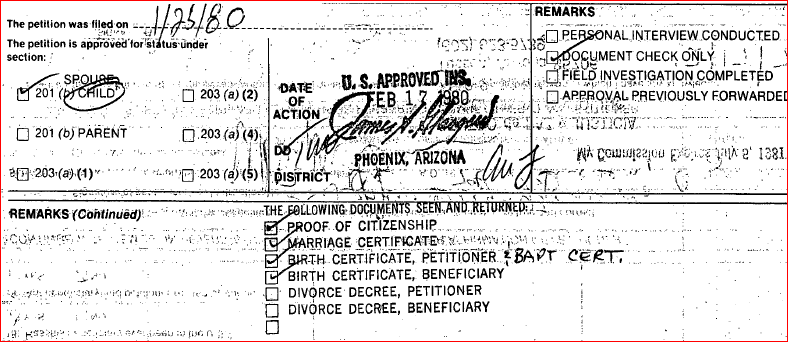
Documents recently received in response to a request under the Freedom of Information Act show that the government actually approved Esteban's petition for U.S. citizenship in 1980 but never informed him or his siblings of this, and then pursued efforts to reverse the approval, going so far as to hide records from its own investigation that confirmed Esteban's claim to U.S. citizenship.  The result has been the ethnic cleansing of Esteban and his family from their rightful places in their Tucson homes and history.

From Esteban's 1084 page file, of which 148 pages were redacted in their entirety:

INS Never Sends Esteban's February 17, 1980 Citizenship Approval.


 Note that there is nothing to indicate that there was any tampering or fraud involved with the documents submitted and that they were "seen and returned."  Nonetheless, On May 1, 1989, an ICE predecessor agency Immigration and Naturalization Service (INS) agent wrote a letter to Jesus Tiznado stating that it was revoking the approval he never received.

1982 Investigation
Two years after approving the Tiznado petition to recognize Esteban as a U.S. citizen, the INS Tucson office initiated an investigation into the validity of  Jesus Tiznado's delayed birth certificate showing birth in Topawa, Arizona.

In a request of the Mexican government to search for "Birth Record or no existence Record" for Jesus in El Plomo, Sonora and Hermosillo, Sonora, the INS officer wrote: "several of the children have his place of birth as Topawa, Az. and several have it as El Plomo, Son., Mexico.  The ones that show Arizona have been altered...It is possible that we have a suspect third party agency involved."


-The Mexican government conducted the search and a December 14, 1982 notation on this same document indicates the INS received documents from the Mexican government certifying its search of official and church records revealed no records of birth for Jesus Tiznado.


 1985 Investigation
Not content with these responses, the agency in 1985 continued its efforts to purge Jesus and his children from the ranks of U.S. citizens, requesting on this occasion a search of the records in Rancho Vera Cruz, and requesting yet another request of the records of El Plomo, both in the state of Sonora.


 Not only were no documents found but the Mexican government issued several certificates stipulating that these records did not exist.


 Furthermore, Esteban's 1979 certificate of legitimacy issued by Mexico states Jesus Tiznado was born in Topowa, Arizona, and shows no indications of having been altered, nor does the INS suggest otherwise.

Indeed, INS records also show that immediately upon copying the records, the originals were all returned, raising questions about the basis for the officer's assertions that they were "visibly altered."

2010 ICE Arrest Report States Jesus Born In Topawa, Arizona
Furthermore, ICE's own recent records indicate Jesus Tiznado IS a U.S. citizen.
An October 18, 2010 ICE warrant of arrest and removal issued in Salt Lake City for Esteban indicates that Jesus Tiznado's nationality is "United States."


(Why did they nonetheless deport Esteban again?  Because that's what ICE does.  The ICE arrest report notes Tiznado's 2000 conviction for Illegal Reentry but has no reference to the more recent Not Guilty verdict from his trial on the same charge in 2008.)

Why the change between 1980 and thereafter?

The May 1, 1989 letter states the reasons for this decision: "an investigation into the documentation used to obtain the delayed birth certificate [for Jesus], documents relating to other family members, and the testimony of various family members which is a matter of record..."

An undated report titled "Esteban Tiznado-Reyna, United States Citizenship Analysis" by DHS Assistant Chief Counsel Robert C. Bartlemay appears to have been prepared in late 2011, after Esteban had emphasized to his most recent ICE captors the 2008 jury Not Guilty verdict based on his U.S. citizenship.  It appears to be a justification for proceeding with his deportation despite evidence of Esteban's U.S. citizenship. 

This analysis provides the most explicit factual allegations for this reversal.  It is a deeply disturbing document, and will be more so if it turns out to be representative of how the Tucson office was handling citizenship applications for people of Mexican descent.

For its 2008 Illegal Reentry prosecution, the U.S. claimed that Esteban's sister's birth certificate indicated that Jesus was born in Rancho Vera Cruz, an assertion the jury rejected after hearing the testimony of USCIS officer Jaime Yslas and that Bartlemay reiterates.

Bartlemay never mentions any of the  the Mexican government's research falsifying the U.S. government's claim Jesus was born in any of the places INS claimed he was born, including Rancho Vera Cruz.  Bartlemay never reflects that the evidence in his own dossier shows only one government issued a birth certificate to Jesus Tiznado: the government of Arizona, in the United States of America.

Instead, Bartlemay wades into irrelevant and unsubstantiated minutiae, much of which is actually falsified by the agencies' own records.  This includes asserting that Esteban's mother, "stated before an immigration officer that Respondent's father was a native and citizen of Mexico" and that "Respondent's father used one of his brother's paperwork to claim birth in the United States."   (Under oath during the trial and when I spoke with her, Julia denied ever making this statement and the government has produced no specific evidence of this alleged statement; other records attribute the statement to the daughter and it appears Bartemay just misread this.)

 More importantly, anyone with a passing familiarity with the documents, especially a government immigration attorney, would realize that such a claim can't possibly be true: all of the government documents the agency credits with (falsely) asserting Jesus's U.S. citizenship are in relation to Jesus's children or his wife.   That is, Esteban's and his siblings' birth certificates, Julia's marriage certificate, and the birth certificates of the other siblings are all from documents for Jesus's family members, not that of his brother, Miguel.

The only other document at issue that could have been altered would be the baptismal certificate, but I personally verified with the Pagago church that they have an entry in their original 1924 books for the baptism of Jesus Tiznado, as well as an earlier one for his brother Miguel, a point volunteered by the woman doing this search for me because someone had recently contacted them for this information to prove the U.S. citizenship of Miguel's grandson and Esteban's cousin, Humberto Tiznado.  (Humberto had been deported several times but in 2011 was issued his Certificate of Citizenship, thus confirming that these earlier actions were unlawful.)

There are a few other points Bartlemay raises to cast doubt but all of them are contentious and lack documentation, in contrast with the documentary evidence Jesus was born in Arizona.  For instance, Bartlemay credits his daughter's alleged statement that Jesus was born in Mexico (she also denied under oath making this statement)  but discounts a sworn statement about Jesus's birth in Arizona: "The affidavit prepared by Respondent's friend stated that he met Respondent's father when he [the Respondent] was three years old, and therefore could not provide evidence regarding the father's place of birth."

Who is more likely to have more immediate historical knowledge of a family's actual residence, an adult who knew Jesus Tiznado and his family since he was three, or Jesus's daughter, who denies making any statement indicating Jesus was born in Mexico and more importantly for these purposes was not cognizant of her family history until her father was an adult?

True enough, the burden of proof is on Esteban to come up with the documents proving he meets the criteria for acquired U.S. citizenship but the standard does not require people to overcome trumped up analyses based on secret and uncorroborated so-called evidence.

What Next?
Esteban has a hearing at the Florence Immigration Court scheduled for June 4, 2012.  This is a master calendar hearing, and thus it may be weeks or longer before Esteban's pro bono attorney David Ouimette has an opportunity to review the underlying documents or cross-examine the government experts.

Esteban's arrest a couple of months ago has devastated his family.  According to his sister, he was picked up because the habeas order prohibiting his arrest had expired; when Esteban saw some police, he ran.  And when they saw him running, then they chased him, caught him, and figured out he had been deported.  He's being held in the wing of the Pinal County Jail under contract to ICE. At the very least ICE needs to release him pending a hearing on the merits of his case.

Arizona demonstrably issued Jesus Tiznado a birth certificate. The Mexican authorities demonstrably did not issue Jesus Tiznado a birth certificate.  In light of this evidence, not to mention, the copious documentation of Jesus's residence in the United States for the requisite time periods, the DHS at the very least needs to comply with John Morton's November 19, 2009 memorandum requiring ICE not to detain someone with possibly probative evidence of U.S. citizenship: ""In all case, any uncertainty of whether the evidence is probative of U.S. citizenship should weigh against detention." 

For more on Esteban's case, please go here.