Wednesday, August 11, 2010

InSecure Communities


According to today's Los Angeles Times, the Department of Homeland Security (DHS) will be increasing its use of the IDENT database, even though this database has produced false positives leading to the arrest of legal residents and U.S. citizens. ("Secure Communities" is the Orwellian name of the program for rolling out its use by local law enforcement agencies.)

On Sunday Colorado public radio station KDNK's Matt Katz and I discussed a specific case of an IDENT screw-up that he's been covering in Carbondale, where, on July 20, 2010, Immigration and Customs Enforcement agents stormed into the home of U.S. citizen Marco Guevara with the intent of deporting him.

The conversation is about 15 minutes and you can listen here.

Tuesday, August 10, 2010

ICE Deports Wrong Man, Attorney Fights Back


As the Department of Homeland Security (DHS) expands its database surveillance programs, civil libertarians have feared, rightly, the agency encroaching on privacy interests. However, equally worrisome is that the government might arrest and deport you by encroaching on someone else's privacy.

Immigration and Customs Enforcement (ICE) agents and local law enforcement officials have been using a DHS database (IDENT) and coming up with false positives and then including in their arrest reports information consistent with the match and excluding from the arrest report information inconsistent with a match. The cases I've seen typically involve two records for two different people: one record is for someone with legal status to remain in the country and the other record is for someone ICE has put into removal proceedings. ICE claims in these cases that one or the other names is an alias and the two records are for the same person.

That means that you could have an arrest warrant issued to you based on ICE claiming that you are "really" someone else. The secrecy of these databases and their protocols, as well as DHS attorneys' failure to produce authenticated and verifiable underlying evidence, makes it difficult to impossible for respondents who lack legal counsel to challenge these orders.

Attorneys have a hard time challenging these matches as well. Florence Project attorney Kara Hartzler's July 20, 2010 Motion to Appeal EOIR adjudicator Linda Spencer-Walters' removal order for someone who was deported on February 2, 2010 provides insight into how ICE agents are playing around with information on their reports and how EOIR adjudicators, many of whom are former ICE attorneys, are rubber-stamping the misinformation.

Ms. Hartzler's incisive and informative appeal contains important legal and factual analyses useful for challenging ICE in these cases. I am posting it here, with the personal information about the respondent and someone else redacted, because her analyses may be helpful for other attorneys confronting similar situations.

By the way, folks who are familiar with the poor quality of decisions by Ms. Spencer-Walters, an adjudicator at the Eloy Detention Center, may know that she is a former ICE attorney but may not realize that she was the ICE attorney who vigorously pursued the deportation of four star high school students in a well-publicized 2005 case following their arrest on a field trip.

An immigration judge in Phoenix, John Richardson, squashed the deportation order on the grounds that it was obtained based on unconstitutional racial profiling, according to Daniel González, a reporter for the Arizona Republic. His story describes two students quoting Border Patrol agents in Buffalo: "In Arizona they may not stick out because there are a lot of Hispanics, but in Buffalo they were eventually going to get questioned."

Ms. Spencer-Walters lost the case but as an apparent reward for her dogged efforts to deport honor students -- the hearing lasted six hours -- the Department of Justice made her a job offer and in 2008 she was sworn in as an adjudicator. Now she can just deport people herself and not bother with little things like the Constitution and evidence.

Monday, July 26, 2010

Deported US Citizen Johann Francis Interviewed on CNN

Yesterday CNN's Don Lemon interviewed Johann Francis, a U.S. citizen ICE deported in 1999, and Rachel Rosenbloom, a Northeastern University Law School Professor. Professor Rosenbloom is an expert on citizenship and immigration law. They discussed Mr. Francis's 10 year forced exile in Jamaica and why the Arizona law and the continued lack of legal counsel for people in ICE detention means more US citizens will find themselves in his position.

CNN Producer Tina Kim linked the interview on her blog, and you can watch it here.

Mr. Francis's story was first reported on this blog when he returned for Christmas in 2009. You can read the details here.

Monday, July 19, 2010

"The Kids Are Alright"...But the Parents Are A Mess


Lisa Cholodenko's latest film "The Kids Are Alright" (2010) has received glowing reviews, including New York Times' A.O. Scott's coveted status as a "critic's pick." It is indeed a fine piece of work but as a symptom of the Zeitgeist, it makes me utterly despondent.

Reader beware: if you haven't seen the film and care about suspense, read a real reviewer, someone who knows better than to reveal key plot details. This is for people who've seen the film or who like to know what they're getting into (or avoiding).

As the trailer suggests, Nic (Annette Bening) and Jules (Julianne Moore) have raised two children to whom they each gave birth, respectively, from the sperm of the same donor (Mark Ruffalo). The kids are teenagers, one is leaving for college, and "Dad" is suddenly on the scene, and connecting with Jules in a way that poor Nic never has and never will. (Paul and Jules have passionate sex; Jules and Nic seem to have done nothing but hold hands for years and years.)

Worse, there was nothing else that seemed meaningful between them except the responsibilities of parenting.

A lawyer was among the friends with whom I saw the film. Over hot dogs (with and without meat) and beer on a fabulous Manhattan patio the size of Nic's and Jules' SUV, he disagreed with this assessment and said that they shared a connection. Evidence of this was the story they told in response to Paul's (Ruffalo's) question about how they met. But that particular story was really a portrait of two forlorn people whose meeting-story had been told so many times it was drained of emotion or meaning, a worn out touchstone for a romance that was never more than the aspiration for romance based on insidious films like Cholodenko's (but hopefully those films had plots that depicted actual romance).

Someone else who approved of the film's message replied that marriage's magic was not always apparent to the outsider.

True enough. But this is a drama, not a documentary.

(It really bothers me when educated people talk about the secret, private lives of fictional characters, mostly because it's a symptom of the primitive intuitions that persist when it comes to narrative, a low-level of common sense intolerable in any other field.)

Anything we see or do not see in "The Kids Are Alright" is because Cholodenko made a choice. If she wanted to show a hidden connection between Nic and Jules, she was free to do just that. Sure, it was a tight budget but it doesn't cost less to shoot constant fuming anger, frustration, and despair than empathy and joy. In the film Cholodenko co-wrote and directed, she made a choice to celebrate a relationship between two people who were unable to bring happiness to the other, and who kept disappointing these expectations, making matters worse.

Charity Scribner, a comparative literature professor at CUNY, agreed that the film showed nothing redeeming in the relationship between the moms, and then made the brilliant point that she thought this was Cholodenko's intention. After all, Charity said, the title is "The Kids Are Alight." Cholodenko is making an incisive observation about generations, Charity suggested. The lesbian moms reproduced the same suburban pain and suffering they were taught in their own homes. The teleology of their remaining together merely represented a culture for which they were they last forbears. Their own children, who were the film's primary conduits of light and possibility, were now free to do something different, something better, something meaningful, something honest and fun.

Charity's partner disagreed and said the film really was about two people just sticking it out.

Alas, having read the interviews with Cholodenko, it appears that while Charity's film was brilliant, her partner was correct; Cholodenko's intentions really were banal and reactionary.

If you google "Cholodenko intervew," portions of which seem to be channeling James Dobson and Phyllis Schlafly, you'll see what I mean.

The moral of Cholodenko's film, at least according to Cholodenko, is: who cares about anything except the fact that they stay together? Isn't that what families are for? In Cholodenko's film, the country's 50 per cent divorce rate is the talismanic enemy, not a symptom of a painful, archaic institution that Cholodenko reveals as stifling desire, sex, and connection.

The problem with the film is that the relationship between the moms is hollow, miserable, depressing and without any redeemable qualities, save that they raised two children who are alright. Jules at one point gives an impassioned speech affirming the relationship, but the reason she gives is that they've stuck together. Outside of raising two children, Nic and Jule's relationship's only alleged virtue is a tautology: it is good they are together because they are together. (If you stick to the plot, raising two children together is not going to be enough once the kids graduate, yet it is clear that Jules and Nic will disappoint each other until death do they part.)

The upshot is a major victory for conservatives, on whose behalf Cholodenko has made the following blow for same-sex marriage: lesbians are not like any other happy couple but like any other miserable, melancholic couple who cling to each other out of fear not love. Go Prop 8!

Thursday, July 15, 2010

U.S. Citizens Detained and Deported: 2010 Fact Sheet

FACT SHEET ON THE U.S. GOVERNMENT

DETAINING AND DEPORTING U.S. CITIZENS

This fact sheet is a response to recent requests for original data.

Findings based on this research have been published in The Nation magazine, States Without Nations: Citizenship for Mortals (Columbia University Press, 2009), and on this blog (see tag ICE Deporting US Citizens).

.In January, 2011 the Virginia Journal of Social Policy and the Law will be publishing “U.S. Government Detaining and Deporting U.S. Citizens as Aliens,” a 78-page typescript.

"It is better that many Chinese immigrants should be improperly admitted than that one natural born citizen of the United States should be permanently excluded from his country."

--U.S. Supreme Court Judge John Clark, majority decision in Fat v. White 253 U.S. 454, 464 (1920).

Key Findings

#1 In 2010 The Department of Homeland Security (DHS) Bureau of Immigration of Customs Enforcement(ICE) continues to unlawfully detain and deport U.S. citizens and to issue false and misleading statements about these activities.

#2 The agency running the immigration courts, the Department of Justice's (DOJ) Executive Office of Immigration Review (EOIR), is a paranoid and bureaucratic backwater beset by cronyism, malfeasance, and close ties to the DHS, rendering many immigration courts, especially those hearing detained respondents, incapable of providing checks on ICE lawbreaking, including ICE's detention and deportation of U.S. citizens.

FINDING #1

RATE OF U.S. CITIZENS DETAINED IN MAJOR LEGAL ORIENTATION PROGRAM SERVICE AREA

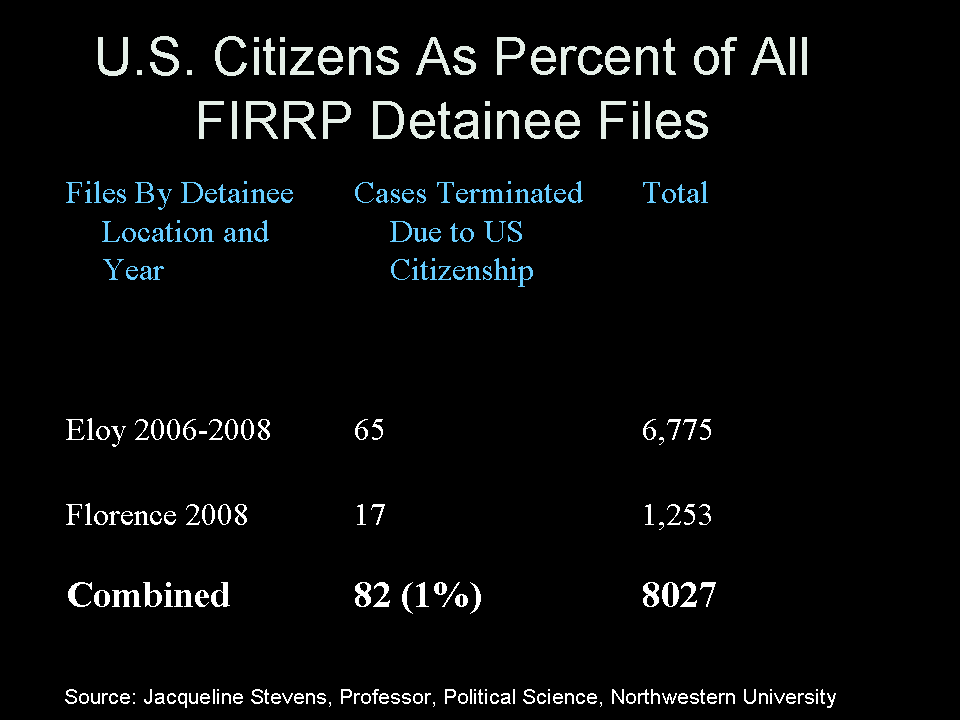
From 2006 to 2008 one percent of people in ICE detention centers in Southern Arizona who consulted with attorneys funded by the Department of Justice Legal Orientation Program had their cases terminated by immigration judges because they were U.S. citizens (82 out of 8,027).

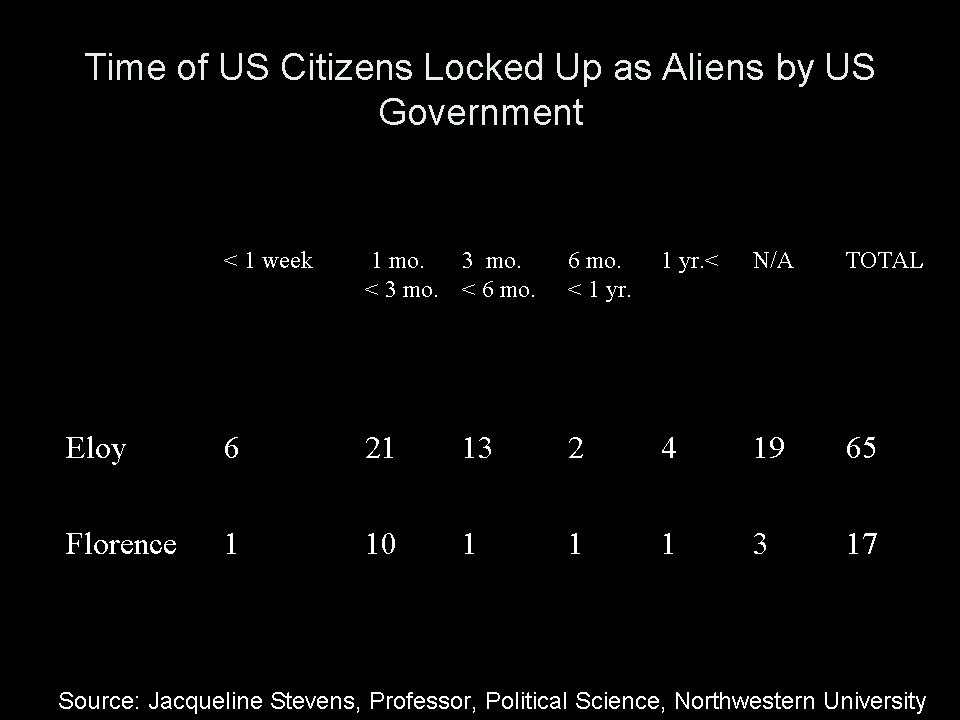
(For chart indicating length of time U.S. citizens held in Arizona jails please go here.)

Only a handful of detainees who were U.S. citizens in ICE detention had been convicted of violent crimes; the majority were reported to ICE while serving sentences for drug convictions.

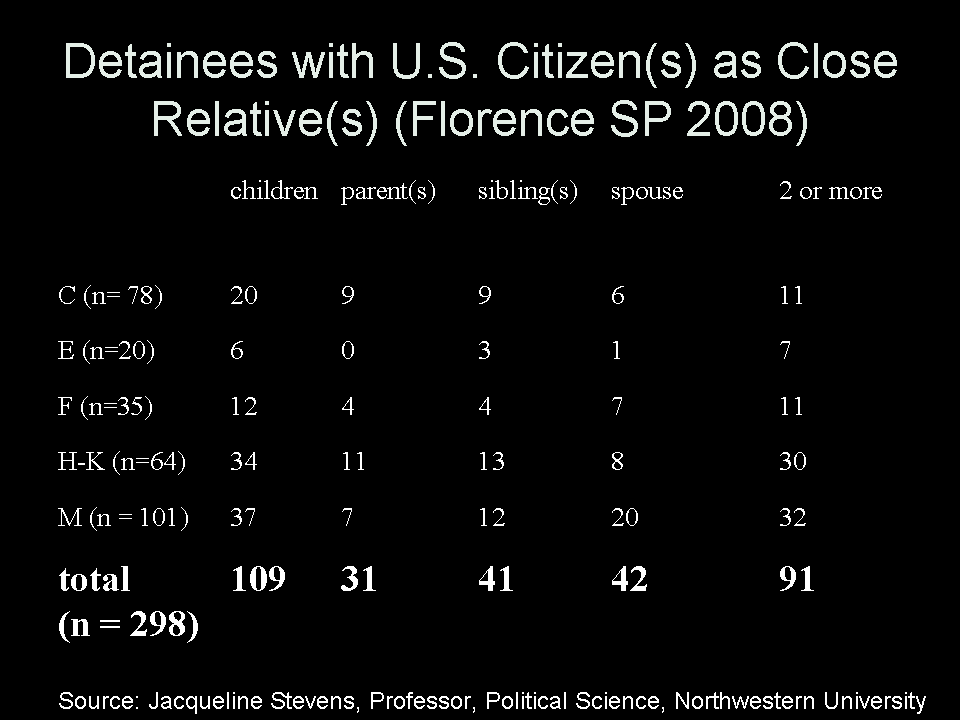
This population of Southern Arizona detainees for the most part originates in California prisons and jails, and accounts for approximately 10 per cent of all detainees nationwide; it appears to be broadly representative of people held in other detention centers. About 30% of the people detained who were not U.S. citizens nonetheless had two or more close relatives who were U.S. citizens.

A 2009 report by the City Bar Justice Center's NYC Know Your Rights Project noted that eight per cent of people who were held in the Varick Detention when they conducted a survey had apparently valid claims to U.S. citizenship.

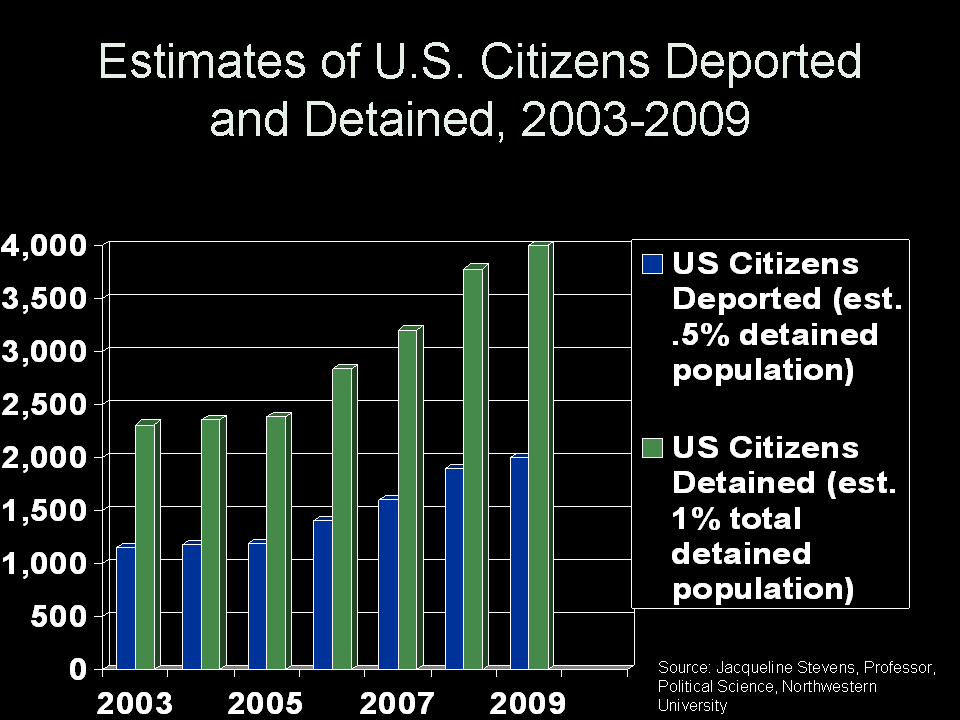
Last year ICE held over 400,000 individuals, including approximately 4,000 U.S. citizens. (See chart for 2003 to 2009.)

RECENT EVENTS
ICE public affairs and other officers are claiming that a November 19, 2009 memorandum issued by ICE Assistant Secretary John Morton has addressed successfully the problem of ICE detaining U.S. citizens.

Far from being evidence of ICE cleaning up its act, such statements to members of Congress and the press are further evidence of government malfeasance and deceptions. As recently as June, 2010, Mr. Luis Delgado, born in Houston, was threatened with prison and turned back to Reynosa, Mexico at the same border crossing where Mr. Mark Lyttle was twice turned away 18 months earlier.

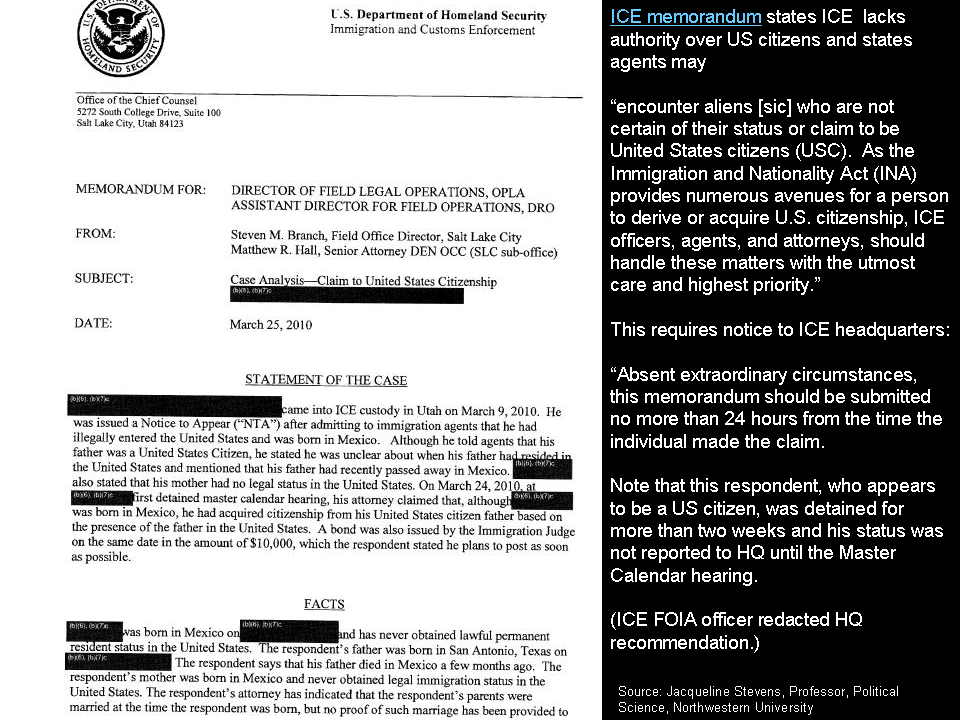
In a June, 2010 response to my request under the FOIA, an ICE FOIA officer told me he had received a CD with over 4,000 pages of email traffic to its email "drop box" between November 19, 2009 and March 29, 2010. He reviewed and mailed a hard copy of the most recent 100 pages at the time (March 17 - 29, 2010). The reports redact the legal response advised by ICE Headquarters.

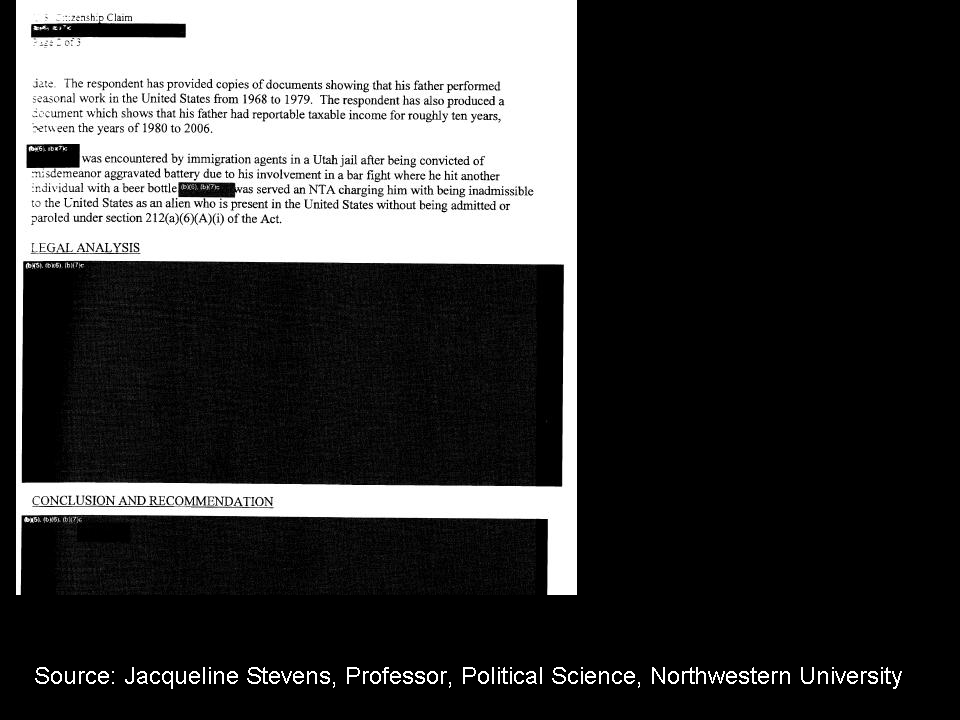
Two inferences are obvious from the documents I received: 1) ICE agents are demonstrably violating the 24 hour requirement by days and even weeks; 2)ICE continues to lock up people with probative evidence of U.S. citizenship.

For an ICE memorandum pertaining to someone claiming US citizenship and held in March, 2010 in violation of ICE procedures and US law, please see PAGE ONE and PAGE TWO.

Also, ICE has not insured its agents know about the new procedures. Therefore the inquiries of the drop box are understating the actual number of cases of detainees who have probative evidence of U.S. citizenship.

In January, 2010 I called a Florence, Arizona deportation officer to find out if Joseph Anderson's original birth certificate (with his USC father's name on it and a recording noting marriage to Joseph's mother as well as noting Joseph's birth as "legitimate") were "probative evidence" of his US citizenship. The deportation officer had no idea what I was talking about and stated he had not heard of this memorandum.

He gave me his email address and I forwarded the ICE memorandum I'd obtain under the FOIA. (After I posted it on my website, ICE posted the Morton memorandum on its website.)

(Mr. Anderson's been locked up in ICE custody at the Pinal County Jail for over two years.) Herbert Flores-Torres, a U.S. citizen, had to endure detention for over four years before ICE complied with the order of a federal judge to recognize his U.S. citizenship and release him. This occurred in December, 2009.

Mr. Anderson told me that when ICE first picked him up, the agent in the Phoenix office told him that the agent didn't know the meaning of "legitimate" in immigration law and was therefore going to detain him.

DEPORTED U.S. CITIZENS
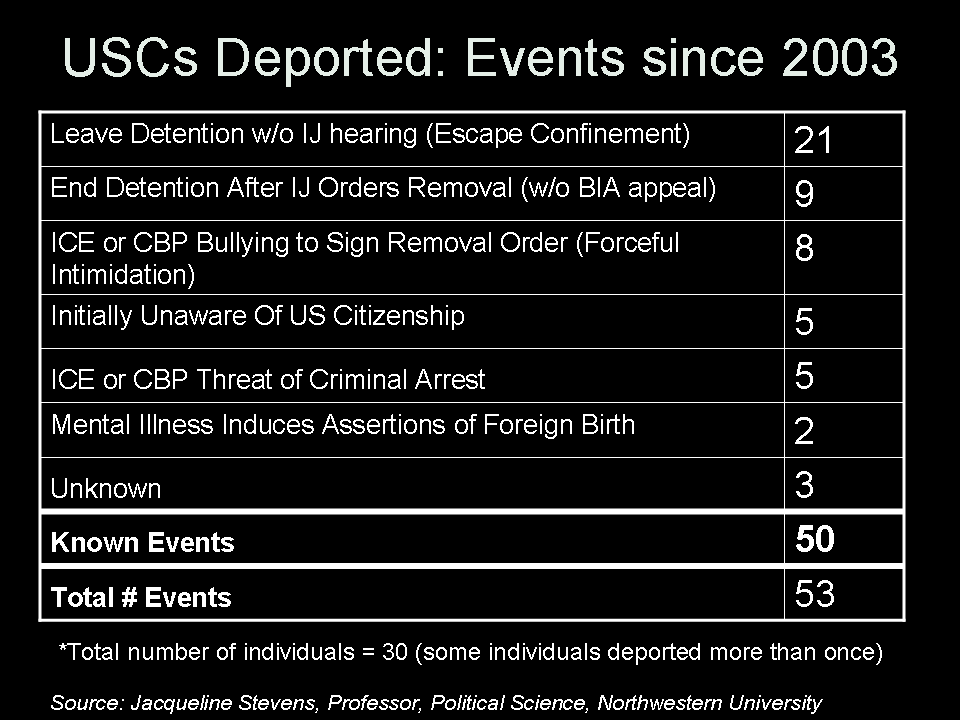
In the 30 cases I have documented in which the U.S. government actually deported U.S. citizens (this does not include the events associated with the recent deportation reported in the Houston Chronicle), the most common factors were U.S. citizens falsely indicating alienage to escape detention, ICE deportation officer threats, and CBP threats and destroying valid legal identification. This has meant years of exile and statelessness (see, e.g., Johann Francis).

-Among the cases I reviewed since 2003 were 19 U.S. citizens who were deported and served prison sentences after being convicted of Personation of a U.S. Citizen (18 U.S.C. 911) or Illegal Reentry (8 U.S.C. 1362), crimes predicated on alienage.

The similarity of the underlying fact patterns in these cases, and their consistency with practices that pervade ICE offices, indicate that the phenonomenon of deporting U.S. citizens is underreported, especially because the government can make it so difficult to falsify the incorrect assignment of alienage.

For instance, on his return from Guatemala after obtaining a U.S. passport through the U.S. Embasssy in Guatemala City, CBP and ICE officials arrested Mr. Lyttle at the Atlanta airport and completed Expedited Removal forms as they, in collaboration with ICE trial attorneys, attempted to deport Mr. Lyttle to Mexico for a fourth time (he was deported twice after he tried re-entering from Mexico).

(For previous reporting on the pattern of CBP tearing up or disregarding U.S. government documents presented by U.S. citizens of apparent Mexican descent, please go here.)

- Nationwide data indicating ICE is holding U.S. citizens include: independent reports from two immigration judges; a 2010 Master Calendar hearing of 105 individuals I observed, which included one U.S. citizen; a survey of pro bono immigration firms listed on a DOJ website for Southern California--in response to inquiries of 15 firms in 2008, 7 replied they had represented one to four U.S. citizens in the last three years.

-Representativeness of Southern Arizona data: The Arizona data may understate the denominator because people who are truly hopeless about their legal status may not meet with the LOP attorneys; but the Arizona data may also understate the total number of U.S. citizens in ICE custody because U.S. citizens are more likely to obtain their own private attorneys and thus would be less likely to meet with LOP attorneys and initiate a file on their cases.


FINDING #2

Immigration courts are run by an agency, the EOIR, whose practices and policies, including unwritten ones restricting access to the courts, are rooted in cronyism and paranoia. EOIR staff nationwide vary in their efforts to follow immigration hearing laws and regulations. Respondents are at the mercy of this decentralized system. The legal counsel at the EOIR headquarters in Falls Church, Virginia have violated FOIA laws, rebuffed inquiries from independent researchers and journalists, and ignored clear evidence of misconduct by EOIR attorneys running the immigration hearings.

William Cassidy and Dan Pelletier, who run hearings for those detained at the Stewart Detention Center, have, according to TRAC at Syracuse University, the highest rate of deportations nationwide and are regularly violating the laws, regulations, and rules for immigration hearings. This incentivizes U.S. citizens, legal residents, and immigrants to give up on legal claims to remain in the United States.

EXAMPLES:

No Check to Ensure Respondents Receive Copy of Government Charging Documents.

If ICE actually allows someone to appeal a removal order by going to an immigration court, a federal regulation requires that the government's basis for seeking removal is shared with the respondent. The first thing that the vast majority of immigration judges do at a Master Calendar hearing is ask the respondents at the hearings if they received this. Judges are also supposed to review the charging document and make sure the respondent has this.

Mr. Cassidy and Mr. Pelletier demonstrably do not do this. Instead, at hearings I have attended and in recordings to which I have listened, the judges TELL the respondents that they were served a "Notice to Appear," a phrase that is itself utterly meaningless. Indeed, one individual, who had been alerted by his attorney about the legal problem of not receiving a Notice to Appear, tried to tell the judge that he had not received this. In this case and others when respondents made inquiries of Mr. Pelletier he ignored their questions and, over the television monitor, barked the next name.

At one hearing that was supposedly a "mass removal" -- everyone has supposedly agreed in advance to be deported and just raises their hands in front of a camera (of course many just sit still with arms folded and show no indication of agreeing with anything Mr. Pelletier is saying on the television screen) -- immediately after Mr. Pelletier adjourned the hearing, several longterm U.S. residents asked the CCA guard when they were going to talk to the judge. The guard ignored the question and was trying to escort them out of the room to lunch. The detainees explained their plight to me and I alerted the ICE trial attorney who requested the judge resume the hearings. It was too late for one detainee who was already outside the court room. I believe that if I had not been present none of them would have spoken with the judge.

Inadequate and Misleading Bond Information.

A key reason people agree to deportation is because they want to escape detention centers. Many are eligible for bond but do not realize this because their deportation officers lie to them and they do not know how to request bond hearings of the EOIR.

Even if they do request a bond hearing, no regulation guarantees this will occur in a timely fashion. Two attorneys who represent clients in the Stewart Detention Center told me of bond hearings being frequently canceled.

At the Eloy Detention Center in southern Arizona, an EOIR attorney presiding over hearings, Mr. Richard Phelps (appointed during the Monica Goodling era), allows those who are resourceful enough to pursue a bond hearing, to hear his TAPE RECORDED INSTRUCTIONS. Following the recording, which is largely incomprehensible to anyone without immigration law training (and concludes with his chit-chat with someone helping him with the recording), the detainees ask questions of the CCA guard prior to Mr. Phelps returning to the court room where he impatiently brushes off the respondents' inquiries.

I encountered one individual who was awaiting a hearing on his green card application following the marriage to his U.S. citizen wife; he had overstayed a tourist visa and had no criminal history. It took three months before he was able to navigate his release on the minimum $1500 bond, an indication of unnecessary detention that cost not only his freedom but also the U.S. taxpayers approximately $9,000.

These experiences encourage U.S. citizens, legal residents, and immigrants to agree to deportation rather than endure the harsh and arbitrary conditions of detention and U.S. immigration courts.

Secret Evidence.
On December 8, 2008, William Cassidy encountered in Mr. Lyttle's "alien file" the ICE arrest report (I-213) showing his claim to be born in North Carolina. As is the case for other EOIR files I have examined, it lacks a "certificate of service" indicating that ICE shared it with Mr. Lyttle, a violation of 8 C.F.R. § 1003.32. During the hearing, Mr. Lyttle asked Mr. Cassidy for a copy of the paper he was reading. Normally a judge will order the ICE attorney to make a copy, but neither the ICE attorney nor the judge did this. Following the judge ignoring his entreaties, Mr. Lyttle filed a grievance requesting a copy of the I-213 but never received it.

I recently obtained an EOIR file for another respondent who appeared in the Stewart Detention Center immigration courts in 2010. It also contains what appears to be deliberately falsified information on an I-213 report that was never shared with the respondent. Mr. Pelletier, the EOIR attorney who presided over the hearing, did not require that the ICE attorney share a copy with the respondent.

Based on my own observations and conversations with practitioners in the area I believe that every EOIR file for those who are in ICE custody and have their hearings at Stewart or Atlata contains I-213s that have not been shared with respondents.

Unlawfully Closed Hearings.
A DOJ regulation states that, specific exceptions notwithstanding, "All hearings, other than exclusion hearings, shall be open to the public..." The EOIR regularly violates this rule by holding hearings in several detention centers where security guards block access. The EOIR also allows immigration judges to close hearings in non-detained buildings without legal reason or penalty. (You can read about this in The Nation and more recent postings about the EOIR on my blog.)

Mr. Cassidy and Cynthia Long, the court administrator in Atlanta, Georgia, have incorrectly told court watchers that a docket listed asylum hearings and therefore they could not attend when the truth was that the docket a) did not include asylum hearings; and b) asylum hearings are only closed at the request of the respondent. This provision is to ensure foreign agents do not retaliate against family members in a respondent's home country. It is a cruel abuse to lie and use the regulation for the purpose of obstructing access to hearings by religious, pro-immigrant observers who want to keep an eye on Mr. Cassidy, a former ICE prosecutor who has one of the highest rates of asylum denial in the country.

The Department of Justice Executive Office of Immigration Review is charged with managing immigration hearings, but its staff in Washington, D.C. also regularly violate federal laws, regulations and rules designed to thwart misconduct. I will be describing these in more detail in a forthcoming article.

Conclusion.
The criminal and regulatory violations perpetrated by the DHS and EOIR vastly overshadow the small infractions of immigration law for which the deportation agencies and their increasingly costly budgets were established.

The government has reporting systems in place that would allow it to systematically track the rate at which deportation orders are terminated because of U.S. citizenship, but ignore Congressional inquiries and fail to collect the requested data. (This could be done easily through by EOIR, if it reported findings of nationality in its Statistical Yearbooks as reported by immigration judges and not ICE attorneys. At present the EOIR's Statistical Yearbook inaccurately lists respondents who are U.S. citizens as having the nationalities ICE ascribes to them and is another indication of the EOIR's poor record-keeping and lack of independence.)

A further problem is that the agency at the DOJ that is supposed to oversee the EOIR, the Office of Professional Responsibility (OPR), is infected by a similar culture. Like the EOIR, OPR is being run by an Acting Director, Mary Patrice Brown, who is a career civil servant. Brown is on leave from her position as a U.S. attorney.

According to the Washington Post's WhoRunsGov.com, Brown has close ties to Attorney General Eric Holder and is rumored to be in line for a position as a federal judge. Brown's appointment seems designed to prevent the OPR from performing as an independent watch dog within DOJ. The OPR is clearly violating the FOIA statute -- in violation of an April 2010 remand from the DOJ Office of Information Policy OPR will not release reports of immigration judge misconduct -- and is so secretive that it refuses to release its 2009 Annual Report.

SOLUTION:

The only way to protect the rights of U.S. citizens and legal residents is to provide an assigned attorney at government expense to anyone arrested by ICE and either held in detention or issued an Expedited Removal Order or an Administrative Removal Order who cannot afford an attorney. Absent this, it is impossible to check the abuses of discretion as well as law-breaking by ICE and border patrol agents.

Expensive? Yes, just as assigned attorneys for indigent people accused of crimes is also costly. This is the cost of doing the nasty business of implementing deportation laws.

If the U.S. public truly wanted to save money, increase jobs, and give a shot to the housing market to boot, it could abandon this parochial cause, as will surely occur eventually. This might seem far-fetched, but not as far-fetched as requiring government documents to travel from the villages to London, or to move within the colonies, as also was deemed imperative for order, the unregulated movement of poor people regarded as a clear threat to stability. Such a policy, once relinquished, now seems a provincial and ridiculous restraint on freedom and justice, not to mention commerce, as will the restriction on movement among countries appear to populations in a few hundred years.

Postscript: In May, 2010 a settlement agreement was reached in which the U.S. government agreed to pay $350,000 to a trust fund for Peter Guzman and his mother because Mr. Guzman was born in Los Angeles and in 2007 the U.S. government deported him. (The agreement has not been finalized by the judge but appears to be on track for this to occur shortly.)

--RSS Subscribers: you received two messages because of time-stamp problem on first one. My apologies for the confusion. (If you are not using the RSS and would like to be notified of new posts on this blog, please click on orange box in right-hand corner of url box.)

Monday, June 28, 2010

U.S. Citizens Detained and Deported: 2010 Fact Sheet

FACT SHEET ON THE U.S. GOVERNMENT

DETAINING AND DEPORTING U.S. CITIZENS

....

July 15, 2010: There was a time-stamp problem. The post for this title is here.

Apologies for any confusion!


Wednesday, June 9, 2010

U.S. Border Patrol Kills Mexican Teenage Stone Thrower Protesting the Occupation


The map shows El Paso belonging to Mexico until the mid-nineteenth century, when the U.S. government acquired sovereignty after invading Mexico City. (It is taken from a Latin American Studies web page that has several excellent maps on the land grab.)

Today's Los Angeles Times features an AP story "Border Patrol in El Paso kills Mexican teen":
Preliminary reports on the incident indicated that U.S. officers on bicycle patrol "were assaulted with rocks by an unknown number of people," Border Patrol Special Operations Supervisor Ramiro Cordero said Tuesday.
The article connects this violence with the U.S. government's targeted and deadly electrocution of someone walking across the border in California:
Less than two weeks ago, Mexican migrant Anastasio Hernandez, 32, died after a Customs and Border Protection officer shocked him with a stun gun at the San Ysidro border crossing that separates San Diego and Tijuana, Mexico. The San Diego medical examiner's office ruled that death a homicide.
The article offers a compassionate portrait of the death's impact on the teenager's family. But, resembling coverage of similar events in Israel-Palestine, the reporter quotes extensively from the U.S. government explaining its armed presence in the area and provides no response from political and religious organizations challenging this.

Of course the real problem is not the unrecognized principle of Mexican or any other nation's sovereignty, but unrecognized principles of justice that require free movement and thus the elimination of birthright citizenship.

----
For a more balanced story, including an eyewitness challenging the Border Patrol version of events, listen in to NPR's Monica Ortiz Uribe on "All Things Considered."

Thursday, June 3, 2010

Administrative Removal and the Deportation of a US Citizen


This is a copy of a "Notice of Intent to Issue a Final Administrative Removal Order" issued on September 5, 2008 to a U.S. citizen. It was canceled about eight months later, after Mark Lyttle had spent about four months stateless in Mexico and four other countries in Latin America. (For more on his experience, go here. And here.)

In the wake of a new Arizona law authorizing local police to make inquiries about residents' immigration status, people are beginning to realize how laws supposedly designed for aliens are affecting U.S. citizens.

As I've reported previously, the number of U.S. citizens already incarcerated by ICE are alarming: my research suggests that last year approximately 4,000 people who went to an immigration court with deportation orders had their cases terminated because they were U.S. citizens. (Of course this should not be that surprising: absent assigned counsel and a working immigration court, the real shock is that the number of U.S. citizens detained and deported is not higher.)

Especially disturbing are those who may have a legal reason to remain in the United States but are shipped out without the opportunity to even appear before an immigration judge.

Administrative Removal Orders
The legal instrument for deporting people without a hearing is either an Expedited Removal Order (usually issued at the border) or an Administrative Removal for Aggravated Felons.

According to the excellent researchers at TRAC
, ICE has been handing these out in increasingly higher numbers. In 2006, the most recent year indexed, 55% of people deported did not have a chance to be heard before an immigration judge.

The only safeguard in the procedure is a requirement that those who receive these orders have ten days to challenge them.

The regulation states:
The alien will have 10 calendar days from service of the Notice of Intent or 13 calendar days if service is by mail, to file a response to the Notice of Intent. In the response, the alien may: designate his or her choice of country for removal; submit a written response rebutting the allegations supporting the charge and/or requesting the opportunity to review the Government's evidence; and/or submit a statement indicating an intention to request withholding of removal under 8 CFR 208.16 of this chapter, and/or request in writing an extension of time for response, stating the specific reasons why such an extension is necessary.(Emphasis added.)
Of course if there's no opportunity to go to even the compromised "courts" available for people in immigration proceedings these procedures are unenforceable and, as it turns out, not always implemented.

ICE Agent Violates U.S. Citizen's Constitutional Right to Due Process
On September 8, 2008 an ICE agent working out of a clandestine facility in the rear of an office park in a Raleigh suburb visited Mr. Lyttle while he was in jail and gave him the Notice of Intent required for an Administrative Removal Order. (The document advises people they have ten days to challenge his deportation order.)

But Agent Faucette did not give Mr. Lyttle this opportunity. Instead of leaving the form with him and allowing him ten days to decide on how to proceed, she instructed him to sign the form in her presence, without him even having a chance to read it, and then she took it from him.

How do we know this? Is this a case of his word against hers? Not really. As the form indicates, the man Ms. Faucette was accusing of being "Jose Thomas" signed his name "Mark Lyttle" to indicate he had received the instructions at 12:05 p.m., the very same minute that he signed the form indicating he was waiving any appeal.

portion of form indicating Notice of Intent has been received:


portion of form indicating Mr. Lyttle does not wish to contest his deportation


According to the government's own document, Mr. Lyttle had been given not even one minute to read a piece of paper that was supposedly giving his informed consent to be sent to Mexico as a Mexican citizen, a country where he had no ties and where his lack of Spanish would prove, as it did in the rest of his exodus in Latin America, a major difficulty.

The form instructs recipients that DHS must receive the form in the mail within ten days, suggesting that the government believes it reasonable for people to have some time to contemplate their legal options:


The process by which Mr. Lyttle's signature was obtained is one that seems part of the ICE routine. An agent from the Criminal Alien Program office (in this case, the Cary subfield office), goes out to a prison or a jail, meets someone, shoves a form in his or her face, and gets the individual to sign it without a chance to read it or consider alternatives. Since the form's addressee is the Department of Homeland Security Office in Atlanta, there is no separate agency that might check on agent misconduct implementing the regulation.

This practice of assuming in advance legal questions that require protections of the rule of law and assigned counsel to be ascertained with any clarity if not justice is an ominous trend begun in the late 1980s and continued by Attorney General Eric Holder, most recently with his pitch to eliminate Miranda warnings for assumed terrorists.

Denying due process rights to citizens because they might be aliens, like denying due process rights to people because they might be terrorists, gives an illogical credibility to the unsubstantiated intuitions of law enforcement. It is not a likelihood but a certainty that under these conditions U.S. citizens have been deported, just as, pressured by law enforcement, people have confessed to crimes for which they are innocent, the very reason the Miranda warning was established.

The solutions are simple: assigned counsel for anyone in ICE custody and an increase in immigration court judges. Expensive? Maybe. Too expensive? Maybe. If so, then Congress needs to realize it lacks the resources to continue its reckless and irrational practice of paying uneducated armed thugs to interfere with the private lives of their constituents.

Post-script: Mr. Lyttle eventually was able to force an ICE agent at the Stewart Detention Center in Georgia to issue a Notice to Appear so that Mr. Lyttle could go before an immigration judge. As I've described previously, the Executive Office of Immigration Review attorney filling that position, William Cassidy, relying on dishonest ICE statements, broke various regulations, ignored Mr. Lyttle's statements, and deported him anyway.

Friday, May 28, 2010

""I was just profiled" -- CNN story on False Imprisonment of Chicago Man


Yesterday CNN news writer Tom Watts put together a great story revealing once again the inanity of deportation laws and the illegal actions they precipitate.

According to the article, Eduardo Caraballo's mother was not allowed to bail him out of a Chicago jail for a stolen car charge because of an ICE hold. But Mr. Caraballo was born in Puerto Rico, and is legally a U.S. citizen by birth, and therefore protected by law and the Fourteenth Amendment from the handcuffs of ICE.

According to the CIA World Factbook, Puerto Ricans were "granted U.S. citizenship in 1917."

ICE has no authority over anyone who is a U.S. citizen by birth, including those born in Puerto Rico. It can only justify arresting someone who makes a claim of having this status if it has proof that the person is lying, and, in this case is from Mexico. Absent such proof, and therefore legal authority, the ICE and jail officials responsible for this are violating not only Mr. Caraballo's civil rights but are also committing serious crimes of kidnapping and false imprisonment.

Further evidence that this is happening around the country, mostly through the Criminal Alien Program, recently came my way in ICE's reply to a FOIA request I submitted in March.

In just the last few months ICE HQ provided guidance to ICE attorneys concerning about 1500 people issued ICE detainers who asserted they were U.S. citizens.

Tuesday, May 25, 2010

The Theory and Practice of Immigration Detention Workshop: Some Comparisons


Manor Road Building, site of Friday's detention workshop

Last Friday (May 21) two Oxford University graduate students -- Stephanie Silverman (Politics and International Relations) and Evelyn Massa (Sociology) -- hosted an unusually fabulous workshop, The Theory and Practice of Immigration Detention.

It turns out that Oxford has three vibrant centers devoted to immigration studies: The Refugee Studies Centre, The Centre on Migration Policy and Society (COMPAS), and the International Migration Institute. Drawing on the support of the first two, Ms. Silverman and Ms. Massa brought together researchers and advocates from across Europe to present cutting-edge findings.

A few tidbits I thought especially interesting:

1) No Detention Regulation in England = Guards Committing Assault.
In response to my mentioning during a Q and A that the U.S. holds people in immigration jails without any regulations, an eminent British immigration rights lawyer, Frances Webber, took me aside during a break and described a similar discovery she had made in 1997, following upheaval at the Campsfield detention center, just outside Oxford. The government was charging the people in their custody with various crimes associated with a riot.

Not only did the video footage reveal it was the guards who had been smashing the televisions (and the people in the centers) but the lawyers asked the government, how, absent regulations, could the government use any force at all?

Without regulations, Ms. Webber explained to the government attorneys, any use of force by a guard constituted an assault. The government lawyers' tacit agreement with this observation was suggested by the fact that they quickly drafted regulations authorizing, and also constraining, the government's use of force in immigration detention centers.

(Also, the prison industrial complex from the US is alive and well in England: the UK's Campsfield web page lists the The GEO Group Ltd as the center's contractor; the GEO Group is also a contractor for many of the large ICE facilities.)

2) Differentiated Detention Centers.
In the U.S., Immigration and Customs Enforcement (ICE) houses people from various criminal backgrounds in the same jails and people are distinguished within them by different colored uniforms and may or may not be segregated into different sleeping areas. This system seems designed to maximize the flexibility of bed space.

In the UK, there are different levels of detention security and these vary by criminal background. In all the centers, the visits are open, not via telephones across windows, and the guards control movement by affixing wristbands to the visitors.

Some facilities are "open" so that the detained may come and go, and even at the closed facilities, people wear their own clothes. Also, at all facilities in England people may use their own cell phones and the internet.

Not surprisingly, escapes happen. But England seems willing to tolerate this as the price of avoiding collective punishment, the effect of housing noncriminals in the conditions of penal incarceration, and worse, used in the United States.

(Joseph Anderson, someone who appears to be a US citizen and has been held at the Arizona Pinal County Jail by ICE for over two years, recently told me that in the same jail people with criminal convictions have outdoor recreation each day but those in the ICE wing are lucky if they are allowed out for an hour once a week.)

3) UK Bribes Foreign Governments.
A lawyer who testifies as an expert witness on behalf of Iranians fearing persecution if they return told me that he had recently prevailed in a FOIA request and learned that the UK was paying Nigeria 250 Euros per deportee for the purpose of obtaining travel documents. Another participant mentioned an individual who was seeking asylum from Somalia and had originally entered with Gambian papers. Despite no connection to Nigeria, the UK deported him there.

4) Less Transparency in the U.S.
England has a Freedom of Information Act but the courts there are much more likely than they are here to defer to the government's reluctance to release policy or statistical information.

For instance, the government's response to a Parliamentary inquiry was to assert "diplomatic relations" as an excuse not to release data on the numbers of criminals with life sentences being deported to respective countries:

Mr. Grieve: To ask the Secretary of State for the Home Department how many prisoners from (a) Ireland and (b) each other European Economic Area country serving mandatory life sentences have been deported or removed in each of the last five years. [320071]

Mr. Woolas [holding answer 2 March 2010]: Since 2007, the UK Border Agency has removed or deported over 15,000 foreign national offenders. Of those removed or deported, less than three in every thousand previously served a mandatory life sentence.

Information from before this period could be obtained only by reviewing individual records. This would be a disproportionate cost.

As a general rule, it is our policy not to disclose the volume or characteristics of those removed to specific countries as it would jeopardise our diplomatic relations.
The above is quoted from a Parliamentary web site that contains other interesting exchanges on British deportation practices.

If you want more information on UK deportation data, this is the government website with that information.

Presentations.
The presentations ran the gamut and without striking a wrong note, from applying Giorgio Agamben's theories to Italian detention centers (rumored to be Europe's worst) to a British physician's grim and thorough review of detainee medical care. The presenters and their talk titles are here.

(Also, I just learned that "run the gamut" refers to the medieval scale, which is pretty perfect for presentations about medieval government practices. Here's what the American Heritage Dictionary says:
[Middle English, the musical scale, from Medieval Latin gamma ut, low G : gamma, lowest note of the medieval scale (from Greek, gamma; see gamma) + ut, first note of the lowest hexachord (after ut, first word in a Latin hymn to Saint John the Baptist, the initial syllables of successive lines of which were sung to the notes of an ascending scale CDEFGA: Ut queant laxis resonare fibris Mira gestorum famuli tuorum, Solve polluti labii reatum, Sancte Iohannes).])


Let's Drink to That!

After the workshop a bunch of us headed off to a nearby pub, The King's Arms (absolutely incredible fish and chips!) and I was able to hear more about the really interesting research the graduate students are doing, including in-depth case studies of foreign nationals in England's prisons undertaken by a U.S. student who hails from Legal Aid work in New York City. (It appears as though there is a lot more fluidity between the criminal and immigration incarceration policies compared with the U.S. For instance, in the U.K., failing to cooperate with an immigration investigation by, say, not providing fingerprints, can put you in prison for a year, whereas here it would typically lead to more time in detention.)

Another student is writing about how liberal theory does and does not accommodate practices of immigration detention, a study that is path-breaking in that takes as a conceptual problem an important but heretofore marginal fact for political theorists. Placing the nitty-gritty details of immigration policy at the center stage of serious theoretical research is absolutely the right move for advancing scholarly and public discussion of our barbaric practices.

It was clear from those conversations as well as a meeting the previous week with Professor Engin Isin (editor of the journal Citizenship Studies) and conversations with Professor Matthew Gibney and his students on Wednesday at Oxford that citizenship studies, if not immigration studies, in England are producing a lot more interesting research and analysis than on this side of the pond. One thought among my colleagues was to blame this on U.S. political science, which kills any interesting subject before it can be examined in real life; that actually seems right to me.

Citizenship studies requires developing heuristics and thinking about history and narrative; political science departments in the U.S. are terrible at this. The best scholarship on this topic in the U.S. is from law professors or those in legal studies but that has different constraints.

Finally, one disappointment was that Engin had told me Agamben's influence had diminished in England but at least two presenters relied on his work quite heavily. Happily, others were eager to wrestle with Agamben's work.
===
Oh, my own contribution to the workshop was a Powerpoint presentation of my data on the detention and deportation of U.S. citizens. The information will appear in a forthcoming issue of the Virginia Journal of Social Policy and the Law. The article is pithily titled "U.S. Government Illegally Detaining and Deporting U.S. Citizens as Aliens."

I showed a photo of the ICE office in Cary, North Carolina that held Mark Lyttle, but forgot to mention that it was adjacent an Oxford University Press printing plant.

------------
correction, thursday: the original post misspelled Engin Isin's name. It's now corrected. Also, he has a really wonderful website, including a lovely "about" description, the updated version of W.E.B. Du Bois's version of Dusk of Dawn: An Autobiography of the Concept of Race. Engin's is an autobiography of the concept of the cosmopolitan.

Wednesday, May 12, 2010

May 19, 2010 Talk at Refugee Studies Centre, Oxford University


In about a week I will be giving a public lecture at the Refugee Studies Centre at Oxford University.

According to the Centre website, "Seminars will take place at 5.00pm on Wednesdays, in Seminar Room 1, Oxford Department of International Development (QEH), 3 Mansfield Road, Oxford (OX1 3TB). "

The title is "States Without Nations: The Future of Free Movement." Copies of States Without Nations: Citizenship for Mortals will be available at Oxford Blackwell on Broad Street.

---
For those interested in the status of the investigations into William Cassidy and his gang at the Atlanta immigration courts: I have contacted the appropriate agencies and am consulting with civil rights experts. It will be interesting to see how this experiment in the rule of law works out.

Also, I am very happy to announce that I will be joining the Political Science Department at Northwestern University.

Sunday, April 25, 2010

Atlanta Immigration Judge Sics Guards on Professor/Writer Who Revealed Improprieties


ABLE, an interfaith group that does court observing, holding a vigil in front of a building housing the Atlanta Immigration Courts and ICE
 
 UPDATE (May 6, 2012):  On April 18, 2012,  I filed a lawsuit against 9 named individuals.

"Unbelievable," "incredible," "crazy" are frequent responses to the story of how Mark Lyttle, born in North Carolina, was illegally ordered deported to Mexico on December 9, 2008 with the imprimatur of William Cassidy, a former ICE attorney who presides as an immigration judge over hearings for people detained in southern Georgia. He is employed as an attorney by the Executive Office of Immigration Review (EOIR), an agency in the Department of Justice (DOJ).

Similarly surreal, unreal, too real, calling to mind Alice as well as Kafka, were the events on Monday, April 19 at the Atlanta federal building on 180 Spring St. SW, where a phalanx of private security guards stormed the waiting room where I was writing notes on Mr. Cassidy's most recent bizarre behavior, discussed below. A private security guard told me I had to leave. I asked him why. Backed by others in his gang, he repeated his "order" and then he took out hand cuffs.

(It's a LONG story, but the punchline is fairly simple: Many but not all employees of EOIR and ICE have no interest in the rule of law; when folks try to hold them to account, they lash out. Both EOIR and ICE are grumpy about me writing on behalf of the U.S. residents whose rights the government is violating. The only thing surprising about the events described below is that Mr. Cassidy's character behaves in ways that are too cliched to be easily believable. And yet...)

I had a plane to catch and decided to go along with the young thugs in front of me. I walked out of the waiting room and asked the guy doing the talking for his name. "Officer Out the Front Door," he replied. As I turned, still walking, to look at his name tag on his right side he twisted away to hide it from my view, placed his hands on me and forced me to walk more quickly, suggesting more force if I paused to examine his identification more carefully. (The building is full of cameras and I have requested Federal Protective Services (FPS) preserve relevant video.)

(The name tag that he was trying to hide said T. Hayes or Hays; an Atlanta supervisor for Federal Protective Services (FPS), a branch of Department of Homeland Security (DHS) that handles security for federal buildings, told me the company handling security at the site is Paragon Systems.)

Hayes shouted to additional guards in the lobby that he was acting at the behest of Mr. Cassidy: "Judge Cassidy wants her out of here! He wants her out of the building!"

But Lauren Alder Reid, Legal Counsel for the EOIR's Office of Public Affairs explained to me that same day that as an employee of the DOJ, Mr. Cassidy has no legal authority over employees of the DHS.

Oops.

I guess a guy deporting a U.S. citizen without authority might not be so squeamish about ejecting a court observer from a federal building without authority.

Atlanta Immigration Courts: "The Worst in the Country."
Mr. Cassidy has a long record of poor judgment and unlawful actions reaching back to the 1990s. I have published some of this information; he knows I have more. In addition to deporting Mark, Mr. Cassidy has held at least one ex parte conversation with an ICE attorney in which he said he would rule against a respondent even though he thought this would be overturned, filed baseless retaliatory complaints against immigration attorneys, failed to record hearings properly, backdated a court record, accepted into evidence materials that have not been served on both parties, and unlawfully closed proceedings to Mark and me in October on the strength of a lie conveyed by the court administrator, Cynthia Long, who said she was acting on the instructions of "the ju" -- and then stopped, apparently attempting to keep this a secret.

It was Mr. Cassidy's email to Jennifer Barnes in the EOIR's Office of General Counsel in late April, 2009, contemporaneous with Mr. Cassidy vacating his deportation order following Mark's return, that cemented my view of Mr. Cassidy as a classic bully, someone who kisses up to those who have power and influence, including certain Atlanta immigration attorneys, and kicks down those who do not--and I wrote as much in an affidavit that was copied to Mr. Cassidy in a case involving what I considered a frivolous, baseless, irrational misconduct complaint he filed and that the state bar to which it was referred closed without taking any action.

(Mr. Cassidy claims Mark was silent about his U.S. citizenship during the master calendar hearing, while Mark, who had never been in an immigration court before, offered in our first conversation, within days of his return, a very detailed narrative of their exchange and that of others in Mr. Cassidy's court, none of which are on the digital audio recording (DAR) Mr. Cassidy is charged with maintaining; instead the DAR has obvious stops and starts with the intervening conversations not recorded. Instead of letting the EOIR investigate a deportation order that appears to display at best gross incompetence, Mr. Cassidy wrote an absurd complaint against an attorney who had nothing to do with the events in Mr. Cassidy's court room the day he deported Mark as a vehicle to assert to the EOIR upper brass that Mark never spoke up.)

The EOIR, in addition to tolerating Mr. Cassidy's persisting in conduct violating federal regulations, the Immigration Practice Manual and the Immigration Judge Benchbook, also has failed to admonish the Atlanta EOIR for requiring the public to "check in" before attending court hearings, an unauthorized restriction on court access that my interviews with observers as well as my own experience demonstrates has been abused to close hearings that should be open to the public. EOIR Public Affairs Officer Susan Eastwood told me last October that it is not EOIR policy for visitors to "check in" before they may attend hearings.

Moreover, the Atlanta EOIR court office appears to have committed document destruction, a violation of various policies not to mention the Freedom of Information Act. In order to document that Ms. Long and Mr. Cassidy were unlawfully closing his hearings I requested a copy of the docket the day I was turned away, by filing a FOIA request.

Only one of the three cases appearing on Mr. Cassidy's 1 pm docket posted in the waiting area October 7, 2009 appeared on the docket printed on December 16, 2009.

The cover letter, dated January 25, 2010 (far beyond the FOIA deadlines for a request submitted mid-October, another symptom of EOIR trying to cover up or delay exposure of misconduct) states: "Please be advised that the original Immigration Court calendar could not be located. However, the enclosed Immigration Court calendar was obtained from the Immigration Court database."

Each court's dockets are maintained in a computer database whose output may be accessed in Washington, D.C. and the local court. A court administrator elsewhere told me that the only way to explain the disappearance of the two cases would be if someone in the Atlanta EOIR office deleted these, a procedure this employee said was technically "easy." (EOIR staff elsewhere have noted different examples of incompetence on the part of the Atlanta court, including a failure to send files in a timely fashion after venue has been changed, leading to delays and confusion. One employee told me, "They're the worst." The Atlanta EOIR staff appear to be spending so much time chasing out the public and covering up misconduct that they are unable to perform basic tasks like sending files.)

When he is in court, Mr. Cassidy still fails to perform the duties of an immigration judge. He does not record significant portions of hearings, fails to note which portions are on and off the record, and does not summarize off-the-record exchanges when going back on the record--all required by the Immigration Judge Benchbook. He also fails to provide the name of the interpreter at the beginning of each proceeding. (The Immigration Judge Benchbook is online and is the EOIR's helpful response to critics who were pointing out the poor habits of some immigration judges. The fact that Mr. Cassidy and EOIR attorney and administrative judge Dan Pelletier (another former ICE trial attorney), also in Atlanta, fail to follow what is basically a script that any high school student could read suggests their disrespect for court rules and respondent rights are deeply ingrained; the EOIR clearly needs to do more than lead these horses to the water.

Other Peculiarities for those in Mr. Cassidy's Court
Most of the morning was taken up with bond hearings, an occasion that allowed for interesting insights by the ICE trial attorney (located in Stewart) into Mr. Cassidy's approach to full hearings. He repeatedly told attorneys he would not negotiate bond because their motions did not include attachments with ten years of income tax returns and, absent these, Mr. Cassidy had a categorical policy of denying relief. Since the ICE attorney was so certain that Mr. Cassidy would deny relief without considering any other factors, the ICE attorney was opposing bond.

(Bond is possible for those in ICE custody as long as their imprisonment is not ordered by Congress -- "mandatory detention." Whether an ICE attorney goes along with this will depend on various factors, including the possibility of relief from being deported, either on the merits of the order or because the immigration judge may use discretion and grant relief; the trial attorney's claim on Monday was that absent ten years of income tax returns, relief in Mr. Cassidy's court would be impossible. Like other actions in immigration court, ICE has more power in this matter than the immigration judge: if the judge orders bond and a family has the funds, ICE can continue to hold the respondent in custody pending an ICE appeal of the immigration judge's order, effectively nullifying the whole point of a bond. Therefore, it is effectively ICE, not the immigration judge, setting bond for those in ICE custody.)

The ICE attorney's rationale for denying bond violates a due process expectation that a bond hearing is different from merit hearings; if the trial attorney were in fact correct in surmising that Mr. Cassidy would never consider relief absent ten years of tax returns, this is a pretty grim summary of Mr. Cassidy's judicial temperment. But unless the ICE attorney expects respondents to know of Mr. Cassidy's strange proclivities on this point, legally available routes for relief should be sufficient to induce respondents to attend a future hearing and hence weigh on the side of granting bond.

By second-guessing the respondents' mindset when faced with a judge who writes his decisions by-the-numbers and not individual circumstances--what if the tenth year were not filed because the respondent was suffering from an injury sustained after carrying NY fire fighters from the World Trade Center?--the ICE trial attorney forecloses the opportunity for such a respondent to appear in court (not by televideo) during the full hearing and present his case as a full human being, not a blurry monitor figure in orange uniform, or grey, if the monitor is not fully working.

(The morning televideo feed was in black-and-white--a poor image drawing notice by an attorney once it was observed that Mr. Cassidy was receiving affirmative responses to a voluntary deportation order by someone other than her client; the individual he believed he was addressing had actually left the room. The interpreter later said to the attorney that she had remained silent despite noticing the switch because Mr. Cassidy 'tells me to stop interfering so much.')

For the record, when he returned to the court room following one of these discussions Mr. Cassidy affirmed that the ICE attorney had accurately represented his rigid requirement for ten years of income tax returns.

More On Mr. Cassidy and his Gang
Other than to tell me that DOJ employees have no authority over DHS employees, EOIR's Ms. Reid, on behalf of Mr. Cassidy, provided no account for his rounding up his pals at Paragon. Mr. Cassidy also has not replied to previous telephone and email messages seeking comment on his deportation of Mark and the events in October.

The immediate trigger for Mr. Cassidy's ordering private guards to have me removed appears to be an exchange we had shortly after 3 pm. I was the sole observer as he left the bench and, out of the camera's line of vision, walked toward me and asked me to leave. I asked him why. He said he had the authority to close hearings. I said that immigration hearings were generally open to the public subject to certain exceptions. I asked him if the respondent had requested a closed hearing. He said "No, the respondent is pro se," meaning without an attorney.

Mr. Cassidy also said he could order me removed. I asked if he would give me a reason for why he was closing the hearing. He thought for a few seconds and then said, "No," and told me he was getting the regulation on closing hearings and that I should wait. I told him I was familiar with the regulation. He nonetheless left the court through the rear exit.

Concerned about his implied threat earlier and also not interested in continuing this exchange I told the interpreter and administrator that I was going to the front office and that if the respondent happened to have understood what was happening and wanted me back, I would be there. The entire episode occurred in about 90 seconds.

The reason I was concerned about the respondent is that Mr. Cassidy, according to Syracuse University TRAC analysis, has among the highest rates of denying asylum applications in the country. For 2004 through the end of 2008 he denied 88% of asylum applications, compared to 57 per cent nationwide; in 2008, the most recent year for data, the TRAC chart appears to indicate that he denied 100% of asylum applications.

The regulation and rules allowing judges to close hearings to protect respondents in asylum applications are for the purpose of protecting people from retaliation by government agents from their home countries. Mr. Cassidy's high rate of denials suggests that in Mr. Cassidy's court, the respondents may have more to fear from him as an agent of the U.S. government than an undercover agent from Burma hiding behind court benches, for example.

The relevant rule in the Immigration Practice Manual states:
Evidentiary hearings involving an application for asylum or withholding of removal (“restriction on removal”), or a claim brought under the Convention Against Torture and Other Cruel, Inhuman, or Degrading Treatment or Punishment, are open to
the public unless the respondent expressly requests that the hearing be closed. In cases involving these applications or claims, the Immigration Judge inquires whether the respondent requests such closure.
At no point did Mr. Cassidy include either the ICE attorney or the respondent in this discussion. He certainly did not inquire whether the respondent requested a closed hearing.

In the front office I spoke with Ms. Long's replacement for the day, Marion Crosby. I told her what had transpired. She left, then returned and informed me that this was indeed an asylum hearing. (The Stewart docket is posted at that location, and is not available in the Atlanta EOIR front office so I was unable to verify this.)

Ms. Crosby and I had a conversation about whether discretion in closing a hearing entailed legal reasons being provided contemporaneously. Since the DOJ has interpreted the regulation on public access to require a respondent's assent to closing an asylum hearing, it appears that Mr. Cassidy simply broke a rule. If he in fact were weighing other factors, then he needs to state these. The regulation does not authorize immigration judges evading all accountability, especially an EOIR attorney with the record of Mr. Cassidy.

Fortunately, a real federal judge (see below) has ruled on this question. Here's what Sixth Circuit Judge Damon Keith wrote when the EOIR tried to block the press from attending so-called deportation cases in immigration courts by invoking a "special interest" exemption and claiming the same broad latitude Mr. Cassidy was asserting:
Today, the Executive Branch seeks to take this safeguard away from the public by placing its actions beyond public scrutiny. Against non-citizens, it seeks the power to secretly deport a class if it unilaterally calls them "special interest" cases. The Executive Branch seeks to uproot people's lives, outside the public eye, and behind a closed door. Democracies die behind closed doors. The First Amendment, through a free press, protects the people's right to know that their government acts fairly, lawfully, and accurately in deportation proceedings. When government begins closing doors, it selectively controls information rightfully belonging to the people. Selective information is misinformation. The Framers of the First Amendment "did not trust any government to separate the true from the false for us." Kleindienst v. Mandel, 408 U.S. 753, 773, 92 S.Ct. 2576, 33 L.Ed.2d 683 (1972) (quoting Thomas v. Collins 323 U.S. 516, 545, 65 S.Ct. 315, 89 L.Ed. 430 (Jackson, J., concurring)). They protected the people against secret government.
The decision as a whole is a great read, and demolishes the claims shared with me by Ms. Reid and Ms. Crosby that an immigration judge has unreviewable discretion to close hearings without providing a reason. (From the decision above, e.g., "... the Government contends ... Congress took the INS's discretion away for exclusion hearings and specifically gave them discretion to open or close deportation hearings. We find the Government's reading unpersuasive.")

Coda
On Tuesday afternoon I spoke with FPS Central District Commander Darren Summers. FPS is the DHS agency that contracts with the Paragon guards. After quizzing me on why I was "hanging out" at the immigration courts and asking who had "detailed" me to Atlanta for my research, Mr. Summers told me the guards had responded to an "order of a federal judge." Mr. Cassidy is not a federal judge but an administrative judge. I told Mr. Summers that Mr. Cassidy was employed by the DOJ and asked him how an employee of the DOJ could have authority over employees of the DHS.

Mr. Summers, his voice dripping with condescension, said that I needed to do more research, as this would show me that "immigration courts are part of the Department of Homeland Security."

This statement, so indecorous as to ignore the thin legal veil between EOIR and ICE, is also pretty awesome for illustrating the actual overlapping personnel and missions of the EOIR and ICE. (Three of the four EOIR attorneys in Atlanta are former ICE trial attorneys.) This blurring of legal authority between DOJ and DHS has consequences far more harmful than wrongfully removing a scholar/reporter from a building and committing battery.

It pervades the atmosphere in which EOIR attorneys are rubber-stamping ICE attorneys' claims that are demonstrably lies and evidence of agent misconduct, including faked fingerprint reports, false assertions on ICE arrest reports, and illegally hiding exonerating evidence from respondents' and their attorneys.

Most immigration judges, especially those who oversee hearings for non-detained populations, follow the rules and suffer the consequences of being overworked and underappreciated for their judicial temperment. Immigration judges with whom I've spoken mention only quantitative, not qualitative assessments, and believe that all EOIR HQ notices is their pace of hearings, and not the quality of their decisions. The fact that EOIR has continued to employ Mr. Cassidy, and colleagues who also show a long record of ignoring rules and regulations--more on others later!--seems to confirm this assessment.

The actions initiated by Mr. Cassidy violated not only my civil rights, but are also a crime. Under Georgia law, misdemeanor simple battery is when an assailant "Makes intentional contact of an insulting or provoking nature with the person of another," which is a great definition of what happened. Mr. Cassidy appears to be running a criminal gang, one that is using force and threats of force to harm the public. I have asked FPS to retain a copy of the video and I have been in contact with the Atlanta police exploring the possibilities for filing charges.

--------------
UPDATE, Monday, April 26: thanks so much for the comments (below) supporting filing criminal complaints against the guards and William Cassidy. I'd like to do this but am not in Atlanta. My understanding from the Atlanta police is that an attorney would need to file an affidavit written by me at a downtown office. If there's someone in the Atlanta vicinity willing to help out with this, please shoot me an email: jstevens AT law.berkeley.edu
---------------

(The photo is a vigil organized by Atlantans Building Leadership for Empowerment in front of the building from which I was removed. In addition to the immigration courts, it houses DHS agencies including ICE and FPS.)
-----------------
Correction 4/27/10: The original post said of Mark's comments to me on April 24, 2009, "Mark, who has never been in an immigration court before..." This was a mistake I just caught. It is corrected to read "had" since Mark has come with me to immigration court hearings in Stewart on a few occasions in 2010, long after the account he gave and I posted two days after he returned. You can read that here.